


/global/header/smart-buildings.svg)


/global/header/facility-management.svg)






/global/header/leisure.svg)






What People Counting Software Does in 2026
The sensor produces a count. The software turns that count into decisions on staffing, opening hours, conversion, layout and rent.
Modern people counting software collects footfall from every entrance, calculates live occupancy, matches visitors against POS transactions for conversion rate and sales per visitor, measures queues and dwell time, breaks the floor into zones and heat maps, and benchmarks every site against the rest of the estate. Vemcount does all of this on one platform and processes more than 60 million counts every day across 55,000+ installations in 98+ countries. The sensor decides how well you count. The software decides what you can do with the numbers, how many sites you can manage, and whether the data reaches the people who make the decisions.
How to Compare People Counting Software: Seven Criteria
Accuracy and How to Test It
Hardware Independence
Integrations and API
Reporting and Benchmarking
Occupancy and Live Data
Beyond Counting
Pricing Models
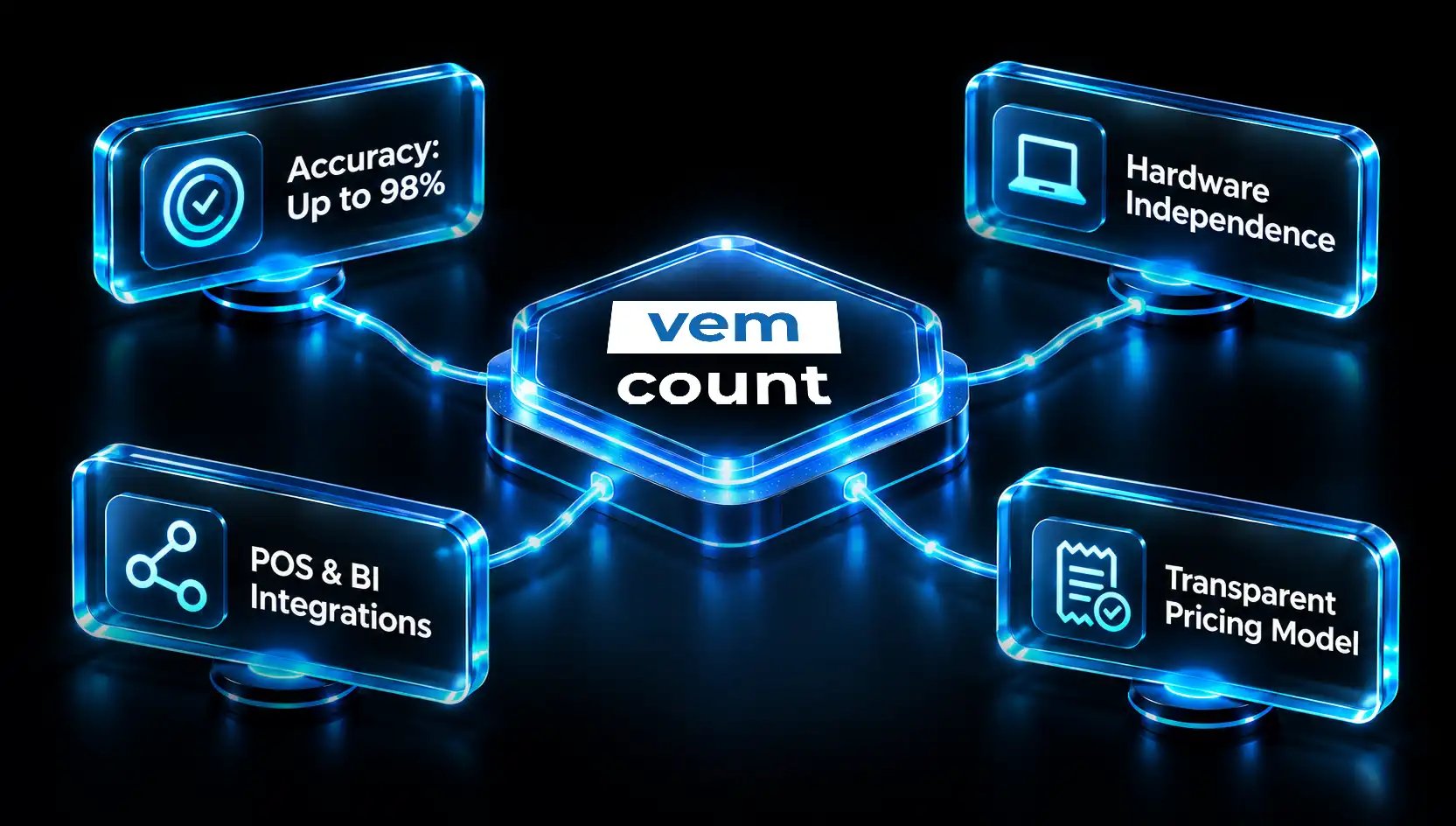
Accuracy is the first number in every sales deck and the least defined. What matters is the contractual minimum, measured against manual counts over a full trading day at your type of entrance. Vemcount installations are contracted at a minimum of 96 percent accuracy and typically deliver 98 to 99 percent with 3D stereo or time of flight sensors. Each technology has trade-offs. 3D stereo and time of flight handle groups, children and trolleys well and produce no identifiable images. Thermal sensors are privacy friendly and simple to install but struggle with wide entrances and crowds. WiFi tracking is inexpensive but samples phones rather than people. Camera based AI is flexible but brings lighting dependencies and GDPR questions. Test before you sign, and get the figure in writing.
A platform that only runs on its own sensors locks the analytics contract to the hardware for a decade. Hardware independent software lets you keep sensors you already own, choose the right sensor for each entrance and change supplier without losing history. Vemcount is sensor agnostic and connects Xovis, Irisys, Brickstream, Hikvision Cloud, Avigilon Alta Aware, Eco-Counter, Axis, Hella Aglaia, Intenta, TDI and VIVOTEK, so a mixed estate reports in one place with one data model. See the full list on our integrations page.
Footfall on its own tells you how busy you were. Footfall next to sales tells you how well you performed. Check which POS systems connect natively, how transactions are matched to traffic per hour and per store, and whether the API is open, documented and included in the licence. Vemcount offers native connectors for Shopify, Dynamics 365 Business Central, Lightspeed Retail and 16 more POS systems, plus BI exports and an open API for your own data warehouse. Details are on the integrations page.
A single site dashboard is easy. The real test is a 200 site estate on a Monday morning: which stores underperformed, why, and who receives the alert. Look for multi-site benchmarking, scheduled reports, role based access for store, region and head office, and the KPIs that drive action: conversion rate, sales per visitor, average transaction against traffic, staff to traffic ratio and peak hour coverage. Vemcount ranks sites and periods automatically and delivers reports by email or dashboard in the language of the recipient.
Live occupancy turns counting into an operational tool. The platform should show how many people are inside each zone right now, trigger alerts when capacity or staffing thresholds are crossed, and display the figure on a screen at the entrance if required. Ask about latency, how several entrances are netted against each other, and how the system corrects drift over a long trading day. Vemcount provides real time occupancy per zone and per building, capacity alerts and public displays as standard.
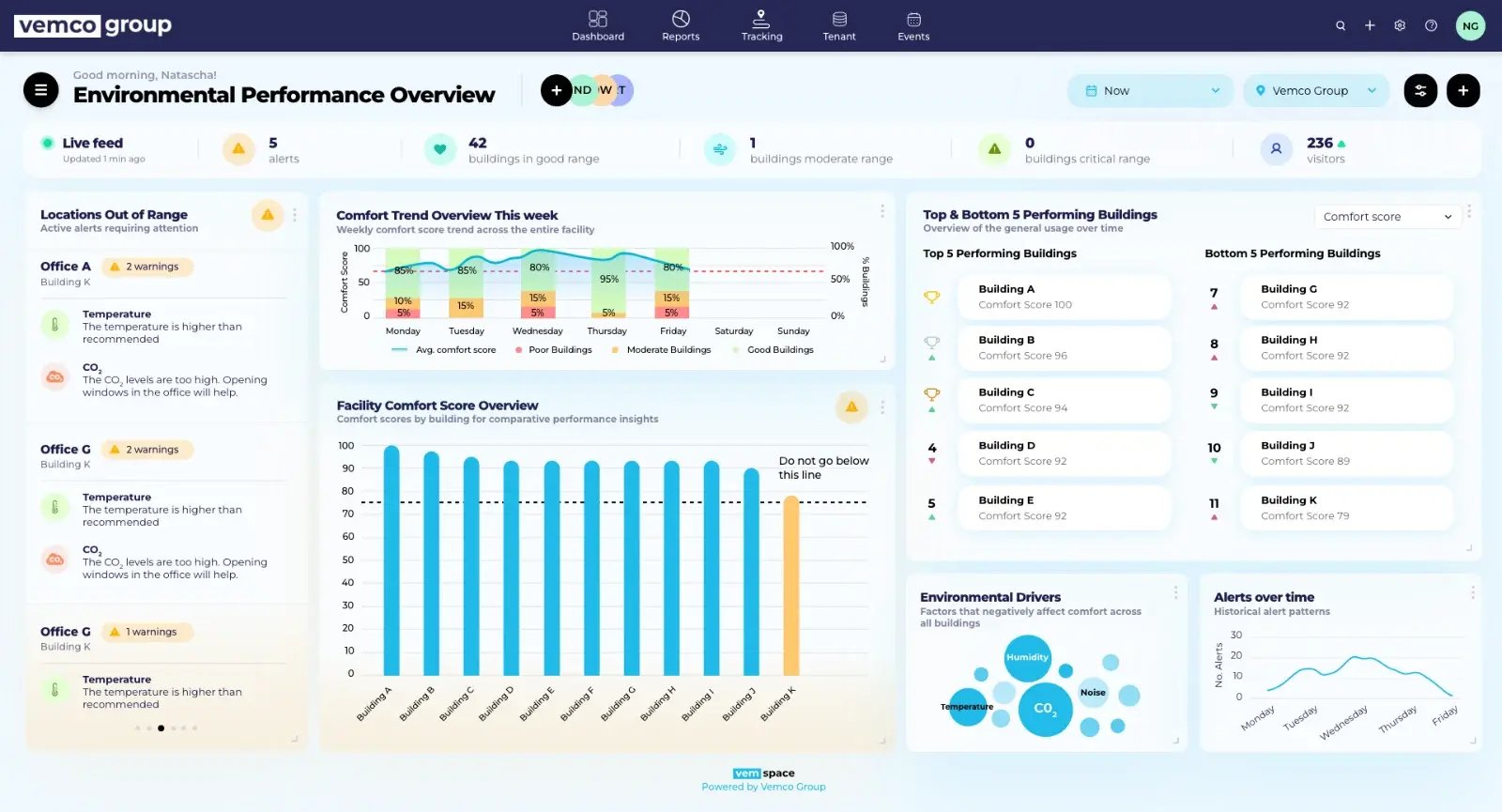
Once counting is reliable, the same infrastructure can carry more. Vemcount sits on the Vemco platform together with VemSpace for indoor air quality and environmental data, VemMaps for visualising traffic and zones on floor plans, and VemTenant for shopping centres and landlords who need footfall and turnover reporting per tenant. One login, one data model and one supplier, which matters when the next project is occupancy driven ventilation or a landlord reporting mandate rather than another entrance.
Most quotes combine two elements: the sensors and the software. Sensors can be bought outright or rented as part of a monthly fee, and the software is normally licensed as SaaS per location or per sensor. Ask what the licence includes: API access, number of users, report scheduling, support hours and data retention. Ask what happens to your data at the end of the term. Then compare the total cost over five years rather than the first invoice, because installation, recalibration and sensor replacement decide the real price.
How to Run a Fair Vendor Comparison
Run a 30 day pilot on two entrances with different character, for example a wide main entrance and a narrow side door. Have the finalists install on the same doors, then verify each system against manual counts on at least three trading days including a peak. Ask every vendor for the accuracy clause in writing before the pilot starts, not after.
Use the pilot to test the parts that rarely get tested. Pull data through the API into your own BI tool. Connect the POS and check that conversion is calculated the way your finance team expects. Log a support ticket and time the answer. Check that the platform is available in the languages your store teams actually work in (Vemcount is available in 24 languages and can be extended to others), and confirm that the vendor supports your regions with local time zones, currencies and installation partners.
The People Counting Platforms You Will Meet in 2026
Vemcount (Vemco Group)
An enterprise platform for retail chains, mall operators, airports and public buildings that run mixed sensor estates across many sites and countries. Hardware independent, with support for Xovis, Irisys, Brickstream, Axis and others, native POS connectors, an open API, live occupancy and multi-site benchmarking. Extends to air quality, floor plans and tenant reporting on the same platform. More than 20 years in the market, 800+ malls, and available in 24 languages, with further languages added on request.

Sensormatic ShopperTrak
Part of Johnson Controls and one of the longest established names in retail traffic counting. Suits large enterprise retailers and shopping centres that want traffic analytics alongside loss prevention and inventory intelligence from a single supplier. Runs on Sensormatic's own overhead sensors and is known for its retail traffic benchmarking indices.
RetailNext
A smart store analytics platform built around its own AI powered Aurora sensor. Suits enterprise retailers that want traffic, occupancy, group counting, pass-by analytics and staffing recommendations in one system. Publicly states 95 to 99 percent counting accuracy and prices per sensor per month with API access included.
FootfallCam
UK based manufacturer offering 3D counting sensors, mmWave radar for queues and zones, and its own analytics software. Suits retailers, supermarkets and offices that prefer one vendor for hardware and software, with a broad set of built in retail metrics and a wide range of sensor form factors.
V-Count
Manufacturer of AI based counting sensors paired with its own BoostBI analytics platform. Suits retailers, malls and airports that want sensors and analytics from one vendor, with a large library of predefined KPIs, staff exclusion and a mobile app. Positions itself on audited accuracy and fast deployment.
Dor
A battery powered, peel and stick thermal counter with cellular connectivity and a simple cloud dashboard. Suits independent and small chain retailers who want traffic and POS based conversion without wiring or IT involvement. Integrates with Shopify, Lightspeed and Square and offers CSV export and an API.
Density
Workplace occupancy analytics built on its own anonymous, non-camera sensors for entrances and open areas. Suits corporate real estate and facilities teams measuring space utilisation across office portfolios rather than retail traffic. API first, with integrations into workplace and building systems.




Content Hub

Blog
Besucherströme messen: Methoden, Sensoren und Kennzahlen für Handel und Einkaufszentren
Learn More





Blog
The Busiest Shopping Days of the Year: What Footfall Data Shows and How Stores Prepare
Learn More
Let’s Get in Touch!