









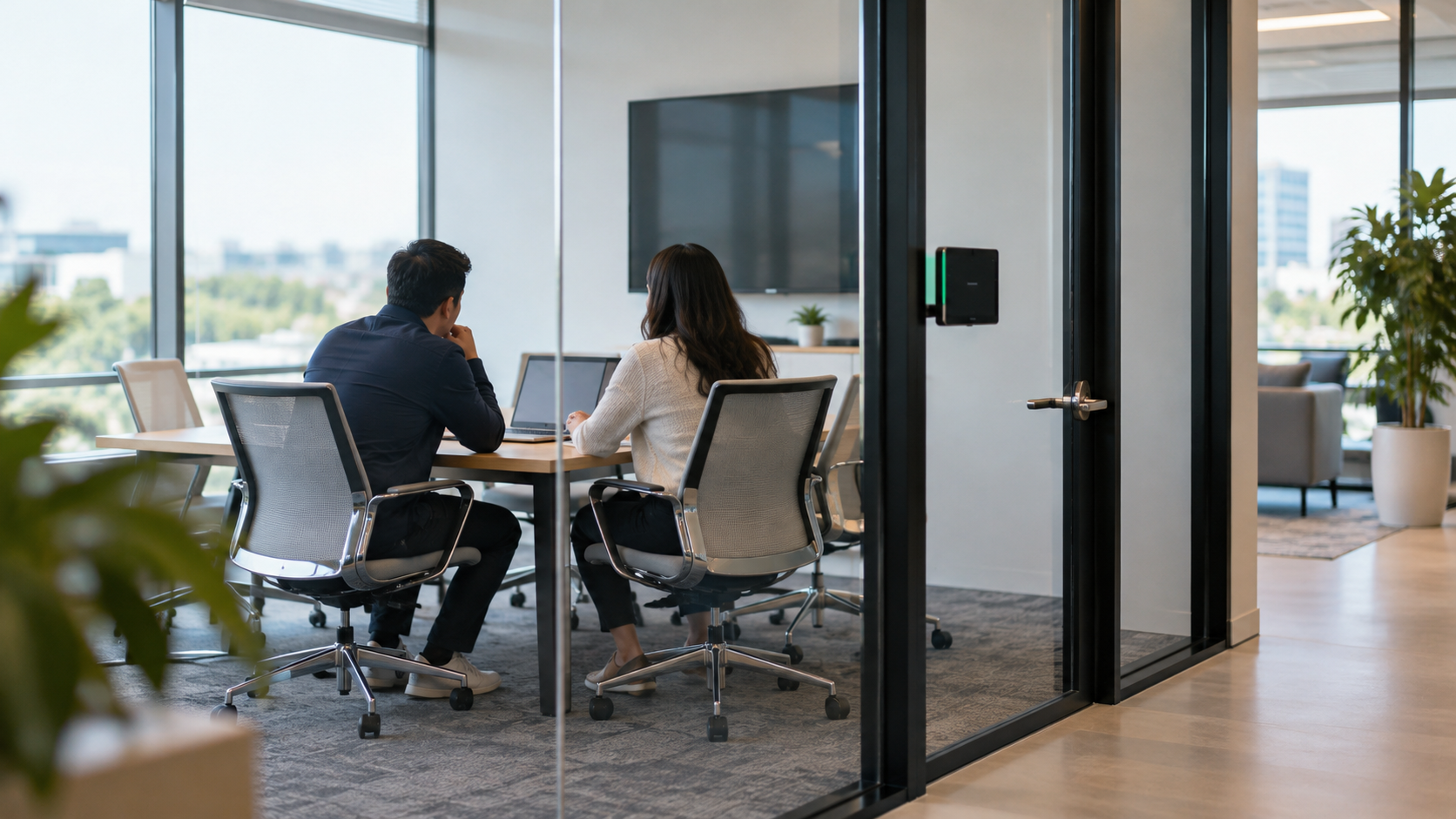
The booking calendar says every room is full. The sensor count says 78 percent of occupied conference-room time holds two people or fewer, and 62 percent of occupied time in rooms with 13 or more seats is one or two people (Occuspace H1 2026 index, Business Wire, 21 October 2026). So the 2027 room count is not a cutting exercise. It is a splitting exercise: which large rooms become two small ones.
The Monday problem: a budget line that needs a number by December
If you manage a corporate campus, you know the conversation. Finance wants a room count for 2027. The business says it cannot get a room on Tuesday afternoon. Your own calendar export shows a 14-seat boardroom booked 34 hours a week. All three statements are true, and none of them tells you how many people sat down.
UC Today (29 October 2026) put it plainly: October to December is when occupiers lock in the 2027 space decision. That gives you roughly six working weeks to replace calendar hours with measured headcount, or you will carry another year of fourteen-seat rooms hosting two-person calls.
A booking is a reservation; a count is a fact
A booking says a room was reserved. A sensor count says how many people were in it, for how long. Those are different data sets, and meeting room analytics only earns its budget line when it sits on the second one.
The Occuspace index is useful precisely because it is sensor-measured, not survey-based: more than 50 million square feet across 100+ corporate clients, February to June 2026. It is vendor data, and you should read it as such, but the shape of the finding matches what facilities teams see when they first put meeting room occupancy sensors into a floor. Three figures matter for your decision:
- Weekly peak utilisation across the portfolio was 52.3 percent. Half the room capacity was idle even at the busiest moment of the week.
- Daily peaks ran 39 to 42 percent Tuesday to Thursday, against 23 percent on Monday and 19 percent on Friday. The "no rooms available" complaint is a three-day problem, not a five-day one.
- 62 percent of occupied time in 13-plus-seat rooms was one or two people. Your largest, most expensive rooms are your least efficiently used.
Why conference room utilization looks high and feels worse
Here is the mechanism. A hybrid team of twelve has four people on site on Tuesday. Someone books the 14-seat room because it is the one with the good camera. Two people turn up, the rest dial in. The calendar records a full room. The sensor records two chairs out of fourteen for fifty minutes. Multiply that across a floor and you get a building where conference room utilization reads 80 percent by booking and under 20 percent by seat.
That is why "cut 20 percent of rooms" is the wrong 2027 instruction. If you remove rooms, Tuesday-to-Thursday scarcity gets worse and the two-person meetings still land in whatever large room remains. The right instruction is: identify which large rooms can be partitioned into two four-to-six-seat rooms, keep one or two genuinely large spaces per floor for the meetings that actually fill them, and let the count tell you which is which.
What meeting room usage data needs to show you
A useful dataset for the budget meeting has four columns per room: booked hours, occupied hours, median headcount while occupied, and dwell. The occupancy management solution reports occupancy per room and zone, dwell time, and live and historical views, which is the minimum you need to make the partition case. The same approach extends beyond rooms; see the earlier post on workplace occupancy analytics for desks, mute boxes and the canteen, because a floor where mute boxes run at capacity while boardrooms sit at two seats is a floor that needs reshaping, not shrinking.
For the budget itself, build the case room by room:
- Any room of 10+ seats where median occupied headcount is three or fewer for eight consecutive weeks is a partition candidate.
- Any 4 to 6 seat room with occupied time above 60 percent Tuesday to Thursday is evidence you need more of that size, not fewer rooms overall.
- Dwell under 20 minutes in a booked hour is a ghost-booking pattern; pair it with auto-release in the booking system rather than more construction.
A practitioner note on sensor placement
One thing implementers learn in the first fortnight: a door-mounted counter on a glass-walled room will undercount when people drift in through a second door or stand in the doorway on a call, and it cannot tell you about the person who booked and never came. For right-sizing you want an in-room count of who is actually seated, not a threshold tally. Counting accuracy on a well-set-up room is typically 98 to 99 percent where lighting and layout allow, with a contractual minimum of 96 percent; the honest figure is a range, not a flat number. Plan a two-week calibration against a manual spot check before you present any of it to finance.
If you are already running desk occupancy sensors, the room data should sit in the same reporting layer so the Tuesday peak on desks and the Tuesday peak on rooms are read together. And once the demand-controlled ventilation guide is live, the same room counts feed HVAC setpoints, which is often the second budget line a partition project pays for.
Experience surveys do not replace the count
VergeSense (Business Wire, 10 November 2026), with 200+ enterprise occupiers in 50+ countries, has added workplace-experience surveys to its platform. Surveys are a reasonable way to learn why people pick the boardroom for a two-person call. They are not a way to learn how often it happens. Keep the two separate in your 2027 paper: the sensor count justifies the partition; the survey tells you what the new small rooms need in them.
The six-week plan before the budget closes
- Weeks 1 to 2: instrument every room of 10+ seats on two representative floors; calibrate against spot checks.
- Weeks 3 to 5: collect Tuesday-to-Thursday headcount and dwell; export booked hours from the calendar for the same period.
- Week 6: present a per-room table of booked versus occupied versus median headcount, with partition candidates marked and a count of small rooms gained for each large room split.
That table is the room count finance asked for, expressed in a way that survives the first "but every room is booked" objection.
Frequently asked questions
What is meeting room analytics? It is the measurement of how rooms are actually used: occupied hours, headcount while occupied, and dwell, compared against the booking record. It turns a calendar that says "full" into a count that says "two people for fifty minutes".
How do you measure meeting room utilization? Place an in-room people counter, record headcount and duration for each occupied period, and compare with booked hours and seat capacity. Report it per room and by weekday, because Tuesday and Friday behave very differently.
What is a good meeting room utilization rate? The Occuspace H1 2026 index found a weekly portfolio peak of 52.3 percent, so anything close to that is normal rather than good. A better target is seat utilisation: small rooms busy Tuesday to Thursday and no large room with a median headcount of two.
Do occupancy sensors count people in a meeting room? Yes, if you specify a people counter rather than a simple presence detector. Presence tells you the room is not empty; a count tells you three people sat in fourteen seats, which is the number the partition decision needs.
What is the difference between a room booking and room occupancy? A booking is an intention recorded in a calendar; occupancy is a measured headcount over time. The gap between the two is where ghost bookings and oversized-room habits hide.
How many meeting rooms does an office need per employee? There is no fixed ratio that survives hybrid attendance; the useful question is the mix of sizes. Measure median headcount per room for six weeks and size the 2027 estate to the Tuesday-to-Thursday peak in small rooms, not to the total count.
If you need measured per-room headcount and dwell before the 2027 budget closes, talk to your local Vemco team about instrumenting two floors this quarter and getting a partition-ready room table in time for the December sign-off.