








Your online store reports a conversion rate every single day. It sits in the Shopify dashboard, you compare it week on week, and when it drops you know within hours. Your physical store, running the same products through Shopify POS, reports revenue and transaction count and nothing else. Nobody knows whether Saturday's weak number came from fewer people walking in or from more people walking out empty-handed. Those two problems need completely different fixes, and most retailers are guessing which one they have. For retail chains and property owners with sites in several countries, see our enterprise people counting and occupancy platform.
That is the gap a Shopify footfall integration closes. Vemcount imports orders and location sales from Shopify, so visitor counts from the store sensors sit next to the Shopify sales those visitors generated, location by location, and the physical store finally gets the metric that e-commerce has had for fifteen years: how many came, and what share bought.
Why transaction count is not a substitute for footfall
Operations managers often argue they already have a proxy. Transactions per hour tells you when the store is busy, so why pay for a Shopify people counter? Because transactions only count the people who said yes. A store with 400 visitors and 80 baskets and a store with 200 visitors and 80 baskets post the same revenue, but one has a 20 percent conversion and the other 40 percent. The first store has a selling problem. The second has a traffic problem, and probably a staffing problem too if those 200 visitors arrive in two tight peaks.
Without the denominator, every discussion about store performance collapses into revenue, and revenue is the one number the store manager has least control over on a given day. Marketing drives traffic. Weather drives traffic. The mall's anchor tenant drives traffic. What the manager controls is what happens once someone is inside, and that is exactly what conversion measures.
What the integration actually does
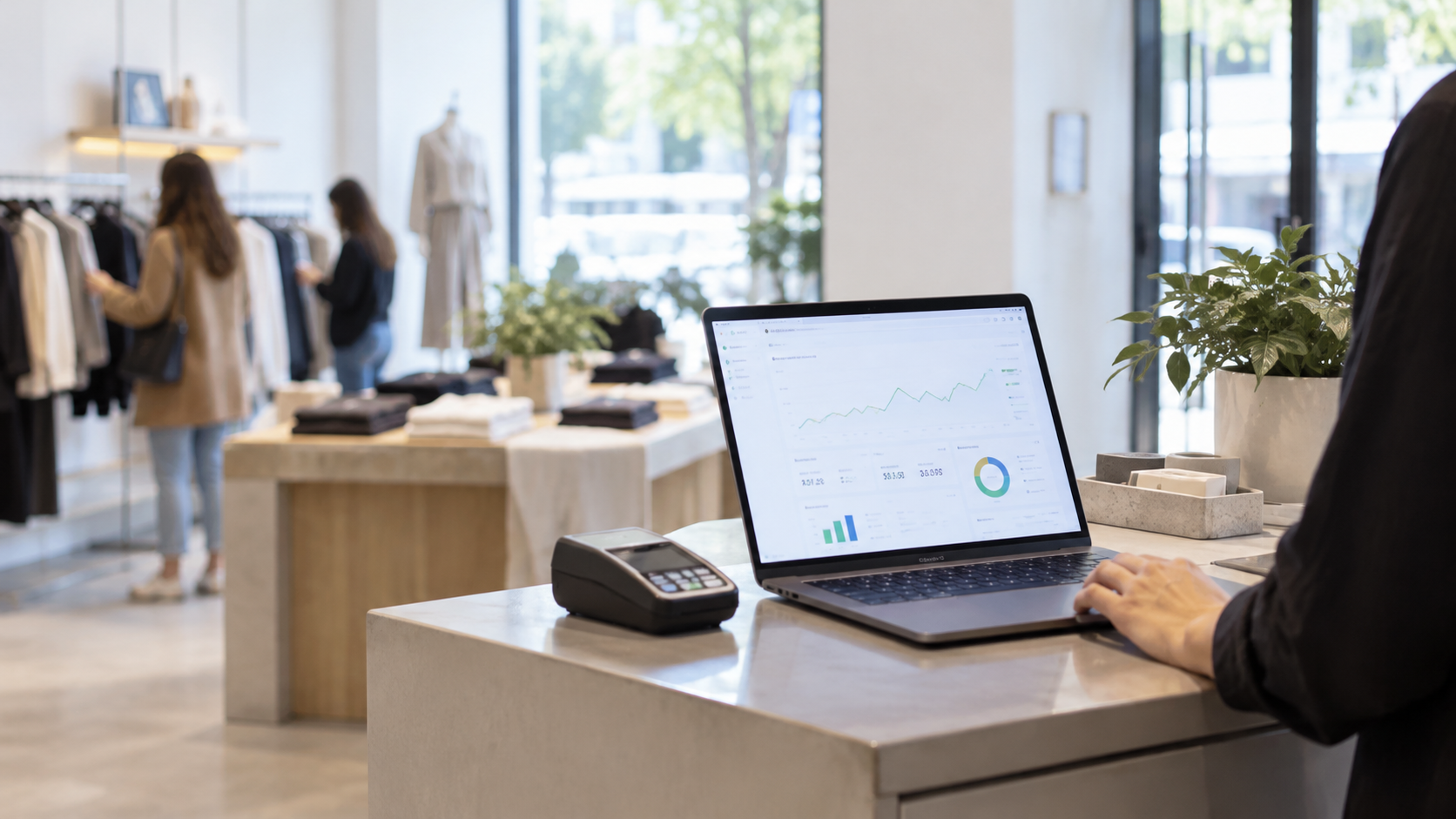
Vemcount, the Vemco Group analytics platform, imports orders and location sales from Shopify through the Shopify Admin API. Store visitors (footfall) and conversion rate per store are then shown in Vemcount next to the Shopify sales for the same location, so conversion, average transaction value per visitor and sales per visitor are calculated against the same clock as the traffic. Headquarters can also read the Vemcount data in its own BI tools through the Vemcount REST API, rather than through a separate export and a spreadsheet someone has to maintain.
Which Vemcount plan the integration requires depends on your setup; our team will tell you before you start.
Matching Shopify POS footfall to the right location
Here is the part implementers learn the hard way. Shopify POS attributes a sale to a location, and the location list in Shopify rarely matches the sensor list one to one. A flagship with two entrances has two sensors and one POS location. A pop-up that shares a Shopify location with the main store for inventory reasons has its own sensor. Staff sometimes ring up click-and-collect orders at the till, which adds a transaction with no corresponding visitor intent.
Before switching the integration on, sit down with the store list and decide three things for every location: which sensors sum into that location's visitor figure, whether online orders fulfilled from that location should be excluded from conversion, and which hours count as trading hours. A sensor that records 30 visitors during a 7am delivery window while the POS is closed will drag down the morning conversion rate for months if nobody sets the schedule. Fifteen minutes of mapping saves a quarter of arguing about numbers.
Reading your Shopify store conversion rate like an e-commerce manager
Once the Shopify store conversion rate is visible, the useful work is comparison, not the absolute number. A bookshop and a jeweller will never share a benchmark. What matters is the same store against itself across hours, days and campaigns, and stores against each other within one format.
- Hourly conversion against rota. If conversion dips between 12 and 2 while traffic peaks, you are understaffed at lunch, not underperforming.
- Campaign weeks against baseline. A promotion that lifts traffic but drops conversion brought in browsers. One that holds traffic flat and lifts conversion changed what the existing customers did. Both can be good; they justify different budgets.
- Online versus offline for the same SKU range. If a product category converts far better in store than online, that is an argument for spending on driving store visits rather than more paid search.
- Sales per visitor across the estate. This exposes stores that convert well but on small baskets, which usually points to merchandising rather than service.
How accurate does the count need to be?
If the denominator is wrong, every ratio built on it is wrong, so this is not a detail. The contractual minimum for Vemcount sensors is 96 percent counting accuracy, and in practice most installations run at 98 to 99 percent when lighting, entrance layout and visitor behaviour cooperate. Glass doors with heavy backlighting, very wide entrances and groups walking shoulder to shoulder are the conditions that push a site toward the lower end. A good installer will tell you that up front and position or add sensors accordingly rather than promise a flat figure.
For conversion work, consistency matters as much as the headline accuracy. A sensor that undercounts by the same small margin every day still gives you a trend you can trust. One that swings with the sun angle does not.
Choosing a Shopify integration over a dashboard export
Plenty of counting vendors can email you a CSV. The reason to want the Shopify sales imported into the counting platform is who ends up looking at the data, and how often. A conversion figure that has to be rebuilt in a spreadsheet gets checked monthly by one analyst; the same figure sitting beside each location's Shopify sales in Vemcount, with alerts and scheduled reports, gets checked by the people who can change tomorrow's rota.
Having the Shopify sales inside Vemcount also matters for the analytics side. Vemcount can run staff-to-visitor ratios, sales-per-visitor comparisons across stores and alerts when a store's conversion falls below its own rolling average, none of which is possible if sales stay locked in one system and traffic in another.
A realistic first ninety days
Weeks one to four are about trust. Walk the store with a clicker for a few hours, compare against the sensor, and show the manager the match so the number stops being questioned. Weeks five to eight, fix the mapping issues that surface once real people look at real figures, usually click-and-collect and trading-hour edges. From week nine, start changing something, typically the lunch rota in the lowest-converting store, and measure the result in Vemcount against the previous month. The retailers who get value from a Shopify footfall integration are the ones who treat conversion as a lever to pull, not a report to file.
If you run Shopify POS across physical stores and want visitor counts and conversion sitting next to your sales, contact Vemco Group and we will walk through your store list, the sensor placement each entrance needs and which Vemcount plan fits the integration. See all supported POS and data connections on the integrations page.
Shopify is a trademark of Shopify Inc. Vemco is not affiliated with Shopify unless stated.