

/global/header/smart-buildings.svg)


/global/header/facility-management.svg)






/global/header/leisure.svg)






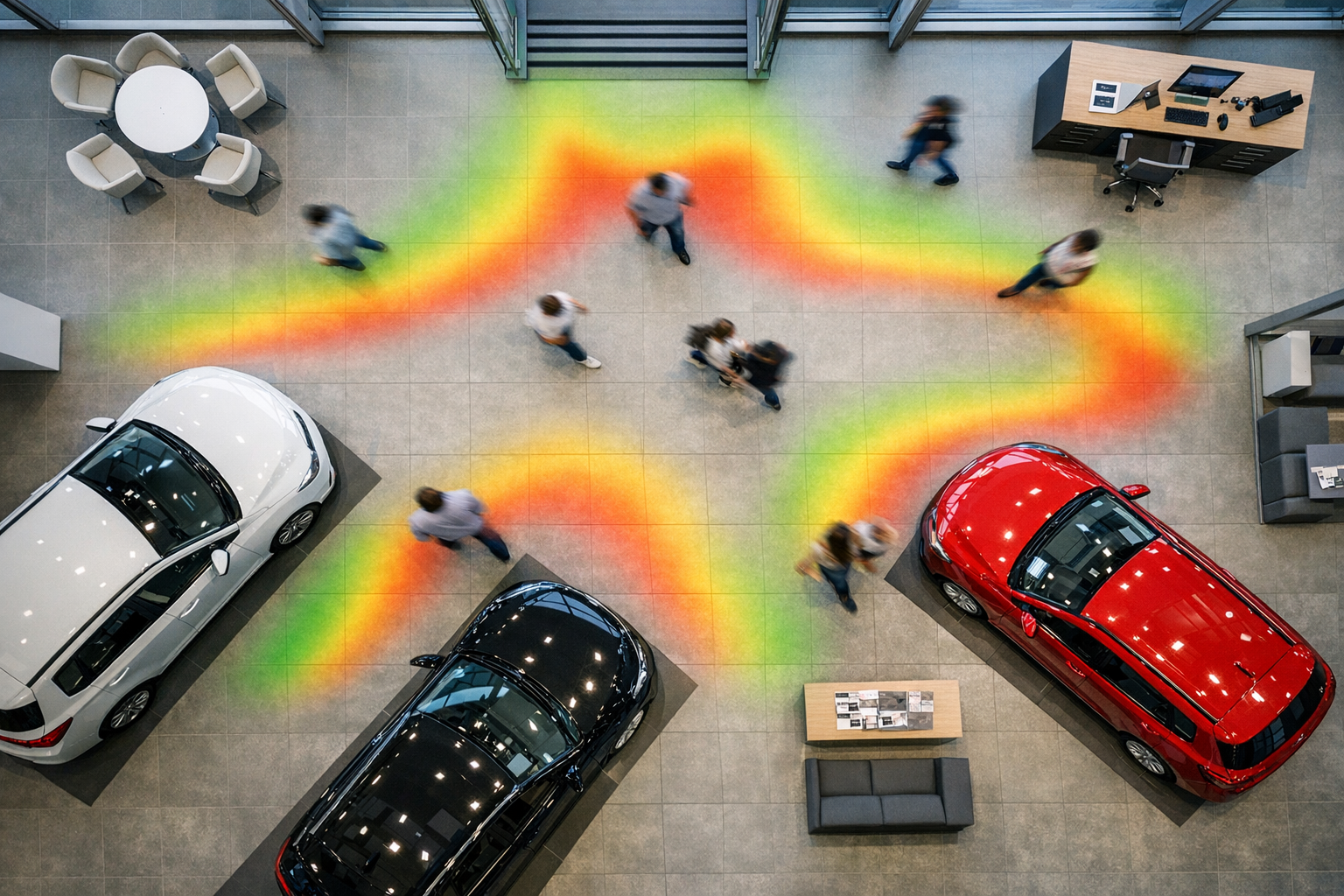
McKinsey research found that car buyers now visit an average of 1.6 dealerships before purchase, down from roughly five a decade ago. That single number should change how you evaluate every launch campaign. When a prospect walks into a showroom, there is a strong chance it is the only showroom they will visit for that purchase cycle. The visit is no longer one touchpoint among many — it is very often the deciding one. And yet most launch reporting still ends at the door: impressions, clicks, test-drive form fills, maybe a footfall estimate from the dealer group. Nobody can answer the question that actually matters: did anyone stand in front of the new model, open its doors, and sit in it?
The attribution gap sits between the door and the car
Digital teams can trace a configurator session down to which paint colour was toggled. Physical launch activity — the showroom refresh, the shopping-centre pop-up, the exhibition stand that cost more than the entire paid social budget — usually gets reported as "strong traffic" and a stack of photos. CBRE's European retail outlook notes that brands are actively closing this analytics gap between physical stores and online channels, using sensors and computer vision to monitor dwell times and flow patterns. Automotive has been slower than fashion or grocery to do this, which is odd given the transaction value involved. A supermarket knows more about how shoppers behave around a promotional gondola than most OEMs know about behaviour around a €60,000 launch vehicle.
The behavioural stakes are real. An experience agency survey of 1,200 recent car buyers found 84 percent said their dealership visit directly influenced their purchase decision, and nearly 60 percent had walked away from a purchase based on how a dealership looked. The same survey found 82 percent felt more positive about the brand after visiting a well-designed showroom. If the visit carries that much weight, measuring it at the level of "people through the door" is like measuring a website by server pings.
What per-vehicle measurement actually looks like
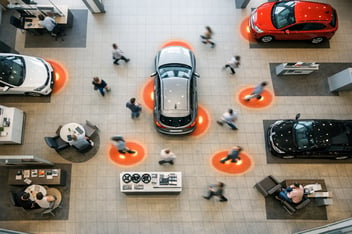
The technique that changes the conversation is placing a counting sensor directly above an individual vehicle. Instead of a showroom-level footfall number, you get a per-model number: how many people approached that specific car and how long they stayed with it. Vemco Group, a Danish company founded in 2005, delivers this on a sensor-agnostic platform that works with hardware from Xovis, Milesight, Elsys, Hikvision, Axis and Irisys — relevant if your dealer network already has cameras or counters installed, because you are not forced into a rip-and-replace. Data lands on AWS in EU-Frankfurt, and the delay from someone crossing a counting line to that count appearing on a dashboard is roughly two seconds. Accuracy is contractually guaranteed at a minimum of 96 percent, and in practice typically runs 98–99 percent depending on lighting, layout and visitor behaviour — worth stating honestly, because vendors who promise a flat number regardless of conditions are promising something physics does not support.
Beyond the overhead count, small IoT sensors on doors and boot lids record which parts of the car visitors actually opened. Seat sensors register whether people sat in the front or the back — and rear-seat occupancy is a surprisingly clean signal that rear legroom is being evaluated, which usually means a family buyer comparing against a specific competitor. For an SUV launch positioned on second-row space, that is not a nice-to-have metric. It is the metric.
Questions you can finally answer with data instead of anecdotes
- Campaign lift, per model: Did approach counts at the launch vehicle rise during the media flight, or did overall showroom traffic rise while the new car was ignored? These are very different outcomes that door counters cannot separate.
- Engagement depth: A 15-second glance and a four-minute stay with two doors opened and a rear-seat sit are different funnel stages. You can now report a physical engagement funnel the way digital colleagues report scroll depth and add-to-cart.
- Placement decisions: Does the launch car perform better by the entrance or deeper in the floor next to the trade-in desk? Rotate it and compare weeks. Dealers argue about this constantly; data ends the argument.
- Format comparison: The same instrumented car can move from dealership to shopping-centre pop-up to exhibition stand, letting you compare cost per meaningful engagement across formats rather than cost per estimated impression.
Why pop-ups and events are the easiest place to start
Temporary activations are where measurement gaps hurt most and where deployment is simplest. Vemco ships the setup as a plug-and-play package with a 4G router, so the only site requirement is a power outlet — no negotiation with a shopping centre's IT department, no network integration project for a stand that exists for three weeks. For an OEM running the same launch activation across ten cities, that repeatability matters more than any single feature: identical instrumentation in every city means the comparison between cities is actually valid.
Here is the observation practitioners learn the hard way: your own staff will wreck your baseline if you let them. Sales consultants leaning on the launch car, cleaners circling it, product geniuses demonstrating the tailgate — all of it registers as engagement unless you plan for it. Experienced implementers exclude staff patterns, timestamp cleaning windows, and establish a two-week baseline before the campaign flight begins. Skip that step and your "campaign lift" may partly be a new detailing schedule. The platform side is fast — Vemco counts more than 60 million people every day across 55,000+ installations in 98+ countries — but the discipline around baselines and exclusions is what makes the numbers defensible when the CFO starts asking questions.
Reframe the launch KPI before the next model arrives
If buyers visit 1.6 dealerships and 84 percent say the visit decided the purchase, then the correct launch KPI is not reach and not even showroom traffic. It is qualified physical engagement with the vehicle: approaches, dwell, doors opened, seats occupied. Those numbers connect media spend to the moment that survey data says actually converts. They also give brand experience teams something they have never had — evidence for which showroom formats, vehicle placements and activation designs produce deeper engagement, argued with the same rigour digital teams have enjoyed for two decades. The next launch window is a fixed date. The measurement decision is the one you control now.
Planning a model launch, showroom refresh or roadshow this year? Talk to Vemco Group about instrumenting the vehicle itself — approach counts, dwell time, door and seat interaction — before the campaign goes live, so your post-launch report shows what happened at the car, not just at the door. Get in touch at vemcogroup.com/contact-us.