

/global/header/smart-buildings.svg)


/global/header/facility-management.svg)






/global/header/leisure.svg)







Watch a single customer conversation at a dealership entrance and you will see the problem in five minutes. The salesperson walks the customer out to look at the trade-in. Both come back inside. The salesperson goes out again to bring a demonstrator around to the front. Back in. Out once more to check a spec on a car parked in the second row. That is one customer, one conversation — and a generic door counter has just logged six, eight, sometimes ten visitor entries. Multiply that by every up on a busy Saturday and your traffic data is not slightly wrong. It is structurally wrong.
Why dealerships break door counters in a way retail does not
In an ordinary retail store, staff mostly stay inside. A fashion associate might step out for a break twice a shift, and the resulting inflation is a rounding error most retailers can live with. The automotive sales process is different because it runs through the entrance by design. Trade-in appraisals happen outside. Inventory is parked outside. Test drives start and end outside. Every one of those steps forces a salesperson — often accompanied, often not — across the counting line. The door is not the boundary of the sales floor; it is the middle of it.
This is why staff exclusion people counting matters more in dealerships than almost anywhere else it is deployed. The distortion is not random noise you can average out. It is correlated with exactly the thing you are trying to measure: the busier the showroom, the more staff crossings, the bigger the inflation. Your worst data quality lands on your most important days.
How big is the gap in practice?
One US showroom-traffic vendor reports that dealers who compare counted door traffic against their up log typically find a gap of 15 to 25 percent. Some of that gap is genuine missed opportunity — customers who walked and were never greeted or logged. But a meaningful slice is phantom traffic: your own team, counted as prospects. If you cannot separate the two, you cannot answer the question your general managers actually care about: are we missing ups, or are we chasing ghosts?
The stakes on getting this right have gone up sharply. McKinsey research found buyers now visit an average of 1.6 dealerships before purchase, down from about five a decade earlier. When a walk-in has already done their research and is realistically choosing between you and one other rooftop, showroom conversion rate stops being a vanity metric and becomes the metric. And a conversion rate built on inflated traffic is worse than no number at all — it tells your sales managers they are converting 12 percent when they may be converting 16, and it tells your ops director to fix a greeting problem that does not exist.
What staff exclusion actually looks like technically
The clean solution is a physical tag, not a software guess. Vemco Group — a Danish analytics company founded in 2005, now counting more than 60 million people every day across 55,000+ installations in 98+ countries — uses UWB staff tags worn by employees. When a tagged person crosses the counting line, the sensor recognises the tag and excludes that crossing from the visitor count in real time. The salesperson can walk out to the trade-in and back four times in an hour; the visitor figure does not move.
A few implementation details worth knowing before you write a requirements document:
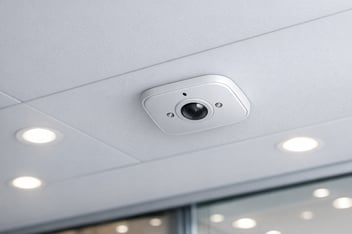
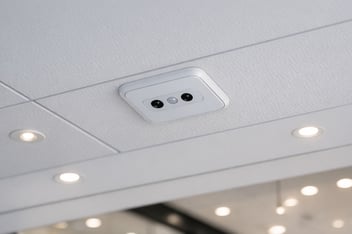
- Sensor flexibility matters for IT. Vemco's platform is sensor-agnostic and works with Xovis, Milesight, Elsys, Hikvision, Axis and Irisys hardware. If your group already has cameras or counters from an earlier project, you may not need to rip and replace across every rooftop.
- Accuracy has to be contractual, not aspirational. Vemco commits to a contractual minimum of 96 percent counting accuracy, typically landing at 98–99 percent depending on lighting, layout and visitor behaviour. Ask any vendor for the contractual floor, not the marketing ceiling — and be suspicious of anyone quoting a flat number with no conditions attached.
- Latency determines what you can act on. Data hosted on AWS in EU-Frankfurt reaches the dashboard roughly 2 seconds after the line cross. That is fast enough to trigger a real-time alert — via app, email, WhatsApp, SMS, webhook or MQTT — when showroom traffic spikes and no one is on the floor to greet.
The part vendors rarely tell you: tags are an operational habit, not a purchase
Here is what actually decides whether staff exclusion works six months after go-live, and it has nothing to do with the sensor. Tags left in desk drawers, tags clipped to a jacket hanging in the office while the salesperson works the lot in shirtsleeves, the new hire who started Tuesday and was never issued one, the detailer who covers the showroom on Saturdays. Every untagged staff crossing goes back into your visitor count. The dealerships that get durable data quality treat the tag like a dealer plate: it is checked out at the start of the shift, it is part of onboarding, and someone — usually the sales manager doing the morning walk-around — owns compliance. Budget thirty minutes of process design for this. It is the cheapest data-quality investment you will make all year.
What clean traffic data lets you do that dirty data cannot
Once staff crossings are excluded, the downstream analysis stops being an exercise in caveats. You can break traffic down by hour, weekday and weekend and put it next to staffing levels — and actually trust that a Tuesday-morning traffic trough is real, not an artefact of fewer salespeople walking the door. You can compare visitor counts against offers issued per rooftop and get a per-store engagement rate that is comparable across the group, because every store is measuring the same thing. For a dealer group operations director, that comparability is the whole point: without staff exclusion, the store with the most energetic salespeople looks like the store with the most traffic and the worst conversion, and you end up rewarding the wrong behaviour.
It also changes staffing conversations. When hourly traffic is genuinely customer-only, matching floor coverage to demand becomes a data exercise instead of a negotiation with whoever shouts loudest about Saturdays.
A quick evaluation checklist before you sign anything
- Does the vendor offer physical staff tags, or only software-based exclusion guesses?
- Is counting accuracy a contractual minimum, with conditions stated honestly?
- Can the platform work with sensors you already own?
- How fast does a line cross appear in the dashboard, and can it trigger alerts through channels your managers actually check?
- Who owns tag compliance in your process, and is it written into onboarding?
If your current traffic numbers have never been validated against your up log, run that comparison this week. If the gap looks like 15 to 25 percent, you now know at least part of the reason — and it is fixable. Talk to Vemco Group about staff exclusion people counting for your dealership group and see what your showroom traffic looks like once your own salespeople are out of the data: vemcogroup.com/contact-us.