

/global/header/smart-buildings.svg)


/global/header/facility-management.svg)






/global/header/leisure.svg)






Here is a scenario every retail manager has lived through: sales are down 8% on last month, and head office wants an explanation by Friday. Without footfall data, you are guessing. With it, the answer takes minutes — either fewer people came through the door, or the same number came and fewer bought. Those are two completely different problems with two completely different fixes, and the entire discipline of footfall measurement exists to tell them apart.
Footfall is the number of people entering or passing through a physical location over a period of time. That is the whole definition. What makes it interesting is not the counting itself, but what the number lets you do once you trust it — and trust is the operative word, which we will come back to.
Footfall, People Counting, Traffic — One Discipline, Many Names
If you have shopped around for measurement technology, you will have noticed vendors using different words for the same thing. Footfall is also called people counting, shopper counting, visitor counting, customer counting or simply traffic. The devices themselves are known as footfall counters, people counters or traffic counters. Footfall counting and people counting are the same discipline: footfall dominates UK retail and shopping centres, while people counting dominates internationally. How the device itself works is covered in our guide to the footfall counter.
This matters more than it sounds if you operate across borders. A UK centre operator searching for "footfall counters" and a German facility manager searching for "Personenzählung" are looking for identical technology. The same is true for persontælling in Denmark, personräkning in Sweden, conteo de personas in Spanish-speaking markets, contagem de pessoas in Portuguese, kişi sayma in Turkey and عد الزوار in Arabic markets. When comparing vendors or benchmarking against international peers, do not let the vocabulary fool you into thinking you are comparing different systems.
Why Conversion Rate Is the Real Prize
On its own, a footfall number is descriptive. Combined with your sales data, it becomes diagnostic. Divide transactions by visitors and you get conversion rate — the percentage of people who entered and actually bought something. This single calculation reframes almost every operational conversation:
- Footfall fell, conversion held: your store is performing; the problem is upstream. Look at centre-wide traffic, local events, weather, marketing reach, or the anchor tenant next door that just closed.
- Footfall held, conversion fell: people are coming and leaving empty-handed. Look at stock availability, queue lengths, staffing rotas against peak hours, merchandising, and pricing.
- Both fell: you have two problems, and you now know to fund two solutions instead of one blunt discount campaign.
The same logic works in reverse for good news. A sales lift during a marketing campaign is only attributable to that campaign if you can show the footfall lift alongside it. Otherwise your CFO is entitled to argue the sun came out.
What Modern Footfall Counters Actually Measure
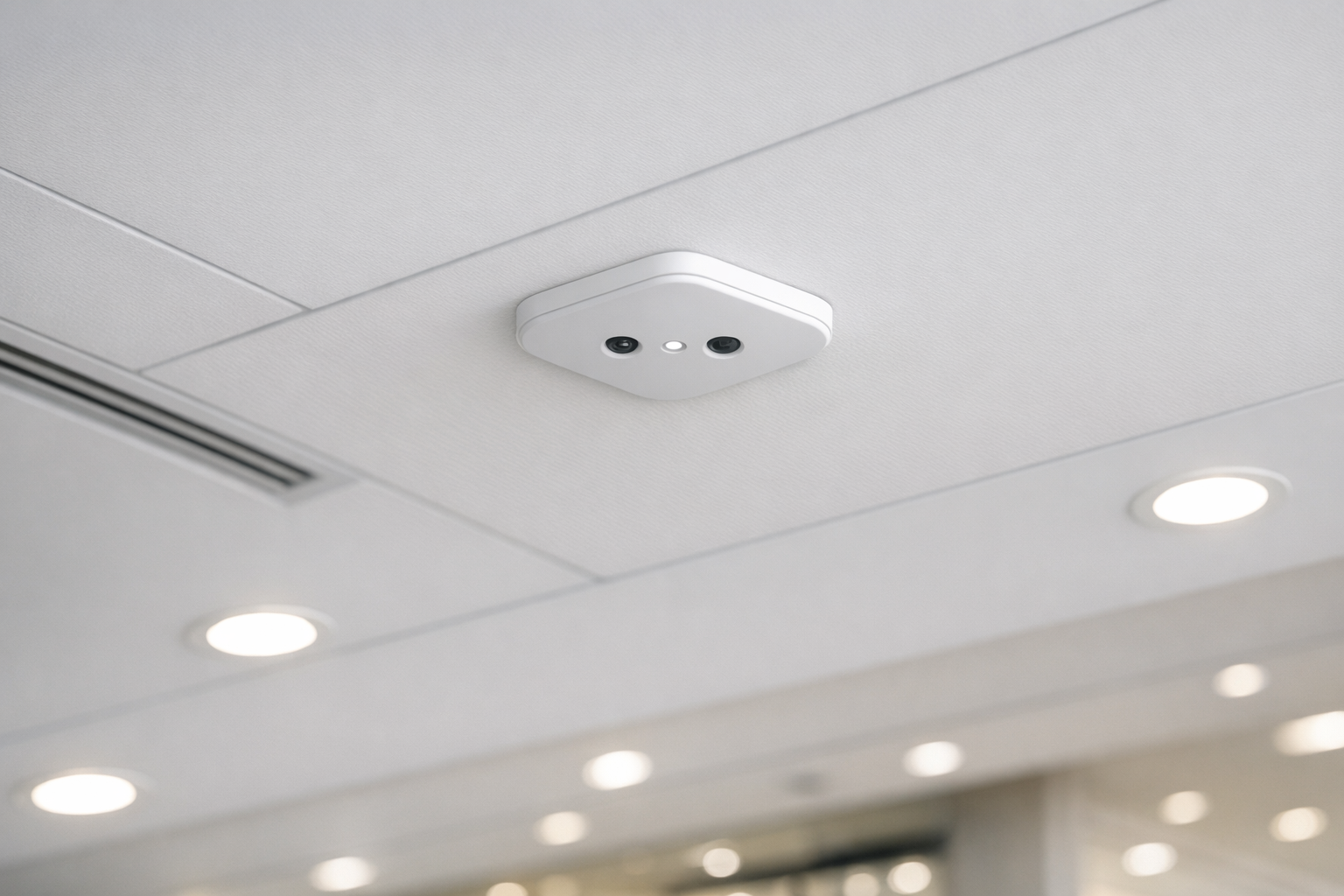
Early footfall counters were beam-break devices at the door — cheap, and cheerfully wrong whenever two people entered side by side. Modern sensors register direction at entrances, which means they know not just that someone crossed the threshold but which way they were going. That directional awareness is what enables live occupancy: entries minus exits, in real time. Occupancy went from a nice-to-have to a compliance requirement during the pandemic, and many operators kept it afterwards for capacity planning, safety and energy management in smart buildings.
Beyond the entrance count, current systems measure dwell time, traffic flow, customer flow, zone analytics and heatmaps. In practice, this is where shopping centre operators extract the most commercial value. Zone-level data tells you which corridors carry traffic and which are dead legs — directly relevant when negotiating rents and turnover clauses with tenants. Heatmaps show where visitors slow down and cluster, which informs everything from kiosk placement to cleaning schedules. Vemco unifies people counting, footfall, occupancy, traffic flow, zone analytics and heatmaps in one platform, turning movement into anonymous visitor data — anonymous being the critical word for GDPR and equivalent regimes, since no personal identification takes place.
The Accuracy Question Nobody Asks Properly
Here is the practitioner observation that separates experienced buyers from first-timers: the sensor is rarely the weak point. Installation and validation are. A high-quality sensor mounted at the wrong angle, or at an entrance where a promotional gondola pushes traffic to the edge of its field of view, will produce confidently wrong numbers for months. The tell is usually a suspiciously flat conversion rate that never moves — real conversion rates breathe with the day of the week and the weather. Any serious deployment should include a manual validation count after installation and again after any layout change near the entrance. If a vendor does not offer that as standard, ask why.
Be equally sceptical of flat accuracy claims. Honest vendors express accuracy as a contractual floor with a typical range above it — for example, a contractual minimum of 96%, typically reaching 98–99% when conditions such as lighting, store layout and visitor behaviour allow. Anyone promising a guaranteed flat 99% across every entrance in your estate has either never installed at a wide mall entrance with pram traffic in December, or is hoping you have not.
Where Footfall Data Earns Its Keep Beyond Retail
Although footfall grew up in retail stores and shopping centres, the same measurement discipline now runs in supermarkets, airports, libraries, museums, universities, offices and smart buildings. The questions change but rhyme. An airport uses traffic flow to predict security queue build-up. A university library uses occupancy to justify — or challenge — an extension budget. A facilities team uses zone data to shift cleaning from fixed schedules to usage-based schedules, which is one of the fastest paybacks in the entire category. A supermarket uses hourly footfall curves to align checkout staffing with actual demand rather than last year's rota.
For operations managers, the common thread is that footfall converts arguments about resourcing from opinion to evidence. "We need more Saturday staff" is a request. "Saturday footfall peaks at 2pm and our conversion drops 4 points in that window" is a business case.
Getting Started Without Overbuying
If you are budgeting a first deployment, resist the temptation to instrument everything on day one. Start with directional counting at every public entrance — that gives you footfall and live occupancy from a single sensor layer. Connect it to your sales feed so conversion reporting is automated, not a spreadsheet ritual. Then, once the entrance data has been validated and the organisation actually uses it in weekly trading meetings, extend into zone analytics and heatmaps where a specific commercial question justifies it. Data nobody acts on is just a subscription fee.
Whether you call it footfall, people counting or visitor counting, the goal is the same: knowing how many people you had the chance to serve, so every other retail metric finally has a denominator. If you are planning a footfall or people counting deployment — a single store, a shopping centre portfolio, or a mixed estate across markets — talk to the Vemco Group team about sensor selection, validation and what your entrances can realistically deliver: contact us here and bring your trickiest entrance layout with you.