

/global/header/smart-buildings.svg)


/global/header/facility-management.svg)






/global/header/leisure.svg)






Search for "traffic counter" and you will get two unrelated product categories. One is a pneumatic tube or radar unit that municipalities strap to a road to count cars. The other is a sensor mounted above a shop or building entrance that counts people walking in and out. This article is about the second kind: the foot traffic counter used in stores, shopping centres, offices, libraries and other public buildings. If you need to count vehicles, the equipment, vendors and accuracy standards are completely different and nothing below applies.
Why the hardware decision is smaller than it looks
Most buyers spend their evaluation time comparing sensors and almost none on what happens to the numbers afterwards. That is backwards. A people counter device is a commodity in a way that the analytics layer is not. Vemco Group, a Danish company founded more than 20 years ago, built its VemCount platform to be sensor-agnostic precisely because a 400-store estate rarely has one entrance type. The same dashboard can take data from Xovis, Milesight, Hikvision or AXIS units, which means you choose hardware per doorway and still get one conversion rate, one occupancy figure and one staffing report. With 55,000+ installations across 98+ countries feeding it, the platform sees a very wide spread of entrance geometries, and that experience shapes the buying advice below.
The six types of store traffic counter and where each breaks
Break beam (infrared). Two posts either side of the door; one beam, one count when it is interrupted. Cheapest option, no ceiling work, but it cannot separate two people walking abreast, cannot tell in from out without a second beam, and counts trolleys, dogs and the door itself. Suitable for a single-file kiosk entrance and very little else.
Thermal. Detects body heat from above, so it works in complete darkness and needs no personal data handling. Its weakness is thermal contrast: on a hot summer day when the pavement is 30°C, or when a doorway lets in direct sun, human signatures blur into the background. Good for dim venues and privacy-sensitive sites such as libraries or council buildings.
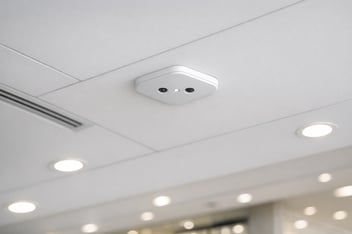
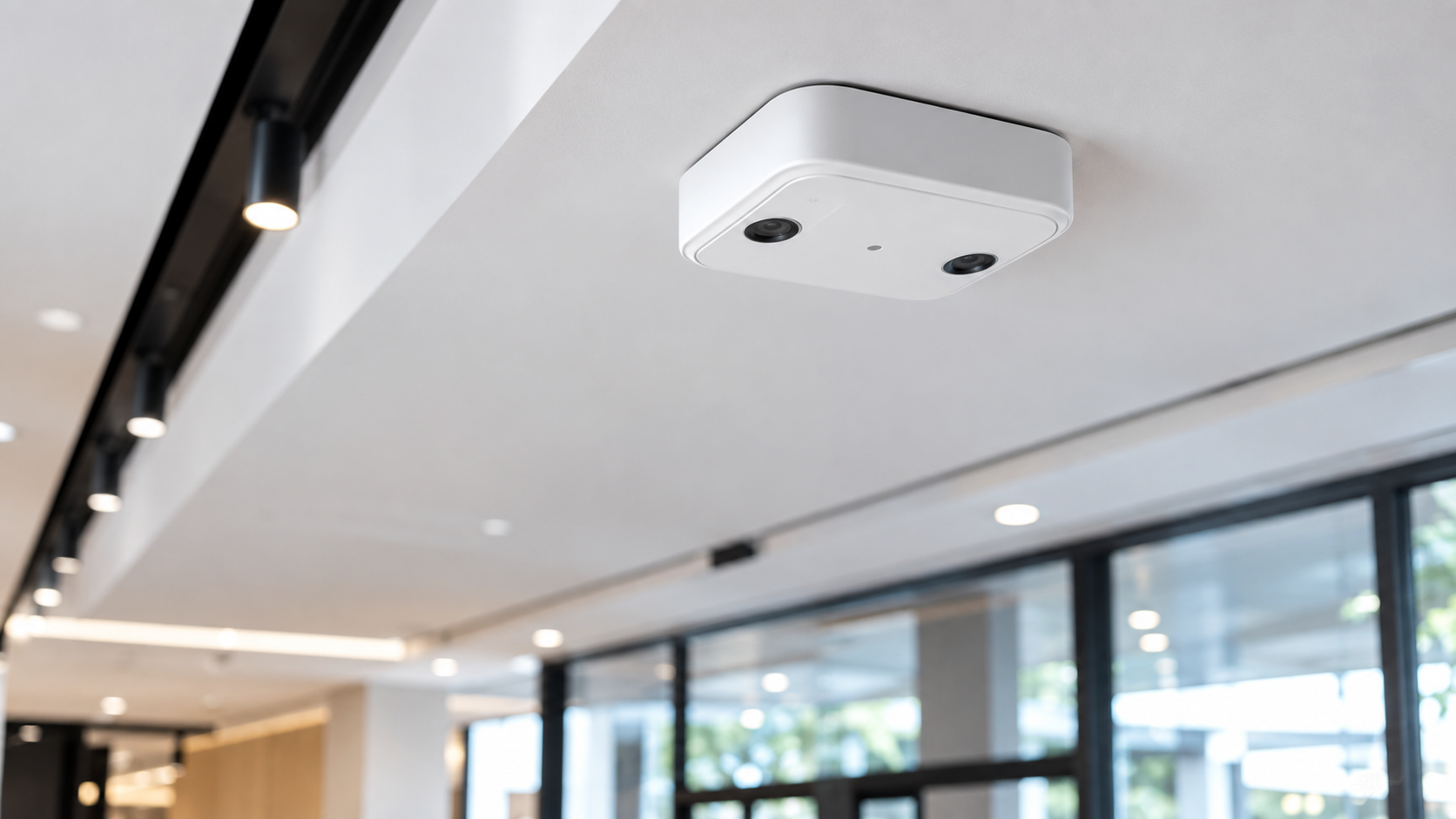
3D stereo. Two lenses build a depth map, so the sensor measures height and volume, not just movement. It distinguishes adults from children, ignores shopping carts, handles bidirectional flow and tracks people who pause in the doorway. This is the default choice for retail traffic counter installations at main entrances, and it is the category Vemco's Xovis GOLD partnership sits in.
Time-of-Flight (ToF). Emits infrared light and measures return time to build a depth image. Similar output to stereo, typically cheaper and lighter on processing, and completely independent of ambient light. Ceiling height limits are usually tighter than stereo, so check the spec against your entrance before ordering.
AI camera. A standard or wide-angle security camera with on-board or server-side analytics. Tempting if you already own a Hikvision or AXIS estate, and results can be good when the camera is placed for counting rather than for surveillance. Tempting is the operative word: a camera angled to see faces at the till is the wrong camera for counting, and GDPR review takes longer than for depth sensors that never capture an identifiable image.
Wi-Fi and Bluetooth sniffing. Counts devices probing for networks, not people. MAC randomisation on iOS and Android has cut its usefulness sharply, and it never counted children or anyone with a phone in flight mode. Use it, if at all, for relative trends across a large mall footprint, never as your customer counter for conversion.
Accuracy: what the number actually means
Every vendor quotes a headline percentage. Ask three questions before you accept it. Is it net or directional (a sensor that miscounts 5% in and 5% out can still report a suspiciously perfect net total)? Was it measured against manual video audit or against the vendor's own logs? And is it written into the contract? Vemco commits to a contractual minimum of 96% and typically achieves 98 to 99% when lighting, layout and visitor behaviour allow. That phrasing is deliberate. A doorway where families stop to fold pushchairs, or a mall entrance with a coffee stand two metres inside, will pull any sensor below its lab figure. Honest vendors tell you that; the rest promise 99% flat and blame your ceiling later.
Accuracy also erodes silently. Sensors get knocked during ceiling work, a new display fixture drifts into the counting zone, a firmware update resets a line. Sensor health monitoring, which flags a unit that has gone quiet or whose in/out ratio has drifted, is worth more over three years than an extra half-point on day-one accuracy. Staff exclusion matters for the same reason: in a small-format store where four employees pass the door thirty times a shift, uncorrected counts can inflate footfall enough to make conversion rate meaningless.
Cost bands and installation reality
Hardware pricing varies by market and volume, but the bands are consistent in shape. Break beam sits at the bottom, thermal and ToF in the middle, 3D stereo and multi-sensor arrays for wide entrances at the top, with AI camera licences priced per channel on top of camera cost. Budget separately for installation (PoE cabling, a ceiling contractor, a lift for atriums), for the analytics subscription, and for the site audit that establishes your true baseline. Multi-year total cost is driven by the software and by how many sensors a wide entrance needs, not by the unit price of one device.
A practitioner note on installation: the single most common cause of poor counts is a counting line drawn too close to the door swing. Automatic doors, wind-blown curtains and people hesitating on the threshold all generate phantom crossings. Move the line 1.5 to 2 metres inside, past the point where visitors have committed to entering, and re-audit. Fixing this at commissioning costs an hour; discovering it after a year of budget decisions costs credibility.
What to buy for which entrance
- Single door, standard ceiling (up to 4 m): one ToF or 3D stereo sensor. Skip break beam unless the entrance is genuinely single-file.
- Wide glass frontage or mall entrance: multiple 3D stereo units stitched into one counting line, so a person crossing the seam is counted once.
- High atrium (6 m plus): long-range stereo models rated for the height, or install at a lower mezzanine choke point instead.
- Dark venues, cinemas, museums: thermal or ToF, both indifferent to lighting.
- Existing camera estate, tight budget: AI analytics on cameras you already own, provided you can reposition them and clear the data protection review.
- Offices and public buildings needing live occupancy: bidirectional 3D at every entrance plus zone sensors on floors, feeding a platform that can also hold air quality and space data, as VemSpace does alongside VemCount.
Buyer checklist
- Accuracy figure stated as directional and written into the contract.
- Platform accepts more than one sensor brand, so a future entrance does not force a rip-and-replace.
- Staff exclusion and sensor health alerts included, not sold as add-ons.
- POS, ERP and BI integration via documented API, tested against your own systems before signature.
- Hosting choice: vendor cloud or private cloud, with data residency you can defend to your DPO.
- A manual video audit at commissioning and at least once a year thereafter.
Frequently asked questions
What is a traffic counter? In a retail or building context, a traffic counter is a door counter that records how many people enter and leave a space, usually from a ceiling-mounted sensor. The term is also used for roadside devices that count vehicles, which are unrelated in technology and purpose. This article covers the people-counting kind only.
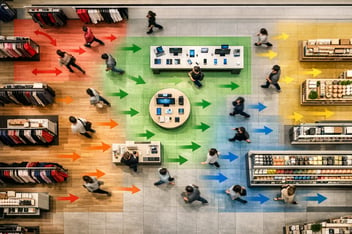
How does a store traffic counter work? A sensor above the entrance detects each person crossing a virtual line and logs the direction. Depth-based sensors (3D stereo, ToF) measure height and shape so they can ignore carts and separate people walking together. Counts are sent to a platform such as VemCount, where they are combined with sales and staffing data.
How accurate are traffic counters? Break beam units are the least reliable, while modern 3D sensors installed correctly reach the high nineties. Vemco guarantees a contractual minimum of 96% and typically sees 98 to 99% where lighting, layout and visitor behaviour allow. Always verify with a manual video audit rather than trusting a brochure figure.
How much does a foot traffic counter cost? Break beam devices are the cheapest, ToF and thermal sit mid-range, and 3D stereo or multi-sensor arrays for wide entrances cost the most per doorway. Installation, analytics subscription and periodic audits usually exceed the hardware over a three-year term. Price the whole system per entrance, not the sensor alone.
How long does the hardware last? The sensors come with a 2-year hardware warranty. In our experience, with regular firmware updates and an annual maintenance contract, the sensors we choose run 8 to 12 years before newer technology replaces them.
If you are specifying traffic counters for a store estate, a shopping centre or an office portfolio and want an honest view on which sensor fits which entrance, and how the data connects to your POS and BI, contact Vemco Group at https://vemcogroup.com/contact-us for a site-by-site recommendation.