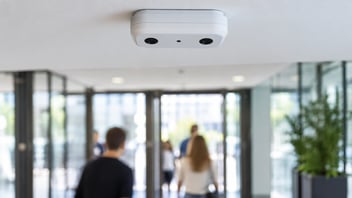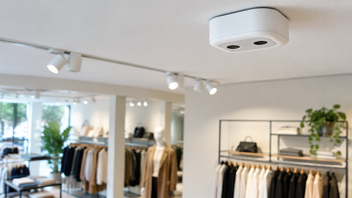









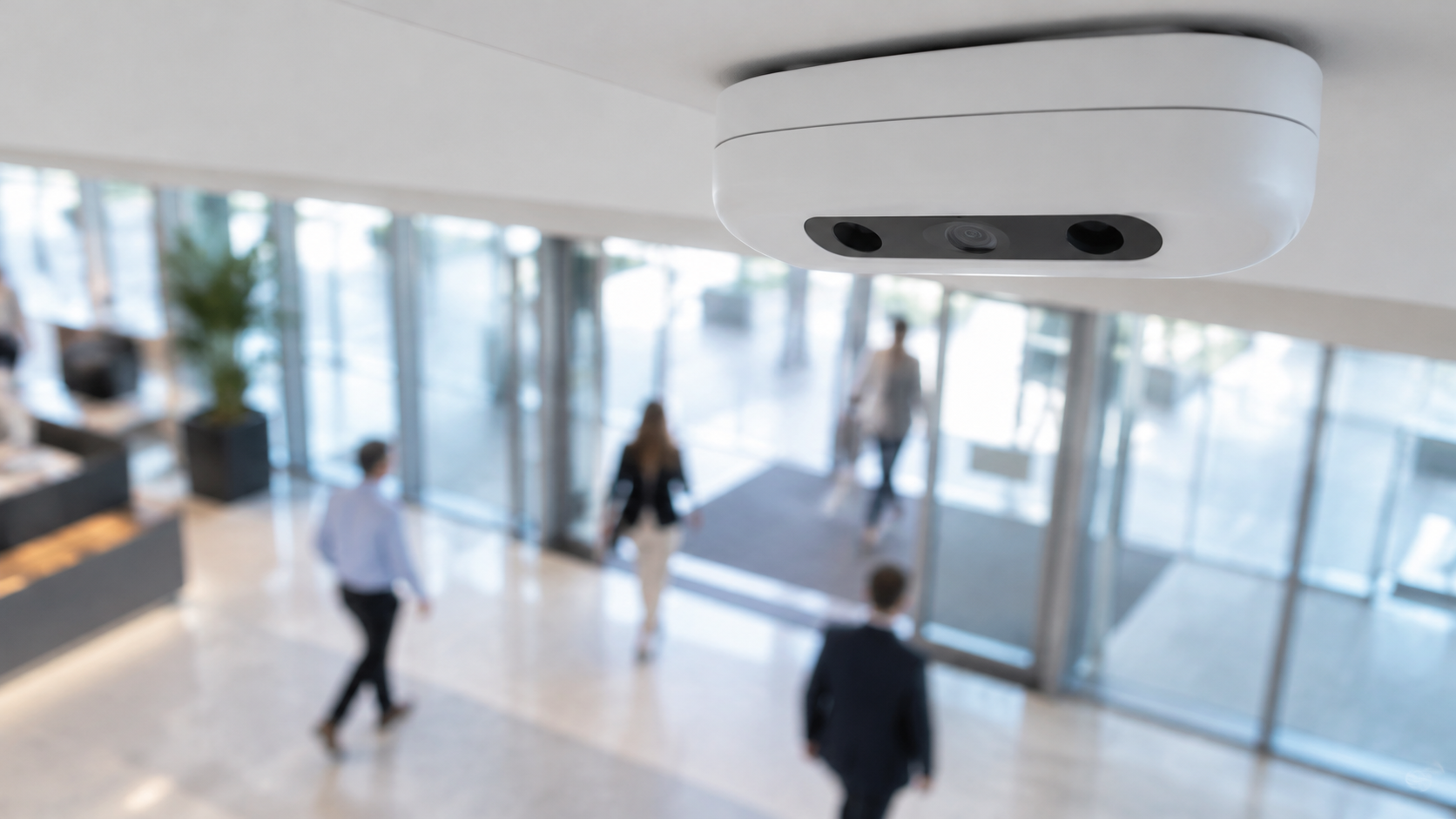
A thermal people counter installed over a side door in 2016 is often still running today, quietly producing counts nobody has questioned in years. Then the mall or the retailer standardises on a new analytics platform, the thermal line and the new 3D line from the main entrance land in the same report, and someone notices that one entrance appears to convert twice as well as the other. Usually nothing changed in the stores. What changed is that two different counting technologies with different failure modes are now being compared side by side.
That moment is where most sensor-replacement decisions actually start, so it is worth being clear-eyed about what each technology does well, where it breaks, and what it costs per entrance over its life rather than at purchase.
What a thermal people counter actually measures
A thermal sensor detects differences in infrared radiation against the floor and tracks warm blobs crossing a virtual line. It does not see faces, clothing or shape in any meaningful detail. That is its main selling point and its main limitation at the same time.
The strengths are real. Thermal units work in complete darkness, so a stockroom door or an unlit loading corridor counts the same at 03:00 as at noon. They are unaffected by strong backlighting from glass façades, which confuses many 2D optical units. They draw little power, and because the output is a heat map rather than an image, the privacy conversation with works councils and data protection officers is short.
The weaknesses show up in exactly the places retailers care about most. Two people walking shoulder to shoulder through a 1.2 metre door produce one merged heat signature at the resolution most thermal arrays offer. A shopping trolley full of refrigerated goods changes the contrast. A heated entrance mat or an air curtain blowing warm air across the threshold can shift the baseline. And on a hot summer afternoon when the floor near the entrance approaches body temperature, the contrast the sensor relies on narrows and counts drift. Practitioners in southern Europe and the Middle East know this pattern well: thermal counts that are fine in January and ten percent low in August.
Where a 3D people counter changes the equation
A 3D people counter, typically stereo vision or time-of-flight, builds a depth map of the doorway. It knows how tall each object is, how wide it is and which direction it is moving. That single difference resolves most of what thermal gets wrong: two adults side by side are two height peaks, a trolley is a flat object below head height, a child is a shorter peak that can be classified separately if the operator wants it.
On wide entrances this matters disproportionately. A flagship with a six metre opening needs either several thermal units with carefully overlapped zones, each a potential source of double counts, or a small number of 3D units stitched into one logical counting line. The stitching is standard on units such as those from Xovis, and it is one reason why a device-agnostic platform like Vemco's VemCount matters: the same footfall, occupancy and conversion figures are produced whether the entrance is covered by one thermal unit or three stitched 3D units, and the sensor health monitoring flags when one of them drops out before the gap reaches a Monday morning report.
On accuracy, be careful with vendor numbers. Vemco's contractual minimum is 96 percent and well-installed 3D systems typically run at 98 to 99 percent, but only when lighting, layout and visitor behaviour allow. A doorway where staff linger to greet customers, or where queues back up into the counting zone, will not hit the top of that range with any technology. Thermal units under favourable conditions on narrow doors can reach similar figures; the difference is how quickly they fall away once conditions stop being favourable.
AI-based people counting camera: more data, more governance
The third option is a people counting camera running on-device AI, including models from Hikvision, Milesight and AXIS. These classify people from a conventional or depth image and can estimate age band and gender, distinguish children from adults, and, when paired with staff-exclusion algorithms, remove employees from the count rather than relying on a separate badge zone.
For a mall operator negotiating tenant leases, demographic splits per entrance are commercially useful in a way a plain count never is. For an IT director, the same features introduce questions thermal never raised: where is inference run, is any image retained, who holds the model update keys, and does the firmware phone home. The better units process on the edge and emit only metadata, but that needs to be verified against the actual configuration, not the brochure. Budget time for a data protection impact assessment on any camera-based rollout across more than a handful of sites.
A practical way to choose per entrance
Mixed estates are normal, and the right answer is usually per doorway rather than per company. A reasonable rule set:
- Thermal for narrow single-file doors, dark or back-of-house areas, sites with strict no-camera policies, and low-value entrances where the budget simply will not stretch further.
- 3D for main entrances, anything wider than about two metres, locations with trolleys or pushchairs, and anywhere conversion rate is used in staff targets or rent calculations.
- AI camera where demographics or staff exclusion have a clear commercial owner, and where the data governance work has already been done or is being done anyway for CCTV.
One observation from implementers that rarely appears in procurement decks: when thermal units are replaced with 3D on main doors, historical footfall almost always steps up, sometimes by eight to fifteen percent, because merged pairs are now counted correctly. Agree in advance how that discontinuity will be handled in year-on-year reporting and in any lease clauses tied to footfall. Otherwise the first quarterly tenant review after the upgrade becomes an argument about sensors instead of a conversation about performance.
Also look at the total cost per counted entrance over seven years, not the unit price. Thermal is cheaper to buy, but on wide doors the extra units, the zone calibration visits and the summer recalibration can erase the saving. 3D costs more up front and tends to be left alone once commissioned. The platform layer is where the two should become indistinguishable: an occupancy sensor of either type feeding the same dashboards, the same POS and BI integrations and the same alerting when a device goes quiet.
Frequently asked questions
Are thermal people counters GDPR friendly? Generally yes, because a thermal sensor captures a low-resolution heat pattern rather than an identifiable image, so no personal data in the GDPR sense is normally processed. You still need to document the deployment, keep raw sensor output from being stored unnecessarily and confirm the unit cannot be reconfigured into a higher-resolution mode. Thermal is the easiest of the three technologies to sign off, which is why it remains common in workplaces and public buildings.
Can thermal, 3D and AI sensors run on the same analytics platform? Yes, provided the platform is sensor-agnostic. VemCount takes counts from thermal, 3D and AI devices alike and normalises them into footfall, occupancy and conversion per entrance, which is what makes a gradual, door-by-door upgrade feasible rather than a rip-and-replace project.
If you are weighing a thermal people counter against 3D or AI units for a specific mix of entrances, send us the door widths, lighting conditions and what the counts will be used for, and we will tell you which technology fits each one and where a mixed estate makes more sense. Start the conversation at vemcogroup.com/contact-us.