








A temperature monitoring system is a set of sensors, a gateway and software that measures temperature continuously, records it at fixed intervals and alerts someone when a threshold is crossed. It is used in cold rooms, chilled display cabinets, server rooms and on the shop floor. The expensive version of the lesson is a Monday morning walk-in freezer at -4 °C instead of -18 °C, a compressor that failed on Friday night, and a bin full of stock nobody can sell. The clipboard on the door still says "OK" from Friday afternoon.
Most facility and operations teams reading this already know the theory. What follows is the practical detail that decides whether the system actually prevents that Monday morning: which sensor goes where, which thresholds to set, how often to log, and what the alert chain looks like at 02:00 on a Saturday.
Why manual temperature monitoring fails even when staff are diligent
Manual checks fail for structural reasons, not because people are careless. A twice-daily reading leaves a 12-hour gap in which a door can be left ajar, a defrost cycle can overrun, or a condenser can ice up. The record then shows two perfectly normal readings bracketing an excursion that is invisible on paper. Auditors know this, which is why a logbook with no gaps and no anomalies often raises more questions than it answers.
Continuous temperature monitoring changes the evidence from "someone looked" to "the sensor measured". That distinction matters for HACCP-style record keeping, for insurance claims after a stock loss, and for the simple question a store manager asks after a weekend: did anything happen that I need to know about?
Cold room temperature monitoring: where the sensor sits is half the job
For cold room temperature monitoring, the decision that causes the most grief is sensor placement. A sensor near the evaporator reads cold and stable; a sensor by the door reads warm and jumpy. Neither tells you what the product is experiencing. The practical answer used by most implementers is one air sensor at product height, away from the airflow and the door, plus a second probe on larger rooms placed in the warmest expected zone, usually the far corner opposite the fan.
Typical sensor types for food retail include:
- Ambient air sensors for walk-in chillers, freezers and back-of-house storage.
- External probe sensors with a cable to a stainless probe, used inside display cabinets or in a glycol-filled bottle to simulate product temperature and ignore brief door openings.
- Door or contact sensors paired with temperature, so an alert can distinguish "door left open" from "compressor failed".
- Combined temperature and humidity sensors for dry goods, bakery storage and wine.
On thresholds: a chiller target of 1 °C to 4 °C and a freezer at -18 °C or below are the common operating points, but the alert threshold should sit a few degrees outside the target with a time delay. A chiller alert at 5 °C for 20 minutes catches a real problem. A chiller alert at 4.1 °C with no delay will fire every time a pallet is loaded and will be muted within a week.
Server room temperature monitoring is a different problem with the same tools
Server room temperature monitoring is about rate of change rather than absolute level. A small comms room in a supermarket can go from 22 °C to 35 °C in under an hour if the split unit trips, and the point-of-sale, CCTV and footfall counting all live in that rack. The same wireless temperature sensor hardware works, but the configuration differs: a higher upper threshold (often 27 °C to 30 °C warning, 32 °C to 35 °C critical), a shorter logging interval, and a rate-of-rise alert that triggers on a 5 °C climb in 15 minutes regardless of the absolute reading.
Place one sensor at the top of the rack where hot air collects and one at the cold-air inlet. Add humidity if the room is in a basement or near a loading bay. The IT team usually wants these alerts routed to their own on-call channel, not the store manager, which is a good argument for a platform that supports per-site and per-sensor recipients.
Logging intervals and the temperature logger question
A temperature logger that records every 10 to 15 minutes is the practical standard for cold rooms. It gives roughly 100 readings a day, enough to show the compressor cycle, the defrost dip and any excursion, without filling storage or draining batteries. Server rooms benefit from 1 to 5 minute intervals because the problem develops faster. Display cabinets with glycol probes can log at 15 minutes because the probe already smooths out door openings.
For HACCP-style records, the system should retain readings for at least the period your auditor expects (commonly one to two years), export to CSV or PDF per site and per sensor, and show who acknowledged each alert and what corrective action was logged. The acknowledgement trail is the part most teams forget to specify and the part auditors ask for first.
Wireless temperature sensor networks: what works in a real store
LoRaWAN has become the practical choice for multi-site retail because a single gateway in the back office can reach sensors in freezers, cold rooms, the comms room and the sales floor without pulling cable or relying on store Wi-Fi. Battery-powered LoRaWAN sensors from partners such as Milesight are available in the Vemco shop, and the temperature sensor collection there covers ambient, probe and humidity variants.
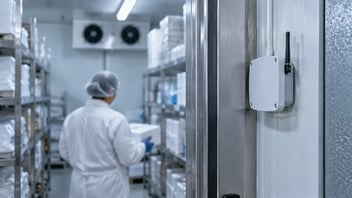
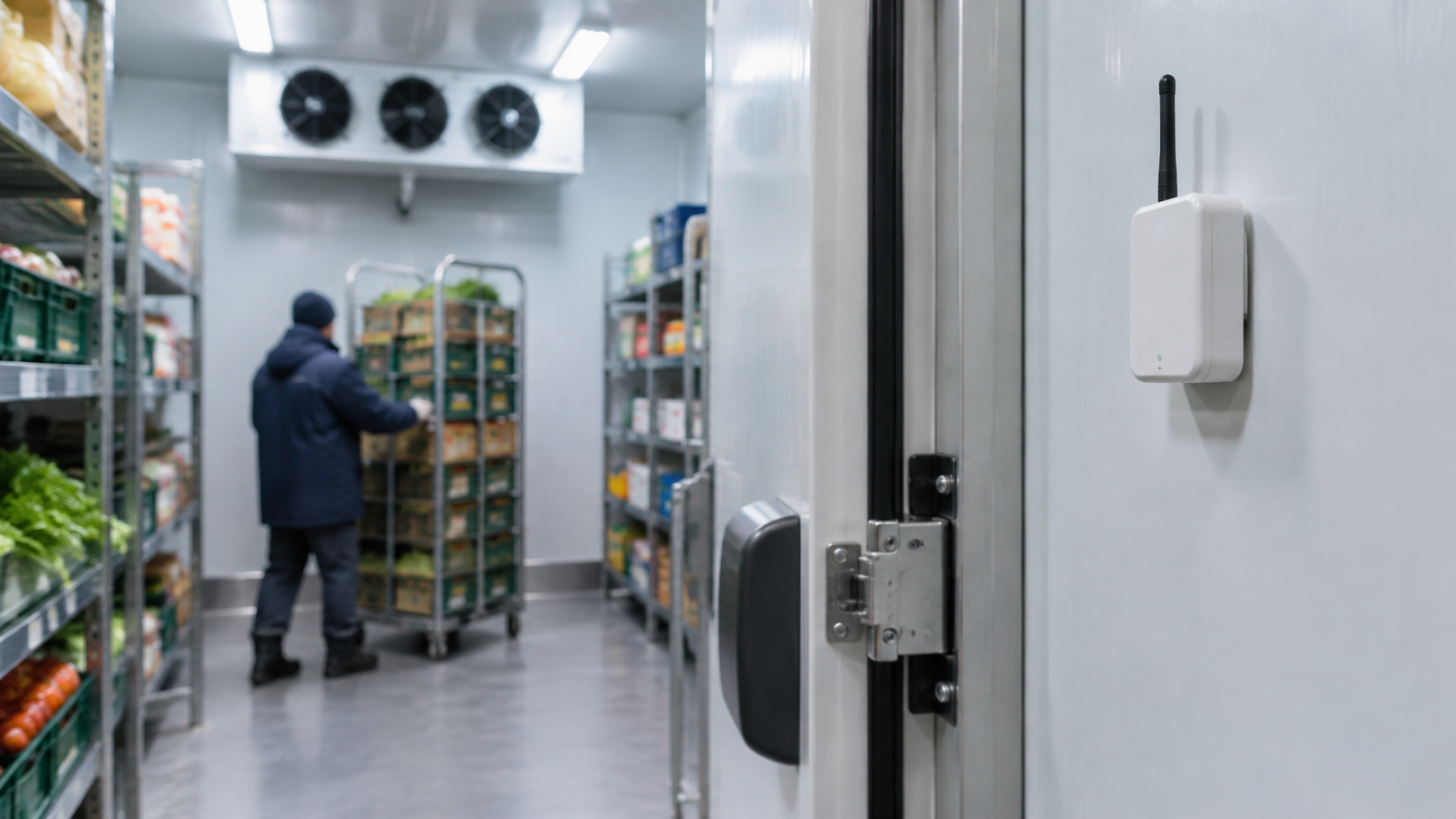
The practitioner observation that saves the most call-outs: walk-in freezers are metal boxes, and a sensor inside one will often not reach the gateway through the closed door. The fix is either a sensor with an external probe where the radio body sits outside the room and only the probe cable goes in, or a gateway positioned so the signal passes through the door seal rather than the panel wall. Test signal strength with the door closed before fixing anything permanently, and do it with the compressor running, because fan motors add noise.
Designing an alert chain someone will actually answer
An alert that goes to an unread email inbox is not an alert. A workable chain for a supermarket looks like this:
- Warning (threshold crossed, delay elapsed): push notification to the duty manager's phone.
- Critical (no acknowledgement within 15 minutes, or critical threshold reached): SMS to the store manager and the refrigeration contractor's on-call number.
- Escalation (no acknowledgement within 45 minutes): call or SMS to the regional facilities lead.
- Offline sensor or gateway: treated as a warning in its own right, because a silent sensor is indistinguishable from a healthy one until it is too late.
Platforms such as VemSpace bring temperature, humidity, door status and occupancy data into one view per site, which lets property and operations teams see a freezer alert alongside the footfall and energy picture for the same store. Vemco targets 99.7% monthly uptime for the platform and provides local support in the markets it serves, which matters when the contractor needs a screenshot of the last six hours at short notice.
Frequently asked questions
What is a temperature monitoring system? It is a combination of sensors, a communications gateway and software that measures temperature at set intervals, stores the readings and sends alerts when values leave a defined range. In retail it protects chilled and frozen stock, IT equipment and comfort conditions on the sales floor.
How often should a cold room temperature be logged? Every 10 to 15 minutes is the common working standard, giving enough resolution to see compressor and defrost cycles. Faster intervals add little for cold rooms but are appropriate for server rooms where conditions change in minutes.
Can one sensor platform cover cold rooms, server rooms and the shop floor? Yes, provided it supports different sensor types, per-sensor thresholds and per-site alert recipients. The hardware is largely the same; the configuration and who gets the alert are what differ.
What happens when a temperature alert fires? The platform notifies the first recipient, waits for acknowledgement, then escalates to the next contact if nobody responds. Each step, the acknowledgement and any corrective action note are recorded for the audit trail.
How long do wireless temperature sensors run on a battery? Battery life depends on the reporting interval, the radio environment and the ambient temperature, with freezers draining cells faster than chillers. Check the manufacturer's rating for your chosen interval and plan a replacement schedule rather than waiting for a low-battery alert.
If you are specifying a temperature monitoring system for a store estate, a cold chain operation or a set of comms rooms, talk to the Vemco team about sensor placement, threshold design and how VemSpace brings the readings together with the rest of your site data.