








The most expensive loss in a freezer container rarely happens inside the container. It happens at the breaker panel. Four or five rented units standing in a row behind a production hall usually hang off one supply, and when that supply trips on a Friday evening, every box warms at the same rate with nobody watching. The controller on each unit will show you the temperature on Monday morning. It will not tell you when the rise started, how long the core sat above -18 °C, or who should have been called. That gap between a display and a record is the whole reason freezer container monitoring is a separate subject from monitoring a walk-in inside the building.
Why a cold storage container behaves differently from a walk-in
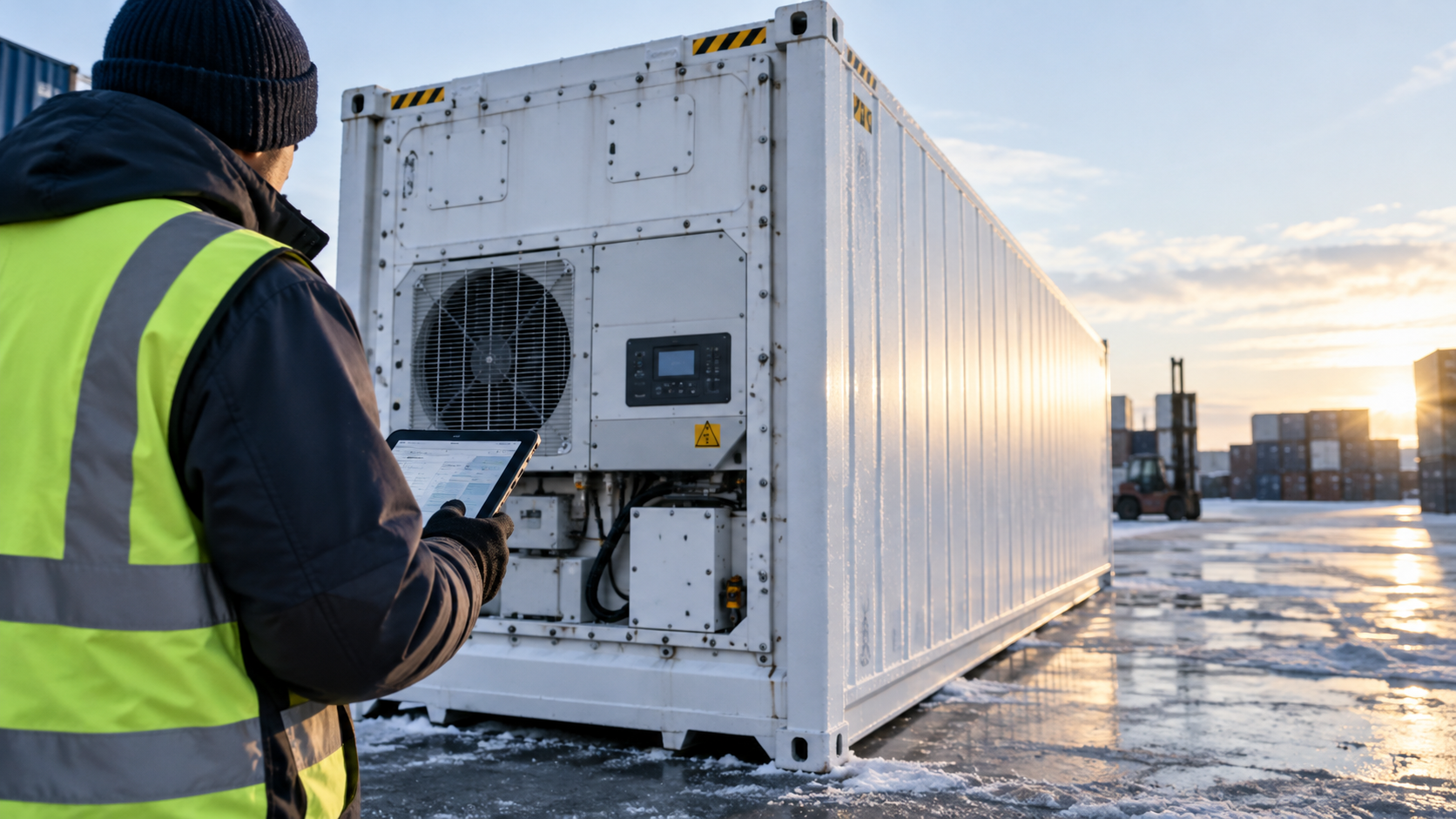
A container freezer stands outdoors. In July the sun heats the steel roof and the compressor runs flat out; in January the condenser drains freeze and the unit may trip on its own protection. Rain gets into every junction box that was not sealed properly on delivery. None of this is unusual, and all of it is invisible from an office window.
The steel box itself is the second problem. A sensor placed inside a refrigerated container is inside a Faraday cage. Wi-Fi and most short-range radio simply do not get out, which is why so many first attempts at reefer container monitoring end with a sensor that logs beautifully to its own memory and never reports anything.
Third, the door. A stationary freezer container on a caterer's yard or a wholesaler's loading area is opened far more often than a shipping container ever was. Rubber seals wear, hinges drop, and the gap at the bottom corner lets warm, humid air in and builds ice on the evaporator. The controller display keeps showing a plausible return-air figure while the product nearest the door is slowly thawing.
And the ownership question does not change any of this. A container rented for the Christmas peak and returned in January is the landlord's asset, but the frozen goods inside are yours, and so are the self-inspection records. An inspector asking for freezer container temperature history will not accept "the rental company's unit has a display."
How the sensor gets in, and how the signal gets out
The practical answer is to split the sensor in two. A probe rated down to -40 °C goes inside on a thin cable passed through the door seal; it is thin enough that the seal closes over it without a visible gap. The transmitter and battery stay on the outside wall in a weatherproof housing, away from the cold that would kill a battery and away from the steel that would block the radio. No drilling into a rented unit, no cable gland to argue about when the container goes back.
Outside the box, the sensors talk LoRaWAN. One gateway positioned to cover the yard serves every container standing there, whether that is three units or twenty, with 4G as the fallback path. There is no cabling between containers and no dependency on the site network, which matters because the site network is often the first thing to go down in the same power cut that stopped the compressors. Where the gateway sits is decided in a short site survey rather than guessed; a yard with a row of containers, a parked trailer and a brick wall is not a line-of-sight problem you want to solve by trial and error.
Readings arrive every few minutes. Each sensor also stores readings locally and resends them after a connection loss, so a power cut that takes out the gateway does not leave a hole in the record. The history shows the curve through the outage, which is exactly the evidence you need to decide whether a batch is saleable or scrap. For the general question of how to choose between Wi-Fi, SIM and LoRaWAN for freezer monitoring, the freezer temperature monitoring buying guide covers it; this article stays on what is specific to containers. The short version is that for an outdoor yard with a steel box, LoRaWAN wins on reach and independence.
Alarms that fire on a dead compressor, not on a forklift
A container freezer being loaded with pallets will show a temperature rise. That is normal and it must not page anyone. A container whose compressor stopped at 02:00 will also show a rise, and that one must. The only difference between the two curves is duration, which is why every container in VemSpace gets three settings: a high limit, a low limit and a delay. Loading an unloading sit inside the delay; a stopped compressor or a tripped supply runs through it and triggers.
Alarms go out by email or via API to an escalation list, so the night operator gets it first and the operations manager gets it if nobody acknowledges. Each alarm is stored together with the readings, which turns a phone call into a documented event with a timestamp, a response and an outcome. A dedicated article on freezer alarm design, including how to set delays for different product types, is in preparation.
One observation from implementations: on a multi-container yard, set the low limit as seriously as the high one. A controller that has drifted or a unit left on the wrong setpoint after a rental swap will overcool, and chilled produce in a refrigerated container at -3 °C is just as much a loss as frozen goods at -12 °C. Businesses that only alarm on the high side find this out on a Monday morning with a pallet of frozen salad.
Seasonal fleets: adding a monitoring point in hours, not weeks
Rented containers arrive on a truck, get plugged in, and are expected to hold product the same afternoon. Monitoring has to keep that pace. With the gateway already covering the yard, a new cold storage container is a matter of fixing the housing to the outside wall, feeding the probe through the seal and registering the point in VemSpace, the in-house developed IoT module of the Vemco platform. When the container goes back after the season, the sensor comes off and moves to the next one.
The commercial model follows the same logic. For a fleet that grows and shrinks with the calendar, an all-inclusive rent per active monitoring point per month means you pay for the containers you are actually running. For an owned fleet that stays put year round, buying the sensors and licensing VemSpace per point is usually the cleaner line in the budget. Either way, every point ships with a traceable factory calibration certificate, and annual recalibration is recommended so the certificate in the HACCP file matches the probe on the wall. Details on the full setup are on the cold storage temperature monitoring solution page.
What the inspector actually wants to see
For quick-frozen food, EU rules require regular recorded air temperature at -18 °C or colder with records kept for at least a year; the buying guide linked above covers the detail. What matters for a container yard is that the record exists per container, not per site average, because the inspector will point at one unit and ask about it. Reports in VemSpace can be exported per container or per site straight into the HACCP file, and the full history is kept, so a question about a batch shipped eight months ago is answered from the archive rather than from memory.
The same export does a second job. When a rental unit is returned and the rental company queries a damaged seal or a compressor fault, a temperature curve with timestamps settles the conversation quickly.
If you run freezer or cold containers outdoors, owned or rented, and your evidence of their temperature still lives on a controller display, contact Vemco Group for a site survey. We will look at your yard, place the gateway, and show you how quickly each container can start logging and alarming without a cable or a hole in the steel.