

/global/header/smart-buildings.svg)


/global/header/facility-management.svg)






/global/header/leisure.svg)






Ask any pool operations manager which hours are busiest and you will get a confident answer. Ask them to prove it, and most reach for a booking calendar. That is the problem. A booking system shows who reserved a hall, not how many people actually turned up. A club that books a hall for forty players and shows up with twelve looks identical on paper to a club that arrives with fifty. Free access areas, such as an open foyer, an outdoor pitch or a drop-in fitness zone, do not appear in booking data at all. So staffing plans in most sports halls and swimming pools rest on estimates and habit, which means some hours are quietly overstaffed while others leave lifeguards and reception staff stretched thin exactly when it matters.
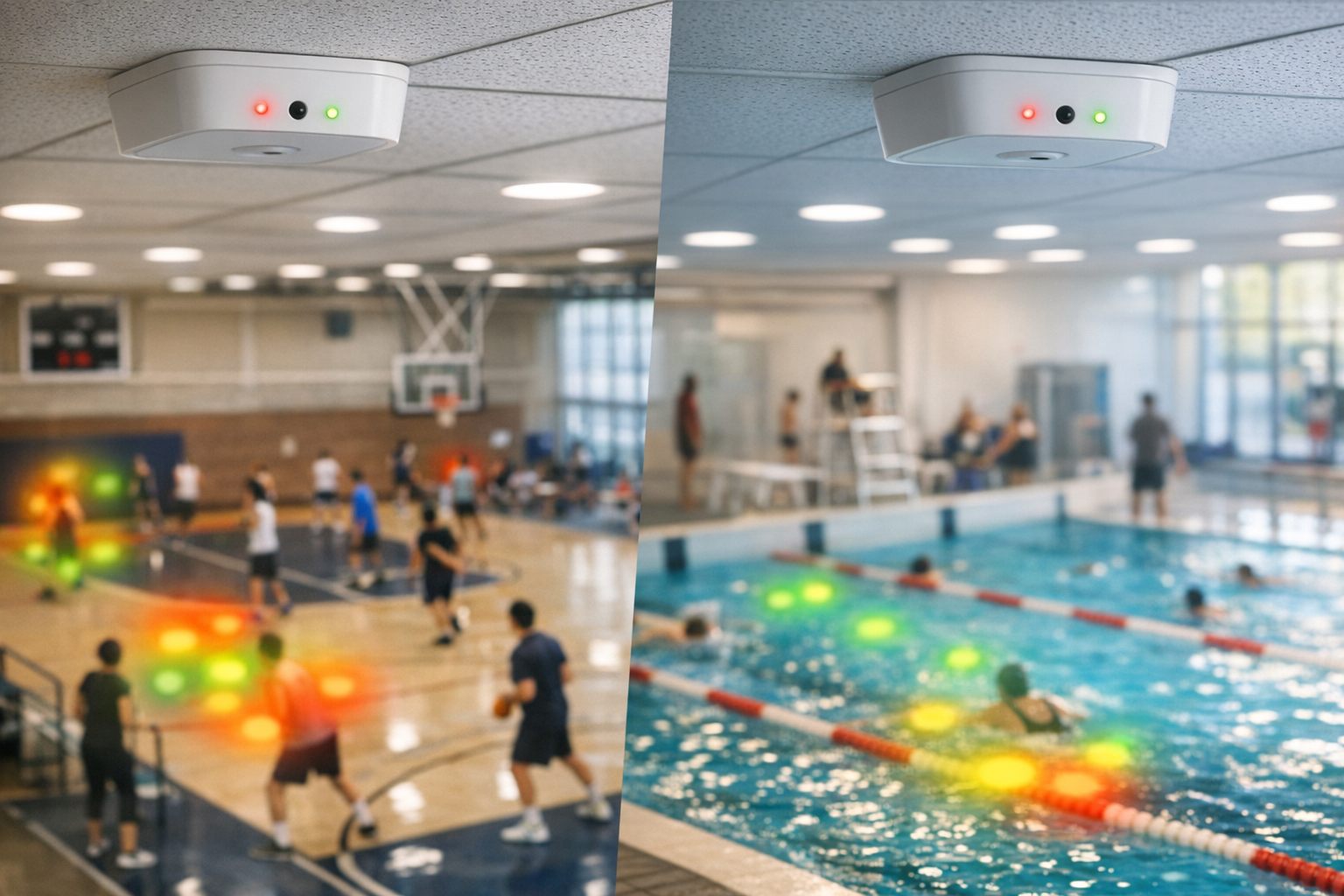
People counting in sports and leisure facilities is the automated measurement of how many visitors enter, occupy and leave a building or individual zones within it, using GDPR compliant sensors that identify no individuals. It replaces booking assumptions and gut feeling with measured entry numbers, live occupancy figures and dwell times per hall, pool, changing area or cafe.
The gap between the roster and reality
Staffing plans in leisure facilities tend to survive for years without challenge. The Tuesday evening rota was built when the swimming club trained Tuesdays, and it stays even after the club moved its sessions. Nobody adjusted it because nobody had the data to justify the change, and no manager wants to cut a lifeguard hour on a hunch and be wrong about a safety-critical shift.
This is where measured occupancy changes the conversation. Fredericia Idraetscenter, one of Denmark's larger multi-activity centres, uses visitor counting to understand the flow to individual activities and to plan the staffing needed. Not staffing the building as a whole, but staffing the actual activities inside it, because a full fitness room and an empty hall next door require very different coverage. Copenhagen, Aarhus and Aalborg municipalities apply the same approach across a mix of sports halls, swimming pools, libraries, museums, outdoor activity areas, forest paths and playgrounds, which puts hall usage on the same evidential footing as every other municipal facility competing for the same budget.
Why zone level counting matters more than door counting
A single counter on the front door tells you the building was busy. It does not tell you whether the pool hit its safety capacity while the badminton courts sat empty. For pools especially, the operational unit is the zone, not the building. Modern setups measure each hall, pool, changing area, fitness room and cafe separately, with real time alerts when a capacity threshold is reached. For a pool with a legal or insurance-defined bather limit, that alert is not a nice-to-have. It is the difference between a lifeguard supervisor knowing the pool is at capacity now, versus discovering it in a monthly report.
Two details separate a credible installation from a misleading one, and experienced implementers check both on day one. First, staff must be excluded from the visitor count, otherwise every shift change inflates your peak hours and your staffing analysis eats its own tail. Second, group identification has to work, because a school class of 28 children moving through a turnstile area in a tight cluster is exactly the kind of traffic that cheap counters undercount, and children and groups are precisely the visitors funding bodies ask you to document.
Five decisions that change when you have real numbers
1. Lifeguard and floor staff scheduling. Predictive analytics built on your own historical data identify which hours are consistently understaffed and which are consistently overstaffed. You reallocate hours rather than add them, which is usually where the budget win sits.
2. Hall time allocation between clubs. Municipalities dividing hall hours between competing clubs typically have no neutral evidence of real usage. Measured attendance per booked slot ends the argument. A club that books heavily and attends lightly becomes visible, and the conversation shifts from politics to data.
3. Funding applications and reporting. Precise visitor documentation can be decisive for public funding, because funding bodies require reliable figures, including for visitors who are hard to document manually such as children and school groups.
4. Reception and changing room bottlenecks. Queue measurement at reception and changing rooms shows whether complaints about waiting reflect a staffing gap or a fifteen-minute crunch that a schedule tweak solves. Dwell time per zone reveals whether visitors linger in changing areas at specific times, which often points to a cleaning or capacity issue rather than a staffing one.
5. Outdoor facilities. Outdoor counting that works in all weather brings outdoor pools, pitches and activity areas into the same dataset as the building. For many municipal managers these areas have never been measured at all, despite consuming maintenance budget every year.
The practical detail most buyers miss
Sensor health monitoring sounds like a footnote until a counter above your main entrance silently stops reporting in week two of a quarter and you find out at reporting time, with a hole in the exact dataset your funding application depends on. Central sensor health monitoring flags a failed counter the same day. Anyone who has rebuilt a quarter of visitor data from till receipts and booking logs will tell you this feature pays for itself the first time it fires.
Integration is the other quiet decider. Counting data that sits in its own portal gets looked at twice and forgotten. Data that flows through a REST API or CSV export into your existing BI, booking or ERP system becomes part of the weekly planning routine. If your facility already has sensors installed, it is worth knowing that some platforms can run on existing hardware rather than forcing a rip-and-replace, since compatibility with more than 40 sensor manufacturer types is possible.
FAQ
Is people counting compatible with GDPR in a public facility? Yes, when the sensor technology identifies no individuals. Counting sensors register presence and movement, not identity, which also applies to AI sensors estimating age and gender distribution at an aggregate level.
Can it handle pool safety capacity limits? Yes. Live inside numbers per zone combined with real time alerts notify staff the moment a defined threshold is reached, so capacity management stops depending on a lifeguard's headcount.
Do school classes and clubs distort the numbers? Not with group identification in place. Groups moving in clusters are counted correctly, and staff are excluded from visitor totals, so the data reflects genuine public usage.
What about unstaffed opening hours? Counting works identically whether staff are present or not. Many Danish libraries use exactly this model, tracking visitor numbers, live inside figures and seating use across both staffed and unstaffed hours, and the same applies to self-service access in sports facilities.
Vemco Group has worked with counting technology since 2005 from its headquarters in Fredericia, Denmark, with over 55,000 installations in more than 98 countries and Danish support behind every public sector project. If you want to see what your actual peaks look like, and what your rota would look like if it followed them, contact Vemco for a conversation about counting in your halls, pools and outdoor areas.