








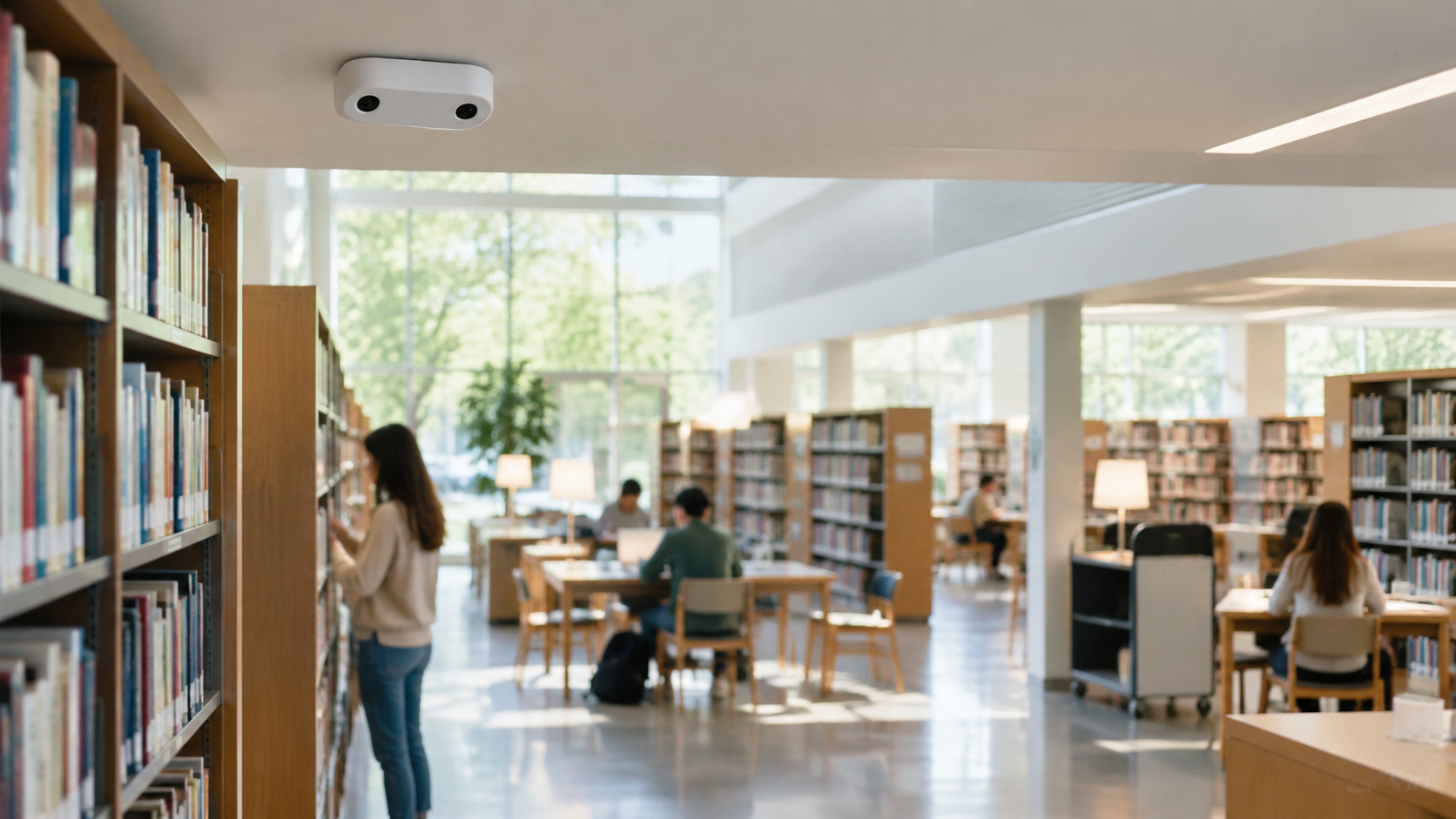
A municipal library opens at 7:00 on a weekday. The first librarian arrives at 10:00. Between those two times, 140 people have walked through the door, borrowed books via self-service kiosks, used the study rooms and left. In the annual report to the council, those 140 people do not exist. The visit figure is built from desk-staffed hours and a tally clicker, and the budget committee that decides whether the branch stays open is working from a number that is 30 to 40 percent too low. For the basics, see our earlier guide to people counting for libraries; this article is about the hours when nobody is on duty.
This is the single most common reason library operators, and the facility and IT teams who serve them, start looking at a library people counter. Open libraries, extended access and staff-free mornings have spread across Scandinavia, the UK and parts of North America, and the visit statistic has not kept pace. The same problem appears in mixed-use buildings where a library shares an entrance with a shopping centre, a civic hall or a community gym: the landlord has footfall data for the retail units and nothing comparable for the public tenant occupying the largest floorplate.
Why the manual count fails during unstaffed hours
Most libraries still have one of three systems in place. A handheld clicker at the desk. A beam counter across the door that halves the number and hopes for the best. Or an estimate derived from loan transactions, which ignores everyone who came to read a newspaper, charge a laptop or attend a class. None of these can report what happened at 7:45 on a Tuesday when nobody was on duty.
The consequence is not just an undercount. It is an undercount that is systematically worse in exactly the hours that justify the extended-access model. If a council invested in access control and self-service to open the building longer, it needs evidence that people use those hours. Without visitor counting that runs regardless of staffing, the investment cannot defend itself.
What people counters for libraries need to do differently
A library is not a clothing store, and anyone who has installed a sensor over a retail entrance will notice three differences immediately.
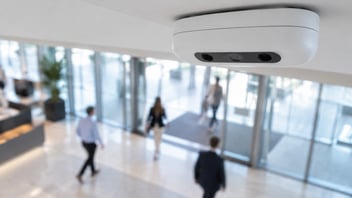
- Dwell time is long and movement is slow. People stop in the doorway to shake off umbrellas, read notices or let a pushchair through. Sensors tuned for a steady retail flow can double-count hesitation. Stereo-vision or AI sensors from Xovis, AXIS or Hikvision track a person as an object across the counting zone, which handles pausing far better than a break-beam.
- Children matter to the statistic. A storytime session brings in forty visitors under 1.2 metres tall. Beam counters at adult height miss most of them. Overhead sensors capture them, and AI sensors can separate children from adults, which is useful when reporting on youth programme uptake.
- Staff and contractors use the same door. Cleaners, security and the mobile library team come and go constantly during unstaffed hours. Staff-exclusion algorithms remove those movements so the figure reflects the public.
On accuracy, be careful with vendor claims. Vemco's contractual minimum is 96 percent, and installations typically reach 98 to 99 percent when the conditions allow: adequate lighting, a sensor mounted with a clear view of the threshold, and visitor behaviour that is not pathological. A glass-fronted library atrium with low winter sun streaming across the floor is a condition that does not allow, and the survey should say so before anything is ordered.
Occupancy, not just visits
Visit totals satisfy the annual report. An occupancy counter answers operational questions. How many people are in the building right now, with nobody there to look? Did the study area hit capacity during exam season? Did the heating run for a nearly empty building from 7:00 to 9:00 every day in February?
For facility managers, this is where the business case usually closes. VemCount calculates live occupancy from entries and exits at every door and holds it per floor or zone, so the same data that proves usage to the council can feed a building management system to schedule ventilation and lighting around real presence rather than a fixed timetable. Several operators have found that the energy saving from trimming two hours of HVAC in near-empty periods paid for the sensors within the first heating season.
For security and insurance, an occupancy figure during unstaffed access is also the number the risk assessor asks for. Knowing that the building rarely exceeds 25 people before 10:00 changes the conversation about lone-worker policies and emergency procedures.
The implementation detail nobody mentions until it goes wrong
Here is the observation from the field. Unstaffed hours are precisely when a sensor fault goes unnoticed. In a staffed store, someone sees that the counter display is dark or that the morning figure is zero. In a library at 7:00, nobody does. We have seen branches lose six weeks of data because a network switch was replaced during an IT refresh, the sensor's VLAN assignment was dropped, and the dashboard quietly reported zeros that looked plausible for early mornings.
This is why sensor health monitoring is not a nice-to-have in this sector. VemCount flags a device that stops reporting, drifts outside its expected pattern or returns implausible entry-to-exit ratios, and raises it before the gap reaches a monthly report. For an IT director managing twenty branches on a thin team, an alert at 7:15 is worth more than a prettier chart.
Two further practical points. First, libraries typically sit on municipal networks with strict segmentation, so confirm early whether a hosted platform or a private-cloud deployment inside the council's environment is required; both are possible, but the procurement paperwork differs. Second, because the platform is sensor-agnostic, a branch that already has AXIS cameras for security can often add counting analytics without new hardware, which shortens the capital request considerably.
Where the retail parallel is useful, and where it is not
Mall operators with a library tenant should treat it like any other anchor in footfall terms. The library's visitors walk past the retail units, and a shared counting platform lets the landlord show tenants the draw the public anchor generates. Where the parallel breaks is conversion: a library does not want a sales ratio, it wants visits per opening hour, visits per staffed hour versus unstaffed hour, and visits per square metre to support space decisions when the council reviews its estate.
Build the reports around those three ratios and the dataset starts doing political work: showing that the 7:00 opening is used, that Saturday afternoons outperform Thursday evenings, and that the proposed closure of a branch would remove the busiest unstaffed hours in the network.
Frequently asked questions
How do libraries count visitors? Historically through desk clickers, door beam counters or estimates from loan data, all of which miss unstaffed hours and undercount children. Modern libraries install overhead 3D or AI sensors above each entrance that count entries and exits continuously, exclude staff movements and feed a platform such as VemCount for visit totals, live occupancy and hourly breakdowns regardless of whether anyone is on duty.
If your library, civic building or mixed-use centre is reporting visit numbers that stop when the staff go home, talk to us about a library people counter deployment that covers every opening hour, including a site survey to check lighting and entrance conditions before you commit. Contact Vemco Group at https://vemcogroup.com/contact-us.