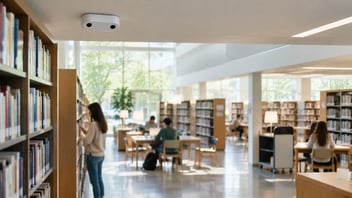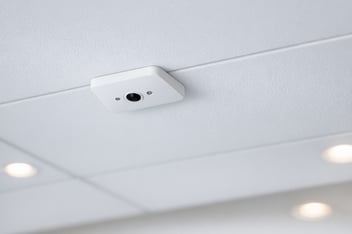









A library people counter measures how many people visit a library, when they come, and which floors and rooms they use. Libraries need this because the way they are judged has changed. Loans are no longer the main measure. Visits, use of space and opening hours are. A people counter gives you those numbers automatically, every hour of every day, without a manual gate count and without storing images of anyone.
This article explains why libraries count visitors, what the counter should measure, and how the data is used for funding, opening hours and live seat availability.
Why libraries count visitors
Libraries count visitors because funding follows evidence. Councils, universities and ministries ask what a library delivers for its budget. Collection size, staff numbers and loan statistics no longer answer that question on their own. Visit numbers do, because they show demand for the building and its services.
Counting also shows how the library is used. Visitor data reveals which floors and areas are busy, which services work, and which do not, so decisions on layout, staffing and investment rest on measured use. The same evidence is used in visitor counting for public buildings such as museums, archives and civic centres.
Three reasons come up in almost every library project:
- Visit numbers justify grants and public funding by showing demand for the library and its services.
- Hourly data lets the library match opening hours and staff rosters to the periods when people actually come.
- Occupancy data per floor and room improves the visitor experience, because people can find a free seat or a quiet room without searching.
Loans are falling, visits are not
Count visits per entrance, per floor and per room, because visits are the measure libraries are judged on today. In many libraries physical loans have declined while visits have held up or grown. People come to study, to work, to attend events, or simply to sit in a quiet place. None of that shows up in loan statistics.
A library people counter at every entrance gives the total number of visits. That is the headline figure for an annual report or a funding application. Counting per floor and per room goes further. It shows how much a reading room, a children's area, a maker space or a group study floor is actually used, and whether use changes after a refurbishment or a new service.
This is the figure that holds up in a budget meeting. A manual count on a few sample days does not. An automatic count across every opening hour is comparable from year to year because the method does not change.
Opening hours should follow visitors
Hourly visitor data shows when people come, so opening hours and staffing can follow measured demand. A library visitor counter replaces intuition with a measured weekly pattern per entrance and per floor.
In practice the data answers simple questions. Is the first hour on a weekday morning used, or do most visitors arrive after ten? How busy is Saturday afternoon compared with Thursday evening? Does the study floor fill up in exam periods while the ground floor stays quiet? With those answers a library can extend hours where demand is high, move staffed hours away from quiet periods, and show the council why.
The same data supports self-service and unstaffed opening hours. If visitors keep coming after staff leave, the library has evidence that extended self-service hours are worth the investment. We cover that case in more detail in our guide to people counters for libraries during unstaffed hours.
Nobody should walk three floors for a free seat
Live occupancy per floor and per room, shown on screens at the entrance or online, tells visitors where there is space before they start looking. Students arrive, see that the third floor is full and the second floor has room, and go straight there.
This is library occupancy data working for the visitor, not only for the manager. The counter at each entrance and on each floor keeps a running total of people inside. A live occupancy view turns that into a simple display: how many people are on each floor right now, and how that compares with the comfortable capacity.
At room and desk level, libraries use room and desk occupancy with VemSpace. Sensors show which group rooms are in use and which desks are free, so booking and reality match. Over time the same data shows which rooms are always full and which are rarely used, which feeds the next floor plan.
What a library people counter should deliver
The counter should give you accurate, anonymous counts per entrance, floor and room, in one dashboard, with support close to you. Look for these points when you compare systems:
- Accuracy you can rely on in a report. Vemco Group delivers a contractual minimum 96 percent, typically 98 to 99 percent, with 3D sensors from partners such as Xovis, Milesight and TDI.
- Anonymous counting. Counts are anonymous and no images of identifiable people are stored, which keeps the library on the right side of privacy rules and public expectations.
- One view for the whole library system. VemCount people counting software collects every entrance, floor and branch in one dashboard, with reports your finance team and your council can read.
- Hourly data, not daily totals. Opening hours and staffing decisions need the pattern through the day.
- Live occupancy for visitors. Screens and web views that show free space per floor and room.
- Local offices and local support. A library runs for decades, so the supplier should be close to you.
Vemco Group has counted visitors for 20+ years, with 55,000+ installations in 98+ countries and 60+ million people counted daily. Libraries are part of our work with universities and public institutions, where the same counters serve lecture halls, student centres and public buildings.
Frequently asked questions
How accurate is a library people counter?
Accurate enough for funding reports. Vemco Group's accuracy is a contractual minimum 96 percent, typically 98 to 99 percent, measured with 3D sensors mounted above each entrance. Manual gate counts on sample days cannot match this, because they cover only a few hours and depend on who is counting and how.
Does a people counter store images of visitors?
No. Counts are anonymous and no images of identifiable people are stored. The sensor counts people crossing a line and passes a number to the software, nothing more. This is why public libraries, universities and other public institutions can use people counting without the concerns that come with camera surveillance.
Can we count per floor and per room, not only at the entrance?
Yes. Sensors at stair landings, lift exits and room entrances give a count per floor and per room. With live occupancy the library can show free space per floor on screens, and with room and desk occupancy sensors it can show which study rooms and desks are free. The same data shows over time which spaces are used most.
What does installing a library people counter involve?
Each sensor is mounted above an entrance, connected to power and the network, and set up in the software. A multi-floor library with several rooms starts with a floor plan review so that stairs, lifts and room doors are covered as well as the main entrance. Our local offices plan the sensor positions with you and support the system after installation.
See your library's visitor data
If you want to see what the data would look like for your building, book a demo with our team. We will walk through counting per entrance, floor and room, live occupancy for visitors and the reports your funders ask for. Ask us about a trial if you want to test it in your own library first.