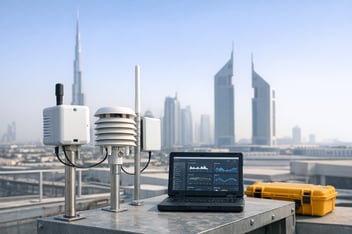











The most expensive mistake in a multi-site sensor rollout is rarely the sensor. It is the assumption that one gateway per building will cover every cold room, basement and plant room, found out six months later when the freezer alarm never arrived. This guide covers what a LoRaWAN gateway actually does, why its range cannot be promised in metres, and how to decide how many you need before you sign a purchase order.
What a LoRaWAN gateway does
A LoRaWAN gateway is the radio receiver that sits between your battery-powered sensors and the network. It listens for sensor messages on the LoRa radio band and passes them on over Ethernet, Wi-Fi or a mobile data connection to a network server, which then hands the readings to the monitoring platform.
That is the whole job. The gateway does not store your data, does not show a dashboard and does not decide whether a temperature is too high. It is a bridge. Think of it like a Wi-Fi access point for very low-power devices that talk rarely and over far greater distances through walls.
Because the sensors only wake up to transmit a small message and then sleep again, they run for years on a battery. That is the trade-off that makes LoRaWAN attractive for temperature, humidity, leak, door, CO2 and occupancy monitoring across many sites without pulling cable.
Sensors are not paired to one gateway
A sensor does not belong to a specific gateway. Any gateway in range that is part of the same LoRaWAN network can receive its message and forward it. The network server removes duplicates, so two gateways hearing the same sensor is normal and useful, not a fault.
This is why a second lora gateway adds resilience rather than complexity. If one unit loses power or its uplink, sensors within reach of the other keep reporting. For a hospital pharmacy fridge or a cold store holding stock worth more than the entire sensor project, that overlap is cheap insurance.
It also means you can add gateways later without touching the sensors. No re-pairing, no site visit to each fridge, no reconfiguration of the devices already on the wall.
LoRaWAN gateway range: why there is no fixed number indoors
Range indoors is not a figure anyone should promise you. It depends on walls, floors, steel, cold room panels, lift shafts and where the gateway is mounted. The only honest answer is that range is confirmed by a site survey or a short test with real sensors in the real rooms.
Datasheet distances describe open air with line of sight. Your building is the opposite. Insulated cold room panels with metal skins behave like a shield. A gateway above a suspended ceiling full of ducting sees a very different world from one on an open wall. Two buildings with identical floor plans can need different gateway counts because one has a concrete core and the other a steel frame.
A useful habit from the field: before committing to a layout, place a handful of sensors in the worst locations you can find, leave them for a day, and look at the signal reports. Mounting height and a clear surround do more for lorawan gateway range than any antenna upgrade, and a gateway moved one room along a corridor can turn a dead zone into solid coverage.
How many LoRaWAN gateways a building needs
Start from one per building or per group of floors. Then test the hardest places first: cold rooms, plant rooms, basements and stair cores. If those report reliably, the easier spaces almost certainly will. If they do not, add a gateway where the signal is weak.
Do not solve a weak spot by turning up sensor transmit power. It works on the day and then drains the battery, which means a site visit to replace cells in every affected device long before planned. Adding a gateway protects battery life across the whole fleet and gives you the overlap described above.
- Small shop or clinic: usually one unit, mounted high and central, tested against the stock room and any chiller.
- Office tower: one per group of floors as a starting point, with the stair cores and basement plant room as the test cases.
- Cold store or hospital: plan for more than one from the outset, because the rooms that matter most are the ones that block radio best.
For a chain, write the test method down once and reuse it at every site. Consistency across locations is worth more than squeezing the count at any single one.
Indoor LoRaWAN gateway or outdoor LoRaWAN gateway
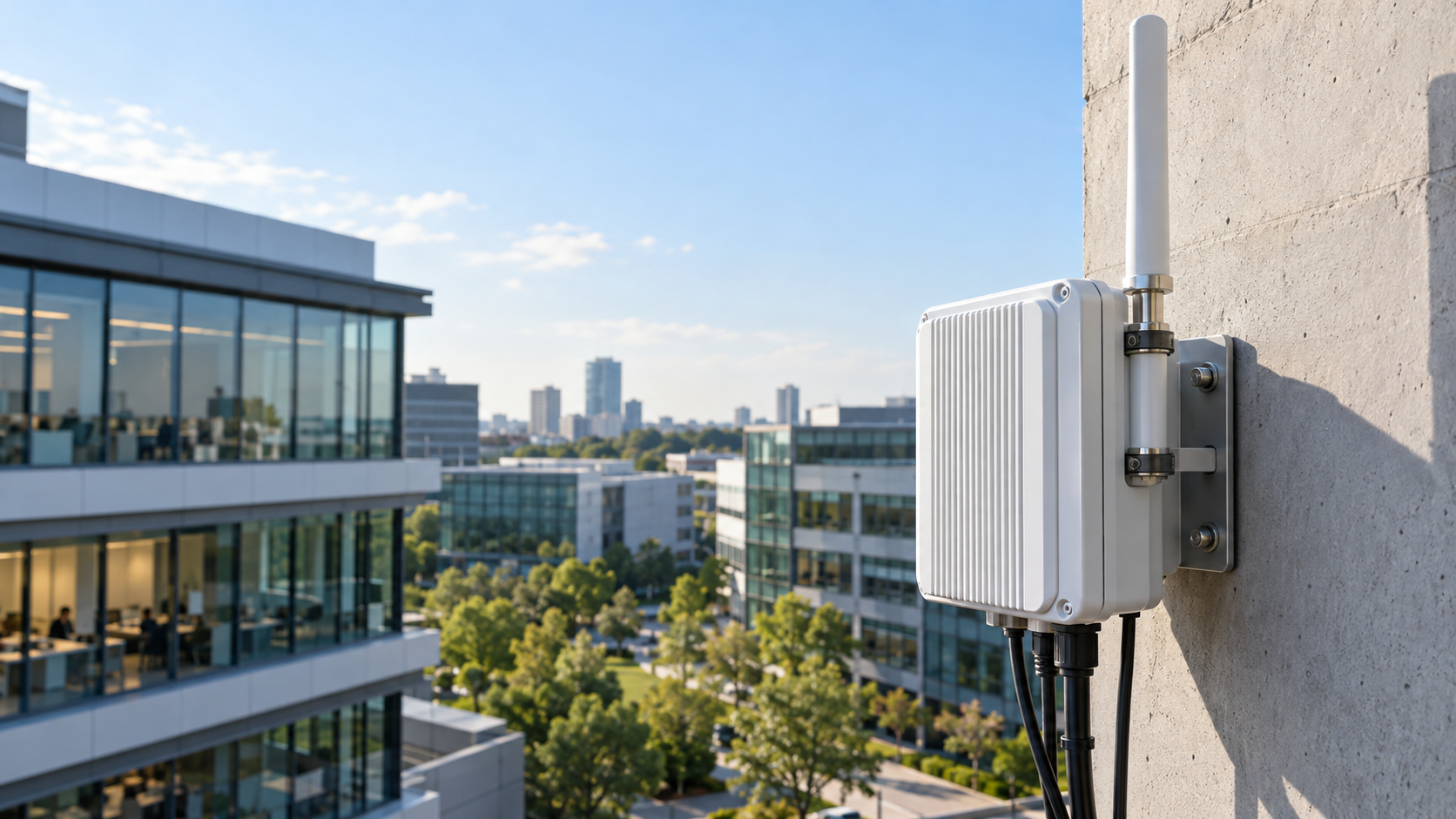
An indoor lorawan gateway suits shops, offices, clinics and server rooms. An outdoor lorawan gateway suits warehouses, yards, campuses and car parks, where it can be mounted externally with a larger antenna and weather protection.
The choice is less about radio and more about mounting. Outdoor units cost more and need an installer comfortable with roofs and masts, but they cover a yard or multi-building campus that no indoor unit would reach. Many sites use both: an outdoor unit for the grounds and loading areas, indoor units for the rooms with cold storage or sensitive stock. The current models are in the LoRaWAN gateways collection in the Vemco shop.
Regional bands: buy sensor and gateway for the same region
The LoRa radio band is regional. Europe and the United Arab Emirates use EU868, North America uses US915. A sensor built for one band cannot talk to a gateway built for another, so every order for a new country needs the region checked on both sides.
This catches chains that centralise purchasing. A pallet of sensors bought for the European estate will sit silent in a North American store. Vemco Group works in 98+ countries, and the regional band question is the first thing checked on any cross-border rollout.
Common mistakes with LoRaWAN gateways
- Hiding the gateway in a metal rack or comms cabinet. It is tidy for IT and terrible for radio. Mount it outside the cabinet, high and clear.
- One gateway for a whole building that contains cold rooms. The insulated panels are exactly what blocks the signal.
- No plan for when the internet line is down. Decide in advance whether a mobile data backup is justified and what alarm should fire when a gateway goes quiet.
- Mixing regional bands across an estate.
- Assuming every sensor model stores readings and sends them later. Many do not. If the gateway was offline, those readings are gone, which matters for audit logs.
A gateway alone shows nothing
The value comes from the platform that turns readings into dashboards, alerts and logs. The Vemco platform takes LoRaWAN sensors, so temperature, humidity, leak, door, CO2 and occupancy sensors from partners such as Milesight and Elsys report into the same platform as people counting.
Alerts can go out as a flashing widget on the dashboard, app alerts, SMS, WhatsApp, webhooks and MQTT messages. MQTT alerts can also trigger an output on a PLC or a small controller on site, for example to switch on a lamp or a siren in a cold store corridor. Readings are available in dashboards and reports and can be passed to your own systems by REST API or CSV, which is what quality managers need for audits. Installation is done by Vemco or our certified partner, with local support in each market.
Read more about cold storage temperature monitoring and indoor air quality monitoring, or see the guide to temperature monitoring systems for cold rooms, server rooms and stores.
Frequently asked questions
What is a LoRaWAN gateway? It is the radio receiver between battery sensors and the network. It hears sensor messages on the LoRa band and forwards them over Ethernet, Wi-Fi or mobile data to a network server and then to the monitoring platform.
Does LoRaWAN require a gateway? Yes. Sensors cannot reach the internet on their own, so at least one gateway must be in range. A second one adds resilience because any gateway on the same lorawan network can receive a sensor message.
Can any LoRaWAN gateway work with any LoRa sensor? Only if both are built for the same regional band, such as EU868 or US915, and both are registered on the same network. Band mismatches are a common cause of silent sensors.
How many LoRaWAN gateways does a building need? Start from one per building or group of floors, then test cold rooms, plant rooms, basements and stair cores. Add gateways where signal is weak rather than raising sensor power, which shortens battery life.
If you are planning a sensor rollout across several sites and want the gateway count confirmed by a real test rather than a datasheet, contact Vemco Group. With 20+ years of experience and local offices, we can run a site survey, check your regional band, and set up the platform that turns gateway traffic into alerts and audit logs you can act on.