


/global/header/smart-buildings.svg)


/global/header/facility-management.svg)






/global/header/leisure.svg)






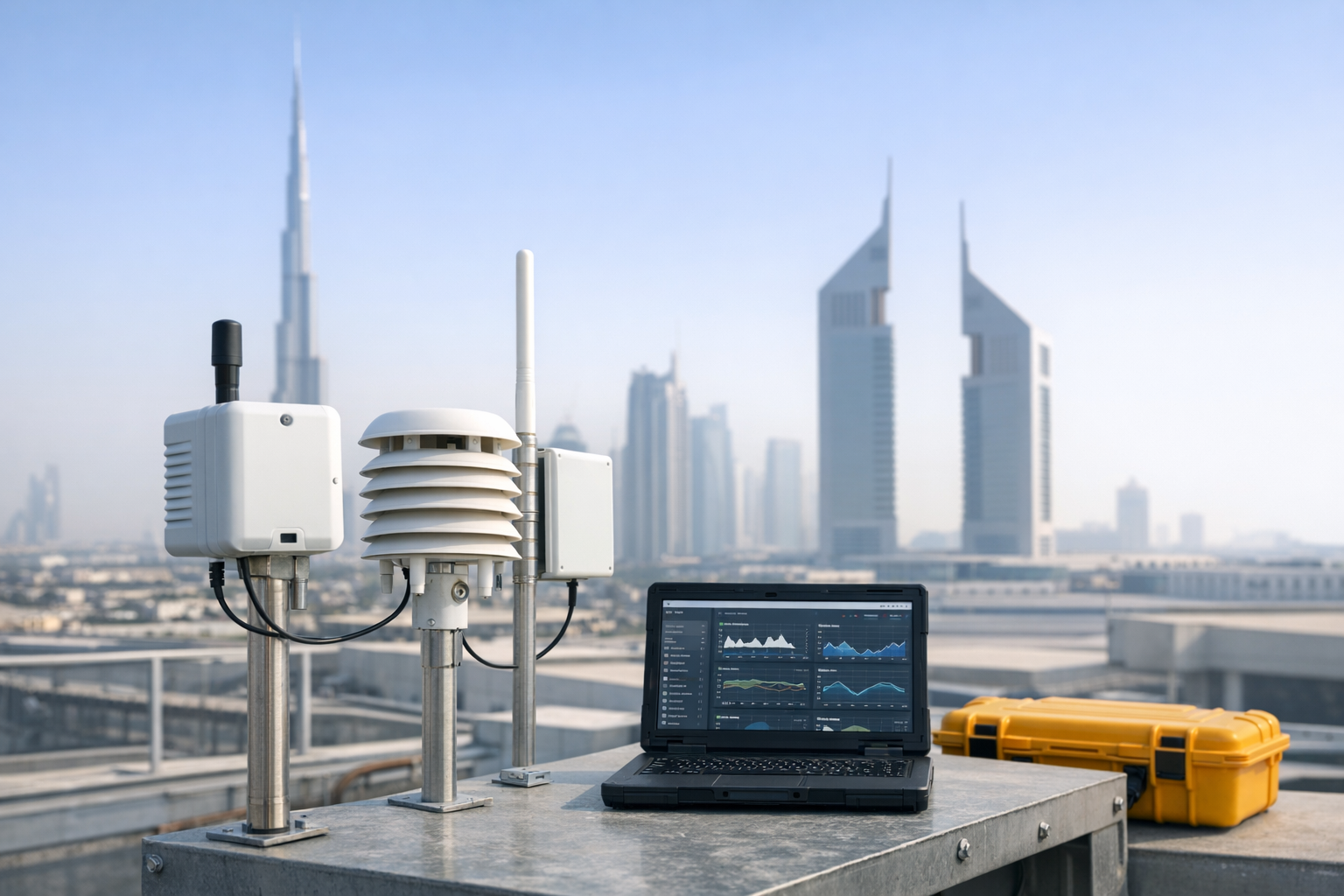
The single most expensive mistake in a LoRaWAN indoor air quality UAE deployment happens before a single sensor is mounted: someone orders the US915 or AS923 hardware variant. It ships, it clears nothing, and it sits in a Jebel Ali warehouse while the project deadline burns. The UAE runs LoRaWAN on the EU868 band under TDRA short range device regulations aligned to EN 300 220. Order the wrong regional variant and you have hardware that cannot be type approved and cannot legally transmit — full stop. There is no waiver process for this, no firmware flag that fixes it, and no distributor who will take back 400 CO2 sensors with the wrong radio.
If you already know why indoor air quality monitoring matters — occupant wellbeing mandates, ESG reporting, HVAC optimisation in buildings that run chillers eleven months a year — this article skips that and goes straight to what decides whether your GCC deployment gets paid for or disqualified.
The regulatory sequence, in the order it actually happens
TDRA type approval is mandatory before import — not before commissioning, before import. The process takes roughly three to five weeks and the approval is valid for three years. Since 2026 there is an additional step that catches teams who last did this in 2023: a customs clearance permit aligned to the type approval. Your freight forwarder will ask for it, and if your procurement timeline assumed the old flow, you lose weeks at exactly the point in the project where you have none to spare.
Type approval covers the radio. Most electronics also need ECAS conformity from MOIAT, which covers the product as a product. These are two separate regimes with two separate document sets, and tender evaluators in government projects will check for both. A bid that attaches TDRA certificates but no ECAS conformity reads as incomplete, and in a pass/fail compliance matrix, incomplete means out.
One more thing GCC-wide bidders should internalise: this is not a UAE quirk. Regulators across the GCC operate comparable type approval and conformity regimes. The band plans and authority names differ, but the discipline is identical — verify the frequency variant, secure approval before shipment, and keep the certificates matched to the exact model numbers in your bill of materials. A sensor approved under one part number and shipped under a revised one is a customs problem waiting to happen.
RF planning: where the datasheet lies to you
Vendor datasheets quote LoRaWAN range in kilometres. Indoors, in Gulf construction, plan for roughly 150 to 300 meters through partitioned buildings — and that is with sensible gateway placement, not a gateway tucked into a comms cabinet behind two block walls. Gulf commercial buildings are dense: reinforced concrete cores, block partitions, foil-backed insulation everywhere because of the cooling load. Every one of those attenuates 868 MHz.
The special case that catches almost every first-time deployment: insulated metal-clad cold stores, data vaults and similar enclosures. Range through these drops far below the partitioned-building figure. If your scope includes a vault cluster — cold rooms in an F&B facility, secure records storage in a government building, server rooms — budget a dedicated gateway for that cluster. It costs less than the two site visits you will otherwise make chasing sensors that report intermittently at SF12, draining their batteries in the process.
A practitioner note worth its weight in variation orders: run a walk test with a field tester before you finalise the gateway count in your commercial offer, and do it with doors closed and the building in normal operating state. A cold store surveyed with its door propped open during fit-out gives you coverage numbers that vanish the day it goes live. We have seen gateway counts double between the desktop design and the door-closed survey — better to discover that during pre-sales than during snagging.
Network architecture government IT will actually approve
The fastest way to stall a deployment in a ministry or semi-government facility is to request inbound firewall openings or a VLAN on the corporate network for your gateways. The security review alone can take longer than the installation. Two architecture decisions remove the friction entirely:
- Gateways with 4G LTE backhaul. This removes any dependency on the customer network. No structured cabling requests, no change-control tickets, no waiting on the facilities team to patch a port. The gateway is a self-contained appliance from the network owner's perspective.
- Device management over an outbound-only encrypted tunnel. No inbound firewall openings means the security questionnaire gets dramatically shorter. When the IT reviewer asks "what ports do you need opened?", the answer "none" ends the meeting early — in your favour.
This architecture also protects you commercially. If sensor data stops flowing, it is unambiguously your infrastructure, not a dispute about whose firewall change broke the integration. In multi-year maintenance contracts, that clarity is worth real money.
The tender mechanics that disqualify good bids
Technical excellence does not win a government tender that fails on commercial compliance. The recurring requirements in the region are specific: ICV certification, a 10 percent performance bond issued by a local bank, prices fixed for the contract term, 120-day bid validity, and bilingual submission. Each of these has a lead time. A performance bond from a local bank is not arranged in a week if your entity has no local banking relationship. Bilingual submission means your technical proposal — including the type approval documentation narrative — needs Arabic-capable review, not machine translation pasted the night before deadline.
The fixed-price term interacts with the regulatory timeline in a way bidders underestimate: if type approval takes three to five weeks and your prices are locked for the term, currency movement and component pricing risk sit entirely with you during that window. Bake it into the margin, not into a variation request that will be rejected.
Why local delivery capability decides these projects
Every issue above — customs permits, walk tests, bond issuance, bilingual documentation — is easier with feet on the ground. Vemco maintains a delivery team in Dubai and runs platform deployments across Abu Dhabi and the wider Gulf, including Abu Dhabi Parks, ADNOC and Sheikh Zayed Grand Mosque. Sites like these are exactly the environments where the discipline described here gets tested: high-profile clients, strict IT governance, and zero tolerance for hardware sitting in customs. Where air quality sensing is combined with people counting in the same platform, we quote counting accuracy honestly — a contractual minimum of 96%, typically 98–99% when lighting, layout and visitor behaviour allow — because a guaranteed flat number nobody can audit is exactly the kind of claim that unravels at acceptance testing.
The pattern across every failed LoRaWAN tender we have reviewed is the same: the radio and the regulator were treated as afterthoughts to the dashboard. Reverse the order. Get the band right, get the approvals sequenced, survey with doors closed, keep the gateways off the customer network — and the dashboard takes care of itself.
Planning a LoRaWAN indoor air quality deployment in the UAE or wider GCC, or preparing a tender response where type approval timelines and EU868 hardware sourcing are on the critical path? Talk to Vemco's Dubai delivery team at vemcogroup.com/contact-us — we will review your gateway plan, compliance documentation and bid timeline before they cost you the contract.