

/global/header/smart-buildings.svg)


/global/header/facility-management.svg)






/global/header/leisure.svg)







Here is a pattern we see constantly in smart building projects: a facility team installs a fleet of excellent sensors, the dashboards light up, and six months later nobody trusts the numbers. Not because the sensors are bad, but because a single sensor type was asked to answer questions it was never designed for. A ceiling-mounted people counter cannot tell you which desks are occupied. A desk sensor cannot tell you how many people entered the building. A CO2 sensor can tell you a meeting room is stuffy, but not whether that is because eight people are in it or because the ventilation failed. Each technology measures one thing well, and the failure mode is always the same — stretching it beyond its domain.
Three questions, three sensor domains
Every serious workplace or building programme eventually needs answers to three distinct questions. How many people are in the building or on a floor right now? Which spaces — desks, rooms, zones — are they actually using? And are those spaces healthy and comfortable to be in? These map cleanly onto three sensor categories, and no single category covers more than one of them well.
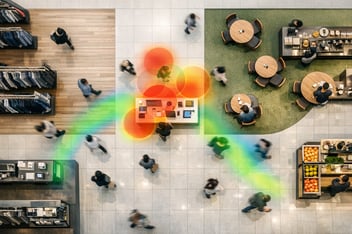
Flow: 3D stereo people counters. Devices such as Xovis sit above entrances and zone transitions and count people crossing a virtual line, tracking direction and filtering out trolleys, children below a height threshold, or staff wearing identifiable tags. Accuracy here is contractual, not aspirational: Vemco commits to a minimum of 96 percent counting accuracy, and in practice installations typically run at 98 to 99 percent when lighting, layout and visitor behaviour allow it. That distinction matters when you write it into an SLA — a vendor promising a flat 99 percent regardless of conditions has not audited enough sites.
Presence and environment: LoRaWAN sensors. Devices from Elsys and Milesight cover desk presence, room presence, CO2, humidity, temperature, and door and window state. Their economics are the opposite of stereo counters: low unit cost, multi-year battery life, and no cabling. That last point is decisive at scale. Retrofitting PoE cabling to 400 meeting rooms in a listed building is a capital project with landlord approvals; deploying 400 battery-powered LoRaWAN sensors is a few days of work with a lift and a barcode scanner.
What neither can do alone. A Xovis counter knows 240 people entered floor three but has no idea whether they are clustered in two team areas or spread evenly. An Elsys desk sensor knows desk 3.041 is occupied but says nothing about total floor load, which is what your fire officer and your catering contract actually reference. A Milesight CO2 sensor reading 1,400 ppm is an alarm without context — pair it with presence and footfall data and it becomes a ventilation-per-occupant metric you can act on.
The combination is where the value sits
Put the three layers into one platform and the questions you can answer change in kind, not just in degree:
- Occupancy vs. utilisation. Footfall gives you the denominator (people in the building), presence gives you the numerator (spaces in use). A floor at 60 percent headcount capacity with 30 percent desk utilisation tells you people are there but working somewhere other than their assigned desks — a space design finding, not a headcount finding.
- Comfort correlated with load. When CO2 and temperature data sit alongside real-time occupancy, you can tune HVAC setpoints to actual demand rather than schedules, and prove to the sustainability team which floors can safely run reduced ventilation on quiet days.
- Trustworthy right-sizing decisions. Lease decisions worth millions get made on this data. A single sensor type gives you one biased view; triangulated data from independent technologies gives you numbers that survive a CFO's scrutiny, because footfall, presence and environmental readings cross-validate each other.
Sensor-agnostic is an architecture decision, not a slogan
For IT and integration architects, the real question is not which sensor to buy but which platform assumption to make. Committing to a single-vendor stack means every future space type — a new canteen, a bike storage room, an outdoor terrace — must be forced through that vendor's product catalogue, whether or not it fits. A sensor-agnostic smart building platform inverts this: the platform normalises data from whichever sensor suits each space, and procurement stays competitive for the life of the building.
This is how Vemco has built its platform. It integrates Xovis, Milesight, Elsys, Hikvision, Axis and Irisys into one data layer, so a customer can run Xovis stereo counters at main entrances, Irisys or Axis devices where the existing estate already has them, and Elsys or Milesight LoRaWAN sensors across desks and rooms — all landing in the same dashboards and the same API. Nobody is ever locked to one vendor's roadmap or one vendor's pricing at contract renewal.
Scale and latency matter here too. The Vemco platform counts more than 60 million people every day across 55,000+ installations in 98+ countries, with data hosted on AWS in EU Frankfurt — relevant for anyone whose DPO asks where occupancy data physically lives. Latency from a person crossing a counting line to the event appearing on a dashboard is around 2 seconds, which is what makes live occupancy displays and capacity alerts feasible rather than theoretical.
What implementers learn the hard way
One thing rarely mentioned in vendor material: your sensor mix will drift after go-live, and that is fine — if the platform allows it. In almost every deployment we have seen, the initial floor plan assumptions are wrong somewhere. A "quiet zone" turns out to be a thoroughfare; a meeting room booked solid in Outlook shows near-zero presence because people ghost their bookings. The teams that succeed treat the first three months as calibration: they move sensors, add a counter to an unexpected pinch point, and swap desk sensors into rooms. If your platform only speaks one vendor's protocol, every one of those corrections becomes a procurement exercise. If it is sensor-agnostic, it is a Tuesday afternoon.
A second practical note: budget the LoRaWAN gateway placement survey before ordering sensors, not after. Concrete cores and server rooms create dead spots that a fifteen-minute walk-through with a field tester will catch and a floor plan will not.
Where this goes next
Once footfall, presence and environmental data flow through one platform, live occupancy displays and dwell-time analysis are natural next steps — the data foundation is already in place, so extending into real-time capacity management or zone-level dwell metrics is configuration rather than a new project.
If you are weighing up a sensor strategy for an office portfolio, a campus or a mixed-use building, talk to us before you commit to a single vendor's stack. We will walk you through which sensor fits which space — Xovis at entrances, Elsys and Milesight across desks and rooms, or integrations with the Hikvision, Axis or Irisys devices you already own — and show what the combined data looks like in one platform. Contact Vemco Group here to start the conversation.