


/global/header/smart-buildings.svg)


/global/header/facility-management.svg)






/global/header/leisure.svg)






A single miscounted door on a Saturday can throw off a whole month of conversion reporting. If your entrance counter runs 4% high because it double-counts staff on breaks, every conversion rate you present to the board is quietly wrong — and nobody notices until a store manager disputes the numbers. That is the real reason accuracy is a contractual matter at Vemco, not a marketing adjective. When you count more than 60 million people a day across 98+ countries, small percentage errors compound into decisions worth serious money.
So it is worth being precise about what the guarantee actually is. Vemco commits to a contractual minimum of 96% accuracy, with real-world performance typically landing at 98–99% when conditions allow. That last clause matters more than the headline number. Lighting, store layout and visitor behaviour all move the result, and any vendor quoting a flat 99% for every site is quoting a lab, not your entrance.
Why the sensor decides everything downstream
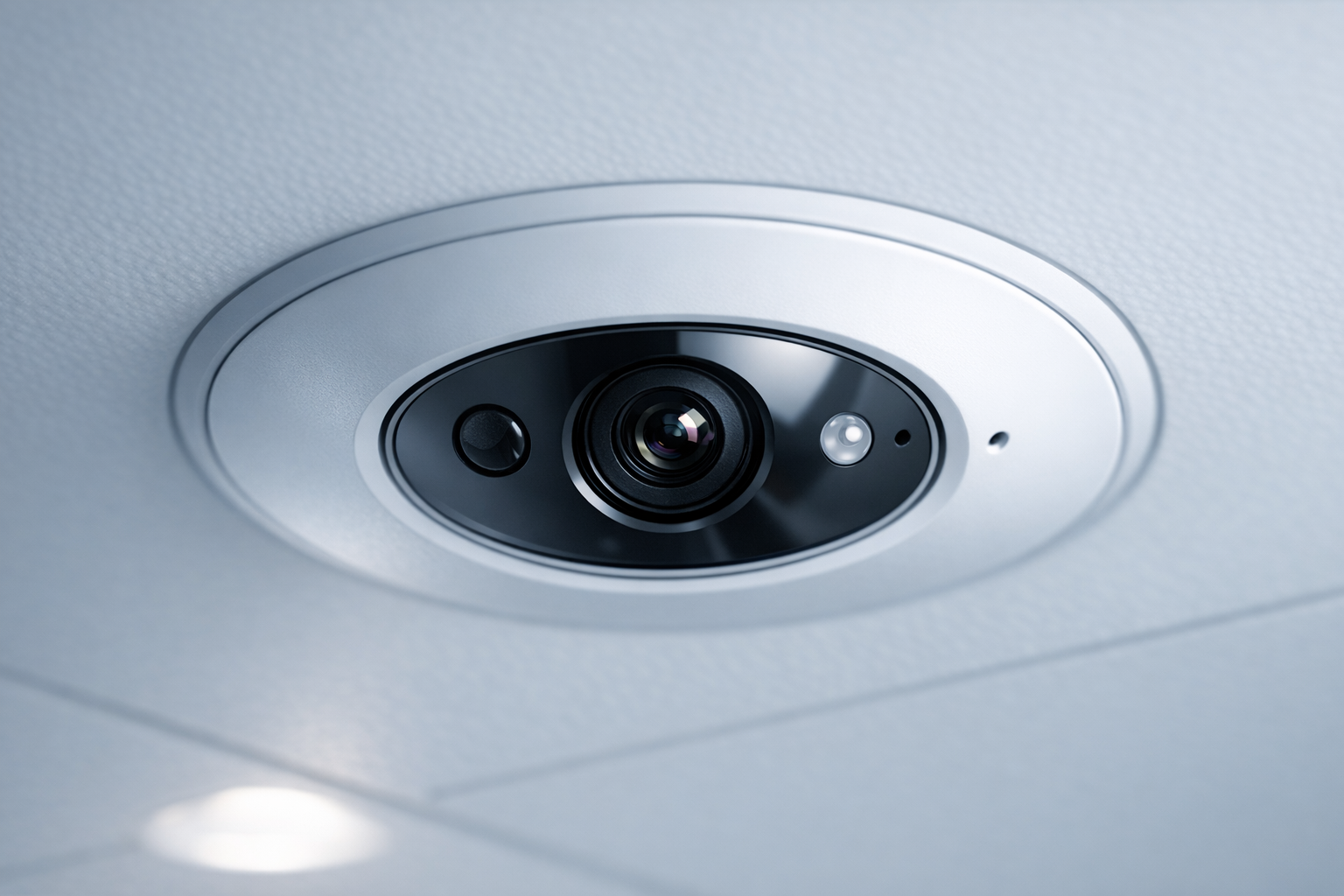
Counting accuracy is set at the ceiling, literally. Vemco works with 3D stereo-vision sensors from partners including Xovis, alongside Milesight, Hikvision and AXIS hardware. The 3D approach is what separates a reliable count from a guess. A flat 2D camera sees a shape crossing a line; a 3D sensor sees height and volume, so it can tell an adult from a child, a person from a shopping trolley, and two people walking close together from one wide silhouette. Vemco's work here isn't theoretical — it earned the Xovis Golden Sensor Award, which is handed out for deployment quality, not attendance.
The height dimension also handles the two errors that quietly destroy footfall data:
- Occlusion — groups entering shoulder to shoulder, which 2D systems merge into one count.
- Loitering and reversal — people who step in, stop, and step back out, which naive line-crossing logic counts as a full entry.
Placement is not a formality
Here is the practitioner observation most procurement decks skip: the single biggest accuracy variable is mounting height and angle, and it is decided in the first hour of installation. A sensor set 20 centimetres too low, or aimed at a doorway with hard afternoon sun behind it, will underperform no matter how good the algorithm is. Reflective floors near the entrance create phantom detections. Automatic sliding doors, if included in the detection zone, get counted as movement. None of this shows up in a spec sheet — it shows up three weeks later when a regional manager asks why one store's traffic looks impossible.
This is why the 96% figure is written as a minimum rather than a target. It sets a floor that survives imperfect sites, while the 98–99% typical range reflects what disciplined placement and calibration actually deliver. When you're negotiating a contract, that distinction is the part to read carefully.
Accuracy across the module stack
Counting is only the first data layer, and each Vemco module inherits or builds on the accuracy of the layer beneath it. VemCount handles counting, occupancy and demographics. VemTrack reconstructs in-store journeys, detects queues, and uses AI Re-Identification to follow the same visitor across multiple sensors without collapsing two people into one path — a harder problem than counting a doorway, because it depends on matching, not just detecting.
From there the numbers feed decisions rather than dashboards. VemTenant gives landlords tenant-level sales and performance benchmarking, where a 2% counting drift becomes a rent-negotiation argument. VemSpace turns occupancy into space-utilisation planning. And VemFusion connects the count data to POS, BI, ERP and CRM systems — which is exactly where inaccuracy gets expensive, because a wrong footfall figure multiplied against POS revenue produces a conversion rate that looks authoritative and is completely misleading.
How the guarantee is actually verified
A guarantee means nothing without a method to check it. The standard approach is manual validation: a person physically counts entries for a defined window — typically the busiest trading hours, not a quiet Tuesday morning — and that ground-truth count is compared against the sensor's output. The comparison has to cover peak traffic, because that is when occlusion and grouping stress the system hardest. A device that reads 99% at 10am and 92% at Saturday lunchtime does not meet a 96% minimum; it fails when it matters.
For IT directors, the operational side is straightforward but worth confirming during procurement:
- Ask how validation is scheduled and who signs off on the result.
- Confirm what happens if a site falls below the minimum — recalibration, remounting, or sensor replacement.
- Check that demographic and journey data are validated separately, since they have different error profiles than raw counts.
Why the track record is part of the science
Accuracy at scale is a different discipline from accuracy in one shop. Vemco has been at this since 2005, now with 55,000+ installations in 98+ countries, and that volume is what refines the calibration logic — every difficult site, every unusual doorway, every lighting edge case feeds back into how the next installation is configured. The 2025 acquisition of TecBrain, a Spanish property-software company founded in 1995, extends that reliability into property and lease workflows through VemLease, where the same count data underpins commercial decisions landlords cannot afford to get wrong.
The point for anyone signing the contract is simple: the 96% minimum is not a promise you take on faith. It is a floor backed by 3D hardware, deliberate placement, peak-hour validation, and two decades of correcting the mistakes that only show up in the field.
If you want to see how the accuracy guarantee applies to your specific store layouts, entrance types and reporting requirements — including how validation would be scheduled across your estate — talk to the Vemco team here and ask them to walk through the numbers against your sites.