

/global/header/smart-buildings.svg)


/global/header/facility-management.svg)






/global/header/leisure.svg)






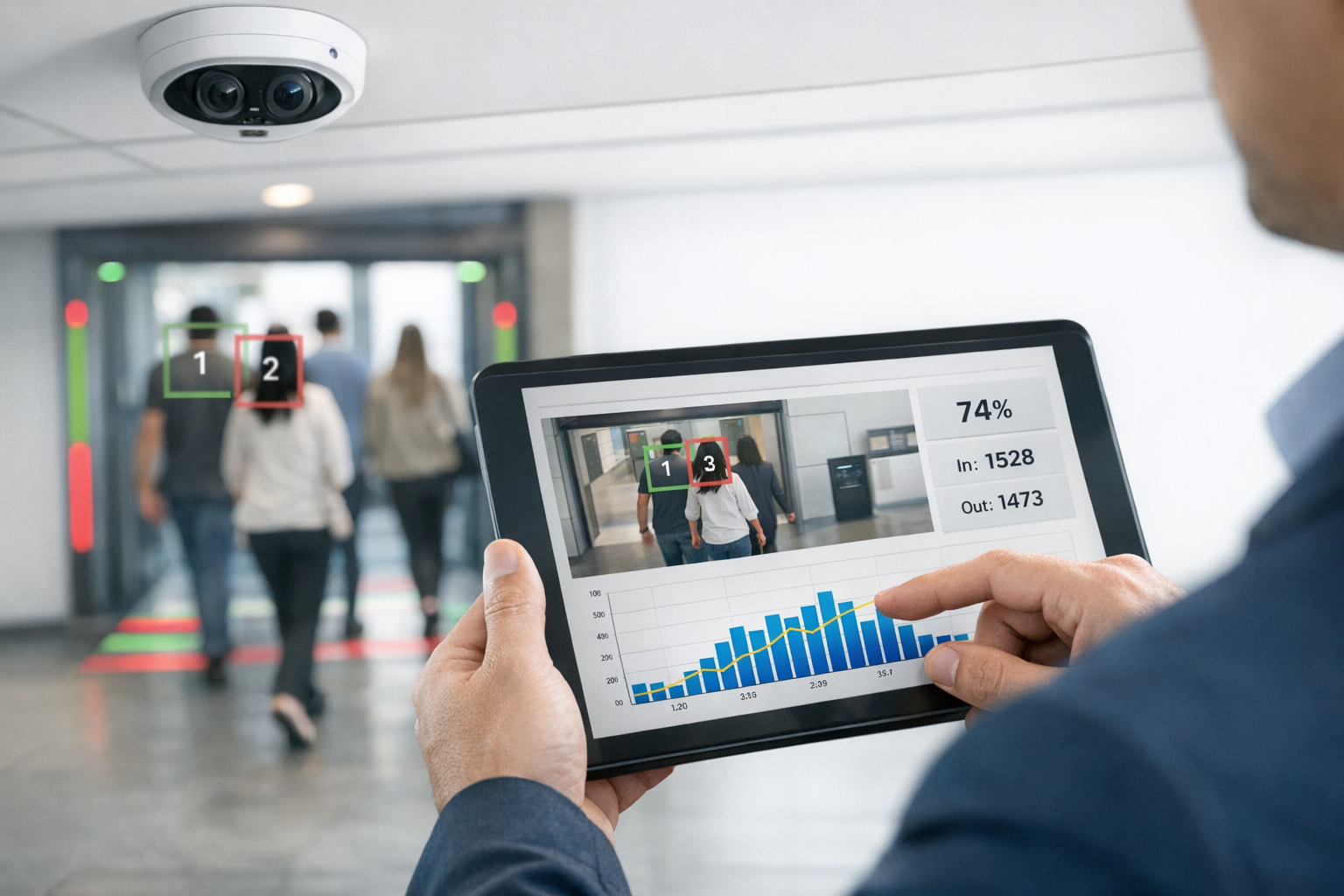
How accurate are 3D people counting sensors? A correctly installed 3D stereo or time-of-flight sensor typically counts 98 to 99 percent of the people passing under it. Vemco Group writes accuracy into the contract for its Vemcount platform: a minimum of 96 percent, typically 98 to 99 percent, verified against manual counts at your own entrances.
A two-percentage-point accuracy gap sounds trivial until you run the arithmetic on a flagship store. At 8,000 daily visitors, the difference between 96% and 98% accuracy is roughly 160 miscounted people per day — over 58,000 per year, per entrance. If your conversion rate hovers around 20%, that error margin is large enough to make a good week look flat, or to justify a staffing decision that was never needed. Accuracy is not a spec-sheet detail. It is the foundation every downstream metric — conversion, sales per visitor, tenant benchmarking, cleaning schedules — quietly inherits.
What accuracy numbers actually mean (and how vendors bend them)
Most buyers have seen "99% accurate" on a datasheet. Fewer have asked: accurate against what, measured how, and under which conditions? There are three common ways the number gets softened. First, lab conditions — single-file traffic, ideal ceiling height, controlled lighting. Second, net error masking, where undercounts and overcounts cancel each other out so the daily total looks right even though individual counts are wrong (this destroys interval-level data like hourly conversion). Third, cherry-picked test windows that avoid peak congestion, when accuracy is hardest to maintain and most valuable.
Honest vendors distinguish between contractual and typical performance. Vemco Group, for example, commits to a contractual minimum of 96% and typically delivers 98–99% when conditions allow — lighting, store layout, and visitor behaviour all being factors that no software can fully control. That framing matters: a vendor who guarantees a flat 99% regardless of your entrance geometry is telling you they have not seen your entrance.
The five conditions that decide your real-world accuracy
After enough deployments across malls, high-street retail, and transport hubs, the same variables show up again and again:
- Ceiling height and mounting position. Sensors have optimal ranges. A 3D stereo sensor mounted at 6 metres in an atrium behaves very differently than at 3 metres over a standard doorway. Wide entrances often need multiple sensors with stitched coverage — and stitching zones are where counts leak.
- Lighting volatility. Glass façades produce hard shadows and glare that shift by hour and season. 3D and AI-based sensors such as Xovis handle this far better than legacy thermal or beam counters, but "better" is not "immune."
- Visitor behaviour. Groups walking abreast, children weaving between adults, people lingering in the count zone with a pram or trolley. Modern AI sensors can separate children from adults and classify age and gender, which also cleans up counts that toddlers used to inflate or escape entirely.
- Staff traffic. In a store with 15 employees crossing the entrance zone 20 times a shift, staff can represent 5–10% of raw counts. Staff-exclusion algorithms that filter employees out of visitor totals are not a luxury feature — without them, your conversion rate is structurally understated every single day.
- Entrance architecture. Revolving doors, side-by-side in/out flows, and entrances that double as mall corridor pass-throughs each require specific zone configuration. Pass-through traffic in mall-facing stores is the single most common cause of inflated counts.
A practitioner's note: the calibration nobody budgets for
Here is what rarely appears in RFPs: accuracy is not a state, it is a maintenance discipline. A sensor validated at 98% in March can drift by autumn — a new promotional gondola placed under the count line, a seasonal decoration hanging in the detection zone, a repainted floor changing contrast for older sensor types, or simply a bumped mount after ceiling work. The implementers who deliver consistently accurate estates all do the same thing: they schedule re-validation after any store refit and run automated data-health checks that flag anomalies (zero-count hours during opening time, sudden in/out asymmetry) before anyone builds a quarterly report on bad data. If your current provider has never asked what changed in your store layout, that silence is a finding.
How to validate accuracy yourself — a method that holds up
Do not accept a vendor's own test as final acceptance. Run this instead:
- Manual ground truth: record video of the entrance (or count live with two people cross-checking) for at least 300 in/out events, including one peak period. Small samples flatter everyone.
- Compare per direction, per interval: match sensor counts against manual counts in 15-minute blocks, in and out separately. This exposes net-error masking immediately.
- Test the hard cases deliberately: walk through in a tight group of three, carry a large box, push a pram, stand in the zone for 30 seconds. Watch what the sensor does.
- Repeat quarterly on a rotating sample of sites rather than validating once and never again.
Write the acceptance threshold into the contract, along with the measurement method. "96% minimum, measured per direction against manual ground truth over 300+ events including peak traffic" is enforceable. "High accuracy" is not.
Why sensor-agnostic platforms change the accuracy conversation
A structural point for IT directors: locking your analytics platform to one sensor brand means every accuracy problem becomes a replacement decision. Device-independent platforms let you match the sensor to the site — Xovis 3D AI sensors for complex, high-traffic entrances; Milesight, Hikvision, or AXIS devices where the environment is simpler or existing camera infrastructure can be reused — while keeping all data in one reporting layer that feeds your ERP or BI stack. Vemco has built on this model since 2005, now counting more than 60 million people every day across 55,000+ installations in 98+ countries, with deployment on hosted or private cloud depending on your data-governance requirements. Twenty years of that volume teaches a company exactly where counts go wrong — which is precisely the experience you are buying.
What to do with accurate data once you have it
Accuracy is the entry ticket, not the prize. Once counts are trustworthy at interval level, you can compare tenant performance fairly across a mall portfolio, tie leasing negotiations to verified footfall, staff to predicted traffic curves instead of last year's habits, and measure whether a window campaign actually pulled people through the door. Mall operators using modules like VemTenant and VemLease are effectively turning validated counts into rent-per-visitor conversations — which only works if both sides trust the number. That trust is what the 96% contractual floor exists to protect.
Ready to find out what your current counting setup is actually delivering? Vemco's team can run an accuracy assessment on your existing sensors — whatever brand — and show you where counts are leaking before you build another budget on them. Get in touch at vemcogroup.com/contact-us to arrange a site-level accuracy review.