


/global/header/smart-buildings.svg)


/global/header/facility-management.svg)






/global/header/leisure.svg)






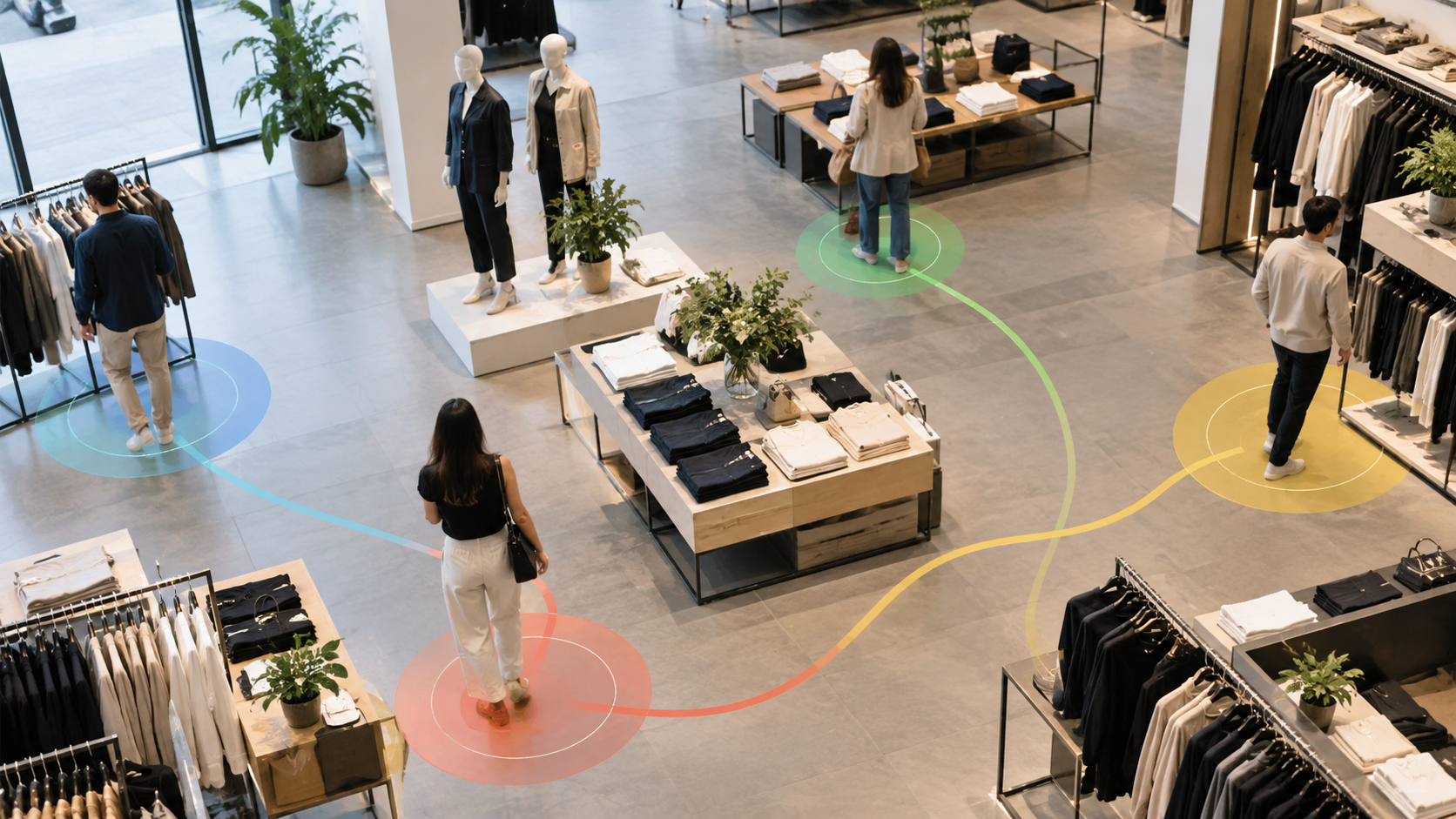
A store manager we worked with had a Saturday that looked like a win on every report she received. Traffic was up roughly a third on the previous Saturday, the floor was busy from eleven until closing, and the team went home tired. Sales were flat. Nobody noticed until Monday, because the only number anyone had been watching was the till. Her retail conversion rate had dropped sharply, and the extra visitors had walked straight back out. That gap between visitors and buyers is the entire reason conversion is worth measuring, and it is also the reason most stores measure it badly.
The formula is easy, the denominator is not
Transactions divided by visitors, multiplied by one hundred. Every retail kpis dashboard can display it. The difficulty is that the transaction count is clean and audited, while the visitor count is only as good as the way it was collected. If your denominator is inflated or deflated, every decision downstream inherits the error.
Three sources of distortion show up in almost every store we audit:
- Staff and deliveries. A team of twelve on split shifts, each stepping out twice a day, adds dozens of phantom visitors. Deliveries through the front door add more. Without staff exclusion, conversion is permanently understated.
- Groups and children. A family of four buys once. Whether you count four visitors or one buying unit changes the figure dramatically and makes comparisons between a toy store and a menswear store meaningless unless both use the same rule.
- Sensor placement. A retail traffic counter positioned where people linger in the doorway, or where a mall corridor passes close to the threshold, will register passers-by as entries.
Counting accuracy itself matters, but be realistic about what the number means. A contractual minimum of 96% is the standard we commit to, and in practice 98 to 99% is typical when lighting, layout and visitor behaviour allow it. The point is not that a few percentage points of counting error ruin the metric. It is that undisclosed, unmeasured error does, because you cannot tell whether a change in conversion is real.
A daily conversion rate hides the decision
Here is the observation that most implementers learn in their first month and most executives never hear. Daily conversion is an average of wildly different hours, and the average is almost never where the money is. A store can hold a respectable daily figure while converting poorly in exactly the two hours that carry forty percent of its traffic. Lunchtime on weekdays and early afternoon on Saturdays are the usual culprits, and the cause is nearly always the same: those are the hours when breaks are scheduled, when replenishment arrives, or when the one person who knows the product range is off the floor.
Plot conversion by hour against labour hours by hour and the mismatch becomes visible within a week. Luksusbaby used VemCount to watch conversion in real time rather than in a weekly report, which is what turned the figure from a retrospective score into a reason to move a colleague from the stockroom to the floor before the hour was lost.
One more trap for commercial teams: a rising conversion rate is not automatically good news. If traffic is falling and only the committed buyers remain, conversion climbs while revenue drops. Always read conversion rate retail figures next to the raw foot traffic data, never in isolation.
The four numbers that belong on the same page
Conversion only explains itself in company. Put these side by side, by store and by hour, and the story usually writes itself.
- Footfall, so you know whether the opportunity grew or shrank.
- Conversion rate, so you know how much of that opportunity the store captured.
- Average transaction value, so you can separate a selling problem from a basket problem.
- Sales per visitor, which combines the last two into the single figure most useful for comparing stores of different size.
Sales per visitor deserves more attention than it gets. Two stores with identical sales per square metre can have opposite problems: one with heavy traffic and poor conversion, the other with low traffic and excellent conversion. The first needs floor coverage and product knowledge. The second needs marketing and a better location strategy. Sales per square metre tells you neither.
Where inside the store is conversion lost?
A door count tells you how many people came in. It does not tell you whether they reached the back wall, whether they picked something up, or whether they joined a queue and abandoned it. That is the job of customer journey analytics. VemTrack adds movement and zone data on top of entrance counting, using anonymous AI re-identification so a visitor can be followed from entrance to department to till without identifying them. Combined with retail heat mapping, this shows which displays draw people and which aisles are effectively dead space.
The practical payoff is a second kind of conversion: zone conversion. If sixty percent of visitors reach the fitting rooms and purchase at a high rate once they do, the lever is getting more people to the fitting rooms, not training the till staff. If a promotional table at the entrance stops people for a moment but they then leave, the table is doing the opposite of its job. These are layout decisions, and they are far cheaper to test when you can measure the result in days rather than wait for a quarter's sales.
Conversion across channels, not just across doors
For a chain, the honest conversion picture includes the website. A shopper who researches online and buys in store lifts store conversion; one who tries in store and orders online depresses it. Treating the two as separate businesses punishes exactly the stores doing the best job of serving omnichannel customers. Daells Bolighus brought in-store sales, online sales and visitor data together across its locations during a turnaround, which meant store performance could be judged on the whole customer rather than on whichever till happened to ring. For executives weighing closures or investment, that distinction can change the decision.
A working cadence for conversion
Measurement without a routine decays into wallpaper. The pattern that holds up in practice is short and unglamorous. Store managers look at yesterday's hourly conversion each morning and adjust today's break schedule. Area managers compare stores weekly on sales per visitor and ask the two lowest what changed. Commercial teams review conversion by zone monthly when deciding what to put where. Marketing checks whether campaign weeks moved footfall, conversion, or neither, and uses visitor demographic data to confirm the campaign reached the age and gender mix that actually walks through the door. A retail analytics platform earns its cost when it fits into those four meetings rather than creating a fifth.
Frequently asked questions
How to increase foot traffic in a retail store? Start by measuring which hours and which days are weak, then target those windows with local campaigns, events or extended opening rather than spending evenly across the week. Use demographic data to check that your marketing matches the people actually visiting, and compare footfall against conversion afterwards so you know whether new visitors are buying or just browsing.
How to measure foot traffic in a store? Install a sensor at each entrance, configured to exclude staff and to apply a consistent rule for groups and children, and validate it against a manual count during the first weeks. Report the result by hour, not by day, and store it alongside transaction data so conversion can be calculated automatically rather than reconstructed later.
If your conversion rate is a monthly number nobody argues about, it is probably not doing any work. Talk to us about measuring it hourly, by zone and across channels, and about what your stores could do differently once they can see it: vemcogroup.com/contact-us.