








A regional shopping centre we worked with had visitor counters at all nine entrances. On paper, the installation was complete. In practice, two of the sensors had been counting the glass-door reflection as a person since the previous summer, one had been knocked out of alignment by a cleaning lift, and the main entrance unit was double-counting every pram and trolley. The monthly footfall report had looked plausible the entire time. Nobody questioned it, because nobody knew what the right number should have been.
That is the real risk when choosing a visitor counter. The failure mode is rarely a device that stops working. It is a device that keeps producing numbers that are quietly wrong, feeding rent negotiations, staffing models and safety decisions for months. So the selection question is not "which sensor is most accurate on the spec sheet" but "which combination of sensor, placement and software will tell me when it is wrong."
Start with the entrance, not the catalogue
Three physical questions decide most of the technology choice before any vendor is called:
- How wide is the opening? A 1.8-metre shop door and a 12-metre mall atrium entrance are different engineering problems. The second needs either a multi-sensor array stitched into one counting line or a wide-angle 3D unit mounted high enough to cover the span.
- What is the ceiling height? Stereo and time-of-flight sensors have a mounting range. Below roughly 2.5 metres or above 6 to 8 metres you are into special cases, and a venue with a glass roof or exposed services may need brackets, not just a mounting plate.
- What does the light do across the day? West-facing glass frontages produce afternoon glare and long shadows. 2D video analytics suffer here; 3D stereo and ToF sensors largely do not, which is why they dominate serious installations.
Walk the site with these three questions and you will usually have ruled out half the market before reading a single datasheet.
Sensor types and where each one earns its place
Infrared beam counters are cheap and still sold in volume. They cannot separate two people walking abreast, they cannot tell direction reliably, and they count a staff member going out for a cigarette break four times a shift. For a single-door kiosk where you want a rough trend, fine. For anything that feeds a decision with money attached, no.
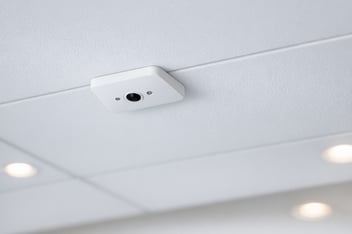
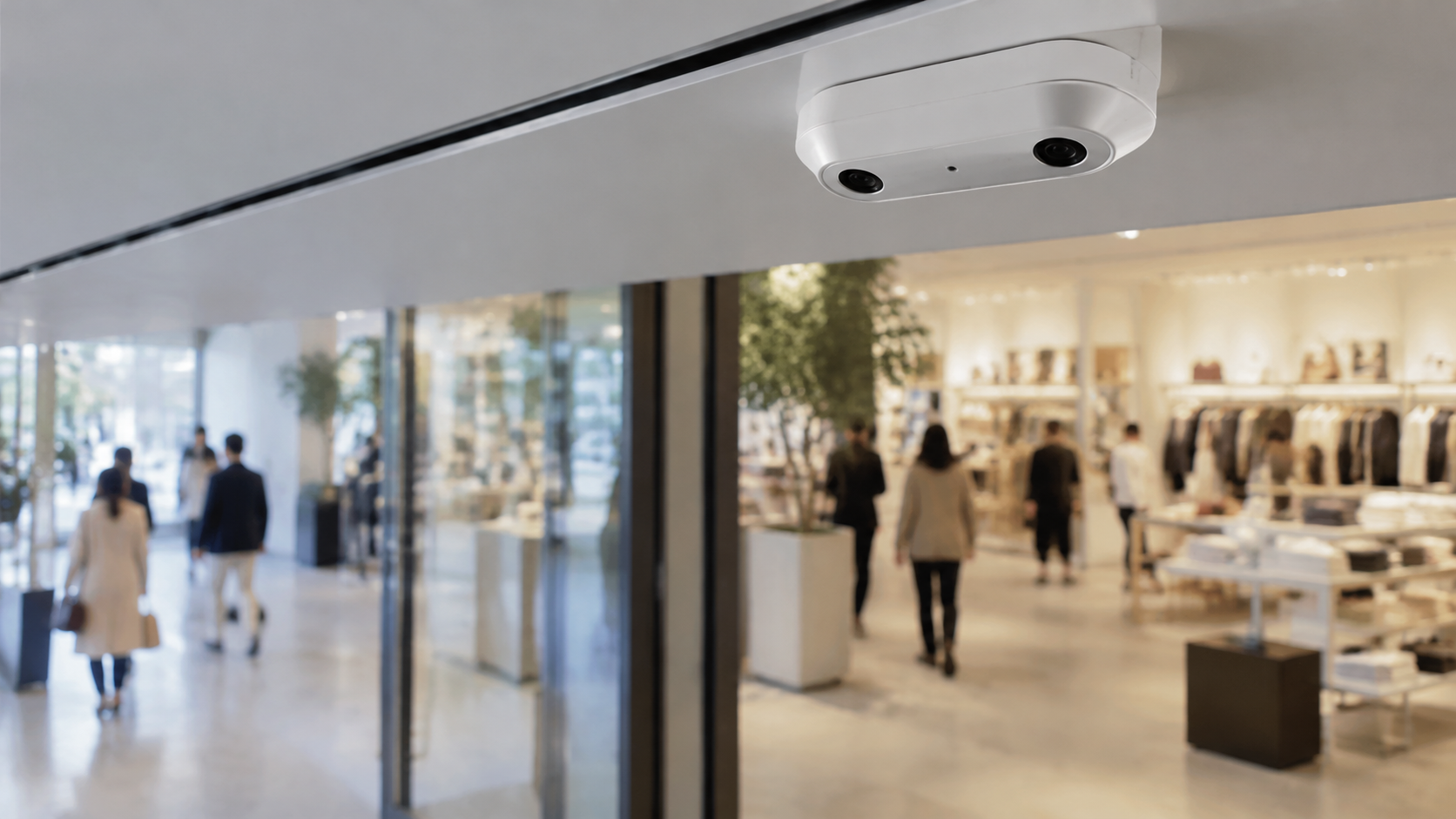
3D stereo sensors, such as the Xovis units Vemco deploys as a Xovis GOLD partner, use two lenses to build a depth map. They distinguish adults from children by height, ignore shopping trolleys, track direction, and hold accuracy under mixed lighting. This is the default choice for retail and mall entrances. Time-of-flight sensors from manufacturers like Milesight work on a similar principle with a single emitter and are often the more economical option for narrower openings and back-of-house occupancy monitoring.
AI camera analytics, available on hardware from Hikvision and AXIS among others, add attribute estimation such as age band and gender. Useful for a flagship store deciding on window displays; largely irrelevant for a library deciding whether to open a second entrance on Saturdays. Buy the attribute layer only if someone has already named the decision it will change.
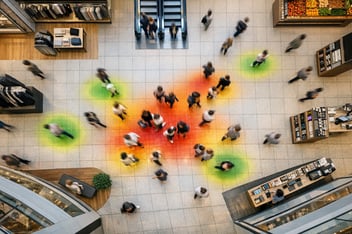
Whatever the sensor, insist that the software layer is sensor-agnostic. A mall operator with 40 entrances installed over a decade will own a mixed estate whether they planned to or not. Platforms such as VemCount normalise counts from different manufacturers into one dataset, which matters far more in year six than in year one.
What accuracy claims actually mean
Every vendor quotes a headline accuracy figure. Ask three follow-up questions. Is it contractual or marketing? Is it measured on a quiet corridor or at a Saturday-afternoon mall entrance with pushchairs and groups? And what happens when it falls below the stated figure?
Vemco's own position is instructive: a contractual minimum of 96%, with 98 to 99% typical when lighting, layout and visitor behaviour allow. The gap between those two numbers is not hedging; it is honesty about the fact that a revolving door in low winter sun behaves differently from a wide, well-lit lobby. Any supplier promising a flat 99% everywhere has not yet seen your worst entrance.
For venues and public buildings where the count feeds a fire-safety occupancy limit, accuracy has a second dimension: net occupancy drift. A sensor that is 98% accurate on entries and 98% accurate on exits can still show 200 phantom occupants at the end of a long event day because the errors do not cancel. Look for software that supports scheduled occupancy resets and flags drift, not just a sensor with a good entry count.
The staff problem nobody budgets for
Here is the observation most first-time buyers only make after go-live. In a mid-sized store with a staff entrance through the front, employees can account for 10 to 20% of raw counts: deliveries, breaks, trolley returns, managers walking the floor. Your conversion rate is therefore understated by the same margin, and your busiest-hour analysis is skewed towards shift changes.
Staff-exclusion algorithms address this by recognising repeat crossings and known patterns, and some sites supplement them with a lanyard tag or a dedicated exclusion zone. Whichever method, build it into the specification. Retrofitting staff exclusion after six months of data means either discarding that history or carrying a known bias forward.
Questions the IT director should ask
- Hosting: Is there a private-cloud or on-premise option, or is the data only available in the vendor's multi-tenant cloud? Public bodies in particular often need a documented answer.
- Privacy by design: 3D sensors should process on the device and transmit only counts and anonymised tracks, never images. Confirm this in writing and ask for the data-flow diagram.
- Integration: Does the platform expose an API and push into your POS, ERP or BI tool? A customer counter that lives in its own portal gets looked at monthly. One that puts conversion next to sales in the existing dashboard gets looked at daily.
- Health monitoring: How quickly will you know that a sensor has stopped reporting, lost alignment or started producing implausible ratios? This is the feature that would have saved the shopping centre in the opening paragraph.
That last point deserves weight. Among people counting solutions, the differentiator is increasingly not the sensor but the monitoring. VemCount, for instance, tracks sensor health across every entrance and raises an alert when a unit goes silent or its in/out ratio drifts outside expected bounds, so the gap is fixed before it reaches a report that a tenant or a board will see.
A practical shortlist process
Pick your two hardest entrances and your one easiest. Have each shortlisted supplier install there for four weeks. Run a manual validation count during peak and off-peak hours, at least two hours each, and compare. Then judge on three things: the accuracy at the hard entrances, how many unexplained anomalies appeared in the dashboard, and how long it took the vendor to notice problems you did not report. The vendor who tells you about a misaligned sensor before you do is the one to keep.
Frequently asked questions
What is the best visitor counter for a building? For most stores, malls and public buildings, a ceiling-mounted 3D stereo or time-of-flight sensor paired with sensor-agnostic software is the best starting point, because it handles direction, groups, trolleys and variable light. The right specific unit depends on entrance width, ceiling height and whether you need attribute data such as age band. Judge the whole system on validated accuracy at your hardest entrance and on how fast it reports its own faults, not on the brochure figure.
If you are specifying visitor counting for a new site or replacing a mixed estate of ageing sensors, talk to Vemco about a site survey and a four-week pilot on your most difficult entrances. We will tell you which sensor fits each opening, what accuracy to expect there honestly, and how VemCount will flag the day a unit starts counting the door instead of the people.