










A regional manager walks into a store on a Saturday afternoon, sees three staff behind the till and nobody on the floor, and asks why. The store manager says it was quiet an hour ago. Both are right, and neither can prove it. That gap between what people remember and what actually happened on the floor is the problem location analytics exists to close. Not with a dashboard for its own sake, but with a record of visits that can be set against sales, rota and lease terms and used to decide something.
Most directors reading this already own some form of people counting system. The question is no longer whether you count visitors, but whether the counts change any decision that costs or earns money. This article is about that second step.
Where the count stops being a number
A raw entrance count tells you how many people crossed a line. On its own it is a vanity figure. It becomes useful at the moment it is divided by something or compared with something:
- Visits divided by transactions gives conversion, the only honest measure of whether a store turned interest into revenue.
- Visits per hour against staff hours shows where the rota is out of step with demand, which is where the Saturday argument above gets settled.
- Entries minus exits gives live occupancy, which matters for safety limits, cleaning schedules and energy settings in a mall or large-format site.
- Visits per tenant against rent per square metre is the number a leasing team needs when a renewal conversation starts.
This is the practical definition of location analytics for a physical estate: the layer that takes sensor counts for every entrance and location and turns them into footfall, occupancy and conversion figures that other systems can act on. In Vemco's portfolio that layer is VemCount, and the reason it is built to integrate with POS, ERP and BI tools rather than live in its own portal is exactly this: the count has to sit next to the sales figure or the rota before anyone will trust it enough to act.
Footfall analytics in retail: three decisions it should drive
If your retail analytics programme cannot point to decisions in these three areas, it is reporting, not analytics.
Staffing to traffic, not to sales. Sales-based rotas reward stores that were already busy. Traffic-based rotas put people on the floor when visitors are present, including the hours where conversion collapsed because nobody was available. A director who moves from weekly to hourly footfall analytics usually finds the rota problem is not total hours but distribution within the day.
Marketing attribution. A campaign that lifts visits but not conversion has a store problem, not a media problem. A campaign that lifts neither has a media problem. Without footfall you cannot tell which, and the budget goes to whoever argues loudest.
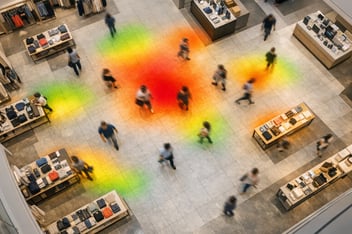
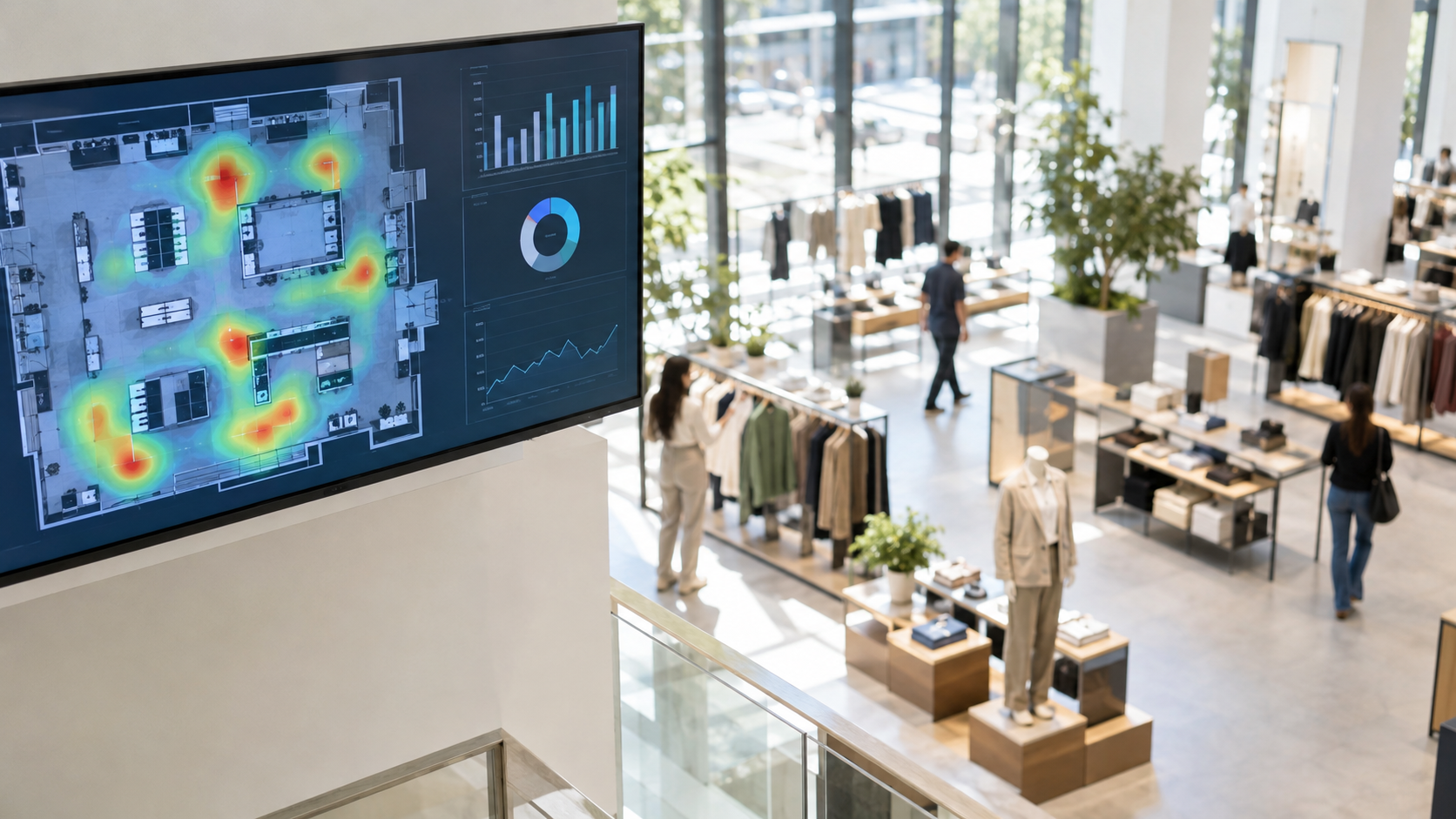
Layout and category placement. Counting at internal zones, not just the front door, shows which departments draw traffic and which are passed by. That is the evidence base for moving a category, resizing a fixture or closing a dead corner rather than relying on a merchandiser's walk-through.
For mall operators, the decision is about tenants
In a shopping centre the owner rarely sees tenant sales directly, so visits become the shared currency. Location analytics at mall level answers questions the leasing and marketing teams argue about every quarter: which entrances carry the traffic, whether a new anchor actually changed flows on the upper floor, and which units are starved of passers-by regardless of what they sell. When that data is tied to lease administration, as Vemco does through VemLease alongside VemTenant, the renewal discussion starts from a shared record rather than two competing stories.
Facility managers use the same feed for a different purpose. Live occupancy by zone sets cleaning rounds, ventilation and lighting to actual use rather than opening hours, which is one of the few places where analytics directly reduces an operating cost line without anyone selling more.
What an IT director needs to check before signing
The analytics are only as good as the counts beneath them, so three technical questions decide whether the project survives its first budget review.
- Accuracy, stated honestly. Vemco contracts to a minimum of 96% counting accuracy, and in practice sites typically reach 98 to 99% when lighting, layout and visitor behaviour allow. Anyone quoting a flat guaranteed figure regardless of site conditions is not describing a real installation. Ask how the vendor validates accuracy after go-live, not just at the sales stage.
- Staff exclusion. Employees crossing the entrance all day inflate visits and depress conversion. Staff-exclusion algorithms remove them from the count; without this, every conversion figure is quietly wrong.
- Hardware independence. A sensor-agnostic platform lets you keep existing devices and mix vendors across an estate. Vemco works with Xovis, where it holds GOLD partner status, as well as Milesight, Hikvision and AXIS, and can run hosted or in a private cloud depending on your data policy.
Where AI sensors are deployed, age and gender estimation and separating children from adults add a demographic layer. Treat that as an enrichment to footfall, not a replacement for it; the count is the base the rest is built on.
A note from the field
One thing implementers learn early: the first weeks after a people counting system goes live are spent arguing about whether the numbers are right, and that argument is won or lost on entrance placement, not software. Doors near escalators, open-fronted units where the threshold is ambiguous, and entrances that double as staff routes all need a decision about where the counting line sits before the sensor is mounted. Agree that line with the store or centre team in writing, walk it together, and the later disputes about conversion mostly disappear. Skip it and you will recalibrate for months.
Frequently asked questions
What is location analytics? Location analytics is the practice of measuring how people use a physical space, such as a store, mall or building, and turning that into decisions on staffing, layout, marketing and leasing. In retail it typically starts with footfall and occupancy counts and is combined with sales, rota and lease data to produce measures such as conversion rate and visits per tenant.
What data does location analytics use? The core input is sensor-based people counting at entrances and internal zones, giving entries, exits and live occupancy. This is enriched with POS transactions for conversion, staff schedules for productivity, lease records for tenant performance, and optionally demographic estimates such as age group and gender from AI sensors.
If you have counts but not decisions, that is usually a fixable problem of integration and counting-line discipline rather than new hardware. Talk to Vemco about reviewing your current footfall setup and mapping it to the staffing, layout and leasing decisions your teams actually make.