

/global/header/smart-buildings.svg)


/global/header/facility-management.svg)






/global/header/leisure.svg)







A 20 by 20 foot booth at a major US show now runs to around 250,000 USD all in. That works out to more per square metre, per day, than almost any retail location on earth — and yet most exhibitors can tell you exactly how many badge scans they collected while having no idea how many people walked past their quarter-million-dollar build and kept walking.
That gap is not a rounding error. It is the difference between measuring the outcome of your sales conversations and measuring whether the stand itself did its job. Badge scans count the people your team talked to. They never count the denominator: everyone who passed the aisle and didn't turn in, and everyone who entered, circled the demo, and left before anyone said hello. Without that denominator, you cannot answer the questions your CFO will actually ask. Did the stand attract? Did the layout work? Was the second demo station worth its square metres?
Bigger bets, fewer shows, same blind spot
The strategic context makes the blind spot worse, not better. Exhibitors are concentrating their money: the median number of shows per exhibitor fell from 9.4 in 2019 to 7.6 in 2025, while custom architectural builds grew from 31 to 44 percent of new exhibit investment (ShowHero State of Trade Shows 2026, citing CEIR). Average exhibitor spend sits around 42,000 USD per show. Fewer, bigger, more designed — every show now carries more weight in the annual plan, which should mean more scrutiny per show.
The scrutiny hasn't arrived. Only about 37 percent of exhibitors formally measure ROI after each event (TradeShowPro 2026), and just 23 percent of B2B exhibitors have a formal ROI process at all (CEIR via AdamExpoStand). When asked why, 64 percent say measuring ROI is challenging and 59 percent point to a lack of tracking tools. This is an industry worth more than 34 billion USD, with roughly 32,000 exhibitions worldwide in 2024 and European fairs alone drawing over 50 million business visitors and around 80 billion EUR in transacted business (UFI). The channel is enormous. The measurement culture is not.
Contrast that with any other line in the same marketing budget. Paid media reports impressions, clicks and conversion by placement. Webinars report registrations, attendance and drop-off by minute. The stand — often the single largest line item — reports a lead count and a gut feeling about whether Tuesday felt busy.
What one exhibitor learned in four days
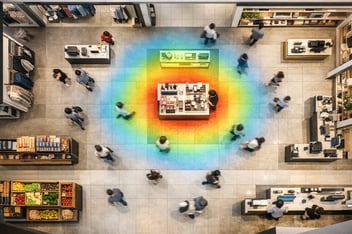
Last autumn, a global medtech exhibitor at a major US medical congress decided to measure the full booth: six ceiling-mounted sensors at two mounting heights, stitched into a single coverage view. The stand was designed around six defined zones — a welcome area, an infographic wall, a photo activation, a meeting area and two product experience zones. Four days later, the exhibitor had numbers nobody on the team had ever seen for a trade show:
- Attraction rate — aisle passers-by compared with actual entries. This is the most honest measure of whether a stand design pulls people in, and it is the number almost nobody has.
- Zone yield — visits and dwell time per zone, plus flow between zones: a heatmap of where people really went rather than where the floor plan hoped they would go.
- True visitor counts — with staff filtered out automatically, so the numbers describe customers, not colleagues doing laps between the coffee machine and the demo.
- Audience shape — visitor demographics per zone and per day.
- The rhythm of the show — peak hours by congress day, now used to set staffing plans and demo scheduling for the next event.
None of this replaced the badge scanner or the sales conversations. It gave those numbers the context they were missing. The post-show report read like performance marketing rather than anecdote — and it changed the internal conversation from "the show felt good" to "the photo activation outperformed the infographic wall three to one on dwell time, and here is what we're changing."
The detail that decides whether the data is real
Here is what anyone who has actually installed sensors on a show floor will tell you: staff filtering is where booth measurement lives or dies. A stand with twelve staff generates hundreds of internal crossings per day, and if those land in the visitor count, your dwell times and zone yields are fiction. The same goes for mounting height — a sensor placed for a 3.5-metre rigging point behaves differently over a 6-metre hall ceiling, and open-sided stands need overlapping coverage stitched into one logical space, not six independent counters producing six contradictory totals. These are build decisions, not software settings, which is exactly why measurement worked in the medtech case: the stand builder designed the zones, knew the ceiling heights, and integrated the sensors into the build the same way they integrate lighting — not an AV vendor bolted on at the last minute.
That is also why this topic belongs on the stand builder's side of the table, not just the marketer's. A builder who hands over a stand delivers a cost. A builder who hands over a stand and the evidence it worked delivers an argument for next year's budget — and a reason to be the builder attached to that budget.
The window is open, briefly
Data-driven ROI measurement is named a top exhibitor trend for 2026 (HIMSS 2026 exhibitor trends), and 87 percent of exhibition companies report already using AI (UFI Global Exhibition Barometer, 36th edition, December 2025). The organisers are instrumenting their halls. Exhibitors who instrument their stands first will set the benchmarks everyone else gets measured against.
The technology itself is mature — this is retail people counting adapted to temporary architecture. Vemco Group has been doing exactly that since 2005, working sensor-agnostic across Xovis, Milesight, Elsys, Hikvision, Axis and Irisys hardware, counting more than 60 million people every day across more than 55,000 installations in more than 98 countries. Accuracy is contractually guaranteed at a minimum of 96 percent and typically lands at 98 to 99 percent when lighting, layout and visitor behaviour allow — an honest number, not a flat promise. Data flows from line cross to dashboard in roughly two seconds, hosted on AWS in EU Frankfurt, with alerts available via app, email, WhatsApp, SMS, webhook and MQTT for anyone who needs to know the moment footfall spikes or a sensor drops offline mid-show.
Three questions before your next show
- What is our attraction rate target — and how will we know if we hit it?
- Which zone of the stand has to justify itself this year?
- Who is responsible for the number we show management the week after the show?
If the answer to the third question is nobody, you are in the majority. Given that only 23 percent of your competitors have a formal ROI process, it is not a majority worth staying in.
If you are budgeting a stand for 2026 — or building one for a client who is — talk to us about what exhibition stand analytics would look like on your specific floor plan, zones and ceiling heights. Book a conversation at vemcogroup.com/contact-us and bring your last post-show report. We will show you what was missing from it.