


/global/header/smart-buildings.svg)


/global/header/facility-management.svg)






/global/header/leisure.svg)






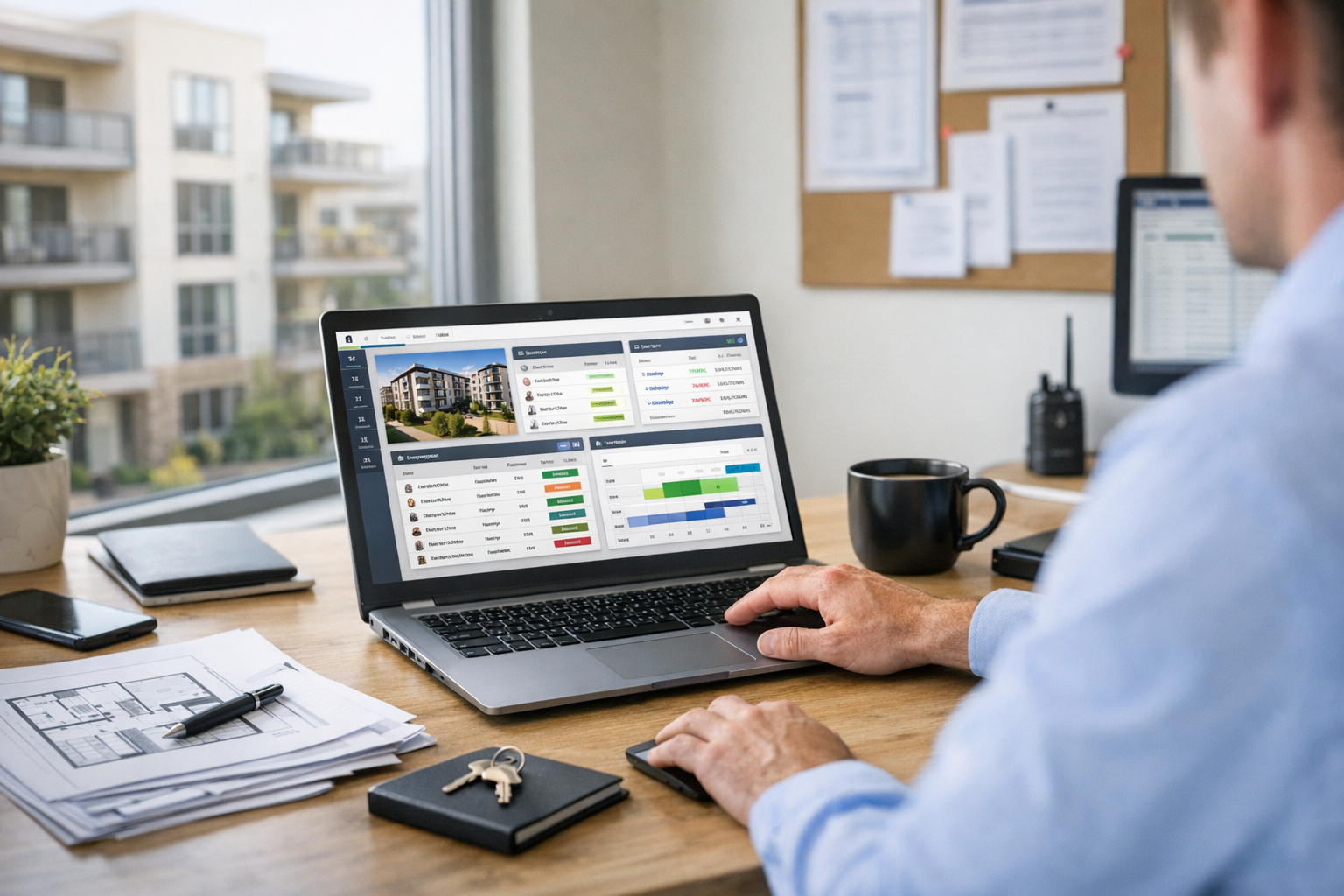
A regional operator with 1,400 units recently discovered that their maintenance team was closing work orders in one system while accounting reconciled invoices in another — and the two disagreed on roughly 8% of jobs every month. Nobody was stealing anything. The systems simply defined "completed" differently, and every month someone spent two days untangling it. That is the actual cost of fragmented property management software, and it never shows up as a line item in the budget. It shows up as headcount doing reconciliation instead of resident service.
If you have already read the generic listicles, you know the categories: lease management, accounting, maintenance, resident communication, reporting. What those articles skip is the operational reality — how to evaluate a platform against your actual portfolio, what implementation genuinely costs, and where operators lose money after go-live. This guide covers that.
Start with your unit economics, not the feature list
Vendors will hand you a feature matrix with 200 rows. Most of it is noise for your specific portfolio. The right starting point is a simple question: where does your team spend hours that do not scale with unit count? For a multifamily operator, that is usually delinquency follow-up, move-in/move-out coordination, and maintenance dispatch. For a commercial or mixed-use portfolio, it is CAM reconciliation, lease abstraction, and renewal tracking. The software that fixes your top three time sinks is worth more than the platform with the longest feature list.
Put numbers on it before demos begin. If your property managers spend six hours a week chasing late payments across 300 units, automated payment plans and escalation workflows have a calculable value. Walking into a demo with that figure changes the conversation from "what can your product do" to "prove your product removes these hours."
The evaluation criteria that separate operators from spectators
Beyond the obvious accounting and lease functions, these are the criteria experienced operators weight heavily and first-time buyers underweight:
- Data ownership and export. Ask for a full data export during the trial, not after signing. If the vendor cannot produce your ledger, lease terms, and work-order history in a usable format, you are renting your own records back from them. This becomes painful at renewal negotiations and catastrophic at migration.
- Integration with what you already run. Your bank feeds, your utility billing partner, your screening provider, your building sensors and counting infrastructure — the platform should connect to existing systems rather than force replacement. A system that demands you rip out working tools is transferring its integration cost onto you.
- Hosting flexibility. Some owners — particularly institutional asset managers and operators in regulated markets — need private cloud deployment for compliance or data residency reasons. If your investors or jurisdiction require it, confirm this before shortlisting, because most SaaS-only vendors cannot accommodate it at any price.
- Role-based workflows that match your org chart. A leasing agent, a regional manager, and an asset manager need different views of the same lease. If everyone gets the same dashboard, someone is either overwhelmed or blind.
- Audit trail depth. When an owner disputes a CAM charge or a resident disputes a fee three years later, you need who-changed-what-when. Test this in the demo by asking to see the change history on a lease clause.
Implementation: where the budget actually goes
License fees are the visible cost. The invisible costs, in rough order of magnitude for a mid-size portfolio, are data migration, staff time during parallel running, and workflow redesign. Plan for the software cost to be 40–60% of the total first-year spend; the rest is people and process.
Here is the practitioner observation that rarely makes it into vendor documentation: the single biggest predictor of a failed implementation is dirty lease data, not the software. Anyone who has run a migration knows this. Legacy systems accumulate years of workarounds — rent concessions typed into memo fields, renewal options tracked in a spreadsheet nobody mentioned, unit numbers that changed after a renovation but only in some records. Budget four to eight weeks of lease data cleansing before migration starts, done by someone who knows the portfolio, not a junior admin. Every week you skip here becomes a month of firefighting after go-live.
Run the old and new systems in parallel for at least one full billing cycle — two if you have complex commercial leases. Yes, it doubles data entry temporarily. It is also the only way to catch calculation discrepancies before they reach a resident's or tenant's invoice.
After go-live: the 90-day discipline
Most platforms are judged too early and optimised too late. The first month after go-live is always messy; the sixth month is where the truth lives. Set three measurable checkpoints for day 90:
- Average work-order close time versus your pre-implementation baseline.
- Hours spent on month-end close and owner reporting, per property.
- Percentage of resident or tenant payments arriving through the platform rather than manual channels.
If none of the three has moved by day 90, the issue is usually adoption, not software — which means training and workflow enforcement, not a support ticket.
Where the market is heading: operations data meets occupancy data
The next competitive gap will not be between operators who have property management software and those who do not — nearly everyone has something. It will be between operators whose administrative system talks to their physical building data and those still managing them separately. Knowing how common areas, amenities, and retail frontage are actually used, alongside lease and maintenance records, changes decisions on staffing, cleaning schedules, amenity investment, and commercial lease pricing.
This is the logic behind Vemco Group's 2025 acquisition of TecBrain, a Spanish property management software provider operating since 1995. Vemco has spent two decades in people counting and building analytics; bringing lease and community management into the same house means the administrative layer and the physical-usage layer can inform each other rather than living in separate vendor silos. For an asset manager, that combination answers questions neither system answers alone — such as whether a low-renewal building also shows declining amenity usage six months earlier, which turns a lagging indicator into a leading one.
The decision, condensed
Quantify your top three time sinks. Demand a data export before signing. Confirm hosting and integration fit your portfolio and your investors. Budget honestly for data cleansing and parallel running. Measure at day 90 and hold the platform — and your own team — to those numbers. Property management software is not a purchase; it is an operating decision you will live with for five to ten years, and the diligence you do in the next sixty days determines whether it compounds value or compounds friction.
If you are evaluating property management software and want to see how lease, community, and building-usage data can work as one system rather than three, talk to the Vemco Group team — bring your portfolio's specific pain points and we will walk through how the platform handles them, not a generic demo.