

/global/header/smart-buildings.svg)


/global/header/facility-management.svg)






/global/header/leisure.svg)







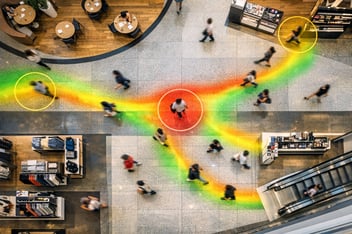
Walk any store with a heat map open on your laptop and you will spot it fast: a rear-left corner where footfall drops to almost nothing, even though it holds full-margin product. Managers usually blame the merchandise. The data usually blames the path. Customers move through a store along predictable routes, and the areas they skip are rarely skipped by accident — they are skipped because the layout, the sightlines, or the entry angle quietly steered people away.
This matters because ignored zones aren't neutral. They occupy square metres you pay rent on, they hold stock that ties up cash, and they distort your sell-through numbers when you assume slow sales mean weak product. Before you discount that range or pull it from the floor, it's worth knowing whether anyone actually saw it.
The right-turn bias and other habits shoppers don't know they have
Most shoppers in Western markets drift right on entry and follow the perimeter counter-clockwise. It's a well-documented tendency, and it means the front-left of a store — the first thing on your left as you walk in — is one of the hardest spots to activate. People are already committed to a direction before they register what's there.
A few structural reasons zones get ignored:
- Decompression zone overrun: the first few metres past the door where shoppers adjust and largely ignore product. If a display sits inside that band, it's invisible regardless of how good it looks.
- Sightline dead ends: tall fixtures that block the view of a back section remove the visual pull that draws people deeper.
- Awkward transitions: a change in flooring, a narrow gap between gondolas, or a step create friction that quietly redirects traffic.
- Category adjacency mismatch: placing a considered-purchase category next to an impulse aisle means the impulse crowd rushes past without slowing.
Why sales figures alone will mislead you
A zone with poor sales tells you one of two very different stories, and the till can't distinguish them. Either people are visiting the zone and not buying — a product, price, or presentation problem — or they aren't visiting at all — a traffic problem. The fix for each is opposite. You don't re-merchandise a display nobody reaches; you move it.
This is where zone-level footfall data earns its place. Vemco Group has built retail-analytics software around exactly this question since 2005, counting more than 60 million people a day across more than 55,000 installations in 98+ countries. When you overlay footfall against sales by zone, the ignored areas stop being a guess. You get a conversion rate per zone, not just per store — and that single number reframes almost every merchandising decision.
Measuring the areas people skip
Detecting a dead zone requires more than a single door counter. You need in-store sensors that map movement across the floor, and the counting has to be honest. Vemco quotes a contractual minimum of 96% accuracy, typically reaching 98–99% when lighting, store layout and visitor behaviour allow. Those conditions matter: a poorly lit corner or an overly reflective floor is precisely the kind of place that both hides product from shoppers and challenges a sensor, so getting placement right is part of the job.
A practical detail that trips up first-time implementers: staff movement. Employees restocking a quiet section can make a dead zone look busier than it is, inflating the count and hiding the problem. Vemco's staff-exclusion algorithms strip employees out, so what you're left with is genuine customer traffic. Without that, you can spend a month wondering why a "healthy" zone converts terribly — the traffic was your own team.
The system is sensor-agnostic, working with 3D AI sensors from Xovis as well as Milesight, Hikvision and AXIS, so you're not locked into one hardware line. AI sensors can also separate children from adults and read age and gender bands, which tells you not just how many people ignored a zone but which shopper groups did. A section that women in their thirties bypass entirely is a very different problem than one everyone skips.
Turning a dead zone back on
Once you know a zone is genuinely under-visited rather than under-converting, the interventions are concrete:
- Plant a magnet. Move a known destination category or a popular promotion into or near the ignored zone to pull traffic toward it.
- Open the sightline. Lower the fixtures between the entrance and the dead area so shoppers can see product from a distance.
- Reroute the aisle. Sometimes a single gondola turned ninety degrees redirects the whole flow.
- Test, then read the sensors again. Give a change two to four weeks and compare zone footfall before and after. If traffic rises but conversion stays flat, the product genuinely isn't landing.
Modules like VemCount for footfall and conversion and VemSpace for zone and layout analysis let you run this loop repeatedly rather than treating a floor reset as a one-off. Because the platform integrates with ERP and BI systems, hosted or in a private cloud, the zone-conversion numbers can sit alongside stock and margin data instead of living in a separate spreadsheet nobody opens.
The stores that keep dead zones alive are usually the ones treating layout as fixed and product as the only variable. Reverse that assumption. The floor plan is the most powerful merchandising tool you own, and the areas customers ignore are almost always telling you something about the path — not the product.
If you want to find the ignored zones in your own stores and see genuine customer traffic without staff distortion, talk to the Vemco Group team about mapping your floor with zone-level analytics — and turn those quiet corners into space that earns its rent.