

/global/header/smart-buildings.svg)


/global/header/facility-management.svg)






/global/header/leisure.svg)






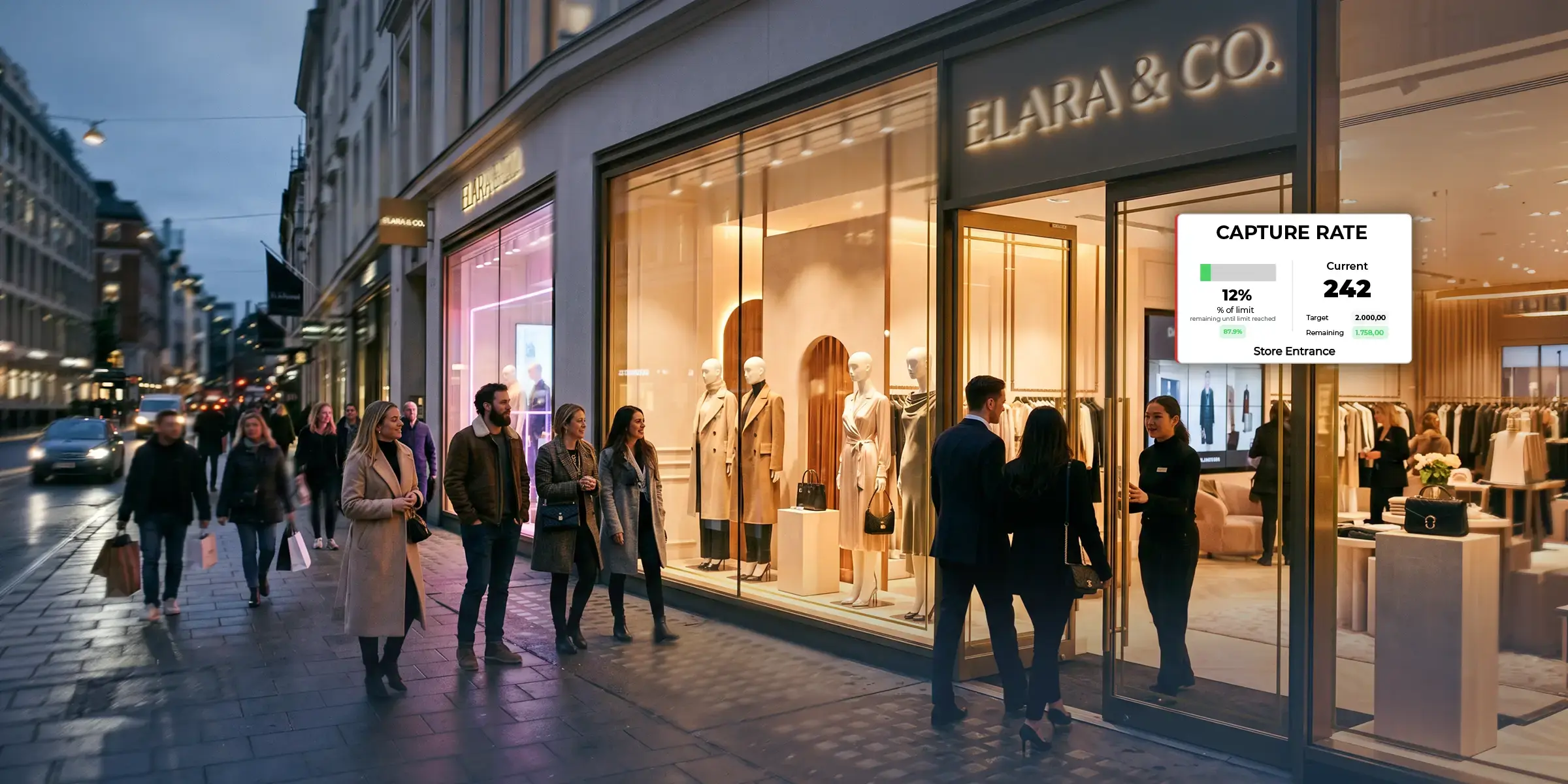
Retailers spend heavily to get people near their stores. But proximity doesn’t guarantee performance.
What really matters is how many of those passersby actually walk through your doors.
That’s where capture rate in physical stores becomes one of the most valuable - and often overlooked - metrics in retail.
It answers a simple but critical question:
Are you converting attention into action?
When paired with footfall tracking and people counting, capture rate reveals whether your store is attracting customers - or losing them before they even step inside.
In this article, we’ll break down what capture rate is, why it matters, and how to improve it using modern retail data.
See how your store performs in real time — Start your free Vemco demo today.
What Does Capture Rate in Physical Stores Actually Measure?
Capture rate in physical stores measures the proportion of people who enter your store compared to those who pass by it.
In practical terms:
- People walk past your store
- A portion of them enter
- Capture rate = that percentage
It’s a direct indicator of your store’s ability to convert visibility into traffic.
A Simple Example
- 2,000 people pass your storefront
- 200 enter
- Capture rate = 10%
That 10% tells a story.
It reflects how well your storefront, brand, and messaging are working together.
Why Capture Rate Is a Core Retail KPI
Retailers often focus on sales and conversion rates - but those metrics only tell part of the story.
Capture rate sits earlier in the customer journey. It measures the decision to enter.
It Reveals Hidden Performance Gaps
Two stores can have identical sales but very different capture rates.
- Store A: High footfall, low entry → missed opportunity
- Store B: Lower footfall, high entry → strong appeal
Without capture rate, this difference stays invisible.
It Connects Marketing to Reality
Campaigns don’t just drive awareness, they should drive action.
Capture rate helps you evaluate:
- Window displays
- In-store promotions
- Seasonal campaigns
To track these effectively, retailers often rely on structured footfall reporting systems.
Capture Rate vs Footfall: Understanding the Difference
It’s easy to confuse footfall with performance.
But they measure different things:
| Metric | What It Tells You |
|---|---|
| Footfall | How many people pass your store |
| Capture Rate | How many choose to enter |
Footfall is about opportunity.
Capture rate is about conversion.
You need both to understand the full picture.
How to Calculate Capture Rate Accurately
To measure capture rate in physical stores, you need two reliable data points:
- Passerby traffic
- Store entries
Capture Rate = (Visitors ÷ Passersby) × 100
The challenge is accuracy.
Manual counting is unreliable. Estimates are inconsistent.
That’s why retailers rely on people counting technology.
Using People Counting to Track Capture Rate
Modern people counting systems remove guesswork from retail analytics.
They use sensors to:
- Track passerby traffic outside the store
- Count entries and exits
- Monitor peak traffic periods
- Deliver real-time insights
Why Automation Matters
Without automation:
- Data is incomplete
- Insights are delayed
- Decisions are reactive
With automation:
- Data is accurate
- Insights are immediate
- Decisions are proactive
Capture rate becomes a live performance metric instead of a retrospective guess.
What Drives Capture Rate in Physical Stores?
Capture rate is influenced by multiple external and internal factors.
Understanding them is the first step to improving results.
1. Visual Merchandising
Your storefront is your silent salesperson.
Key elements:
- Window displays
- Product visibility
- Lighting and layout
These determine whether people stop or keep walking.
2. Promotions That Stand Out
Generic messaging gets ignored.
Effective promotions:
- Clear discounts
- Time-sensitive offers
- Strong visual cues
Even small changes can shift capture rate significantly.
3. Location Context
Not all footfall is equal.
A busy street doesn’t guarantee relevant traffic.
Capture rate improves when:
- Audience matches your offering
- Messaging aligns with local behavior
4. Timing and Seasonality
Capture rate fluctuates throughout the day and year.
Retailers can identify:
- Peak entry periods
- Underperforming time slots
- Seasonal trends
How Vemco Group Helps Retailers Improve Capture Rate
Vemco Group automates people counting analytics, giving retailers full visibility into capture rate performance.
Instead of relying on assumptions, Vemco Group provides:
- Accurate tracking of passerby and visitor traffic
- Real-time capture rate dashboards
- Cross-location performance comparisons
- Actionable insights for optimization
This allows retailers to understand exactly where they’re losing potential customers and why.
Connecting Capture Rate With Sales Data
Capture rate becomes even more powerful when combined with sales insights.
This is where system integration plays a key role.
The Value of POS Integration
By linking traffic data with Point of Sale systems, retailers can:
- Compare entry rates with actual purchases
- Identify high-performing campaigns
- Understand conversion efficiency
Want clearer insights across all your stores? Start your Vemco demo trial today.
Practical Ways to Improve Capture Rate
Improving capture rate doesn’t require major changes. It requires smarter ones.
Here’s where retailers should focus:
Test and Iterate Storefront Design
Small adjustments can have big impact.
Try:
- Changing window displays weekly
- Highlighting bestsellers
- Improving lighting
Use Data to Refine Campaigns
Don’t rely on assumptions.
Track how each campaign affects:
- Entry rates
- Traffic patterns
- Time-based performance
Align Staffing With Traffic Trends
Ensure staff presence during high-opportunity periods.
More engagement can increase entry rates.
Focus on First Impressions
Customers decide within seconds whether to enter.
Everything visible from outside matters.
What Happens When Capture Rate Is Ignored?
Retailers who don’t measure capture rate often face:
- Wasted marketing spend
- Underperforming storefronts
- Missed sales opportunities
- Lack of clarity on performance
The problem isn’t lack of effort. It’s lack of visibility.
Capture Rate as Part of a Larger Retail Strategy
Capture rate should not be viewed in isolation.
It works best when combined with:
- Footfall analytics
- Conversion rate tracking
- Customer demographics
Conclusion: From Passing Traffic to Paying Customers
Every passerby is a missed opportunity or a potential customer.
Capture rate in physical stores determines which one it becomes.
By measuring and optimizing this metric, retailers gain control over one of the most critical stages of the customer journey.
With footfall tracking, people counting, and the right analytics tools, capture rate becomes more than a number - it becomes a growth lever.
Vemco Group enables retailers to act on this data with confidence, turning insights into measurable results.
Turn your footfall into measurable growth. Start your free demo with Vemco today.
FAQ: Capture Rate in Physical Stores
What is capture rate in physical stores?
It measures the percentage of people who enter a store compared to those who pass by.
Why is capture rate important for retailers?
It shows how effectively a store converts visibility into actual visitors.
How can I improve my store’s capture rate?
Focus on storefront design, promotions, and customer engagement strategies.
What tools are used to measure capture rate?
Retailers use people counting systems and analytics platforms.
How often should capture rate be monitored?
Ideally in real time, with ongoing analysis of trends and patterns.