Search Icon
    Count Smarter, Not Harder

    People Counting Software for Retail & Enterprise

    People counting software from Vemco Group gives retail and enterprise teams accurate, real-time visitor data to make confident, data-driven decisions. Track footfall, measure conversion rate, and understand customer behaviour across every location.

    People Counting New
    BUYER'S GUIDE

    Six things separate one people counting system from another: how accuracy is verified, which sensor type fits your space, what happens to the data, what it connects to, who installs it, and how it is priced. The criteria below applies to any vendor, including us.

    01

    Accuracy and how it's verified

    Most vendors quote a percentage. Fewer explain how it was measured or under what conditions. Ask for the counting method, the test conditions, and what causes it to drop.

    ASK A VENDOR

    How was that accuracy figure measured, and what happens to it at a two metre wide entrance in direct sunlight?

    02

    Sensor type

    2D, 3D stereo vision and time of flight all count people, at different costs and with different failure modes. The right choice depends on ceiling height, entrance width and whether you need to separate adults from children.

    ASK A VENDOR

    Which sensor are you proposing for this entrance, and why that one rather than the cheaper option?

    03

    What happens to the data

    Some systems process video in the cloud. Some store images. Under GDPR that difference decides how long your legal review takes. Ask whether any footage leaves the sensor.

    ASK A VENDOR

    Does any image or video leave the device, and where is the data stored?

    04

    Integrations

    Visitor counts on their own tell you volume. Combined with POS data they tell you conversion rate. Check whether the integration you need is native or a custom project.

    ASK A VENDOR

    Is the connector to our till system already built, and can we see it working?

    05

    Installation and who does it

    Some vendors ship hardware and leave you to find an installer. Others install themselves. This is the difference between a two week rollout and a two month one.

    ASK A VENDOR

    Who physically mounts the sensors, and what do we need to provide?

    06

    Total cost of ownership

    Quotes are rarely comparable as issued. One vendor prices hardware and bills installation separately, another bundles both and charges more per site. Rebuild every quote into the same five lines before you compare them.

    PUT EVERY QUOTE IN THESE TERMS

    Sensors · installation · annual software subscription · integration work · support and replacement over three years
    ACCURACY

    VemCount counts at 98%+ accuracy using 3D stereo vision sensors. That figure is measured by comparing sensor counts against manual counts over full trading days, not short sample periods.

    What the number depends on

    Three things move accuracy up or down in a real deployment.
    FACTOR EFFECT ON ACCURACY
    Entrance width relative to sensor coverage A single sensor covers a defined width. Wide entrances need multiple units, and under-specifying is the most common cause of disappointment count.
    Groups entering together 3D stereo vision separates individuals walking close together. 2D and infrared systems tend to merge them into one count.
    Staff movement Employees crossing the lines repeatedly can inflate counts by double digits in a small store. Staff exclusion removes them from visitor totals.

    Where it drops

    Direct low-angle sunlight onto the sensor, ceiling heights outside the specified range, and entrances wider than the deployed coverage will all reduce accuracy below 98%. Any vendor telling you their accuracy is unaffected by these conditions is describing a lab, not a shop floor.
    TECHNOLOGY

    2D, 3D and time of flight sensors compared

    Three sensor technologies dominate people counting. The difference between them is how they separate one person from another, which decides both accuracy and price.

    METHOD TYPICAL ACCURACY SEPARATES A GROUP ANONYMOUS MAIN LIMITATION
    3D Stereo Vision 98%+ Yes Yes Higher unit cost than 2D; needs specified ceiling height
    Time of flight 95-98% Yes Yes Highest unit cost
    Thermal sensors 96-98% in ideal conditions Partially Yes Accuracy falls when ambient temperature approaches body heat, and in low ceilings 
    2D video / overhead camera 90-96% Poorly Depends on whether footage gets stored Depends on camera angle, resolution and lighting
    Infrared beam 80-93% No  Yes Drops sharply on wide or busy entrances and in direct sunlight
    WiFi / mobile signal  Variable n/a No Counts only phones with wifi on, and identifying returning visitors is likely personal data under GDPR
    Turnstiles Near 100% Yes Yes Requieres physical access control, unsuitable for open retail entrances


    Where each one fits

    SITUATION USUALLY THE RIGHT METHOD
    Retail, malls, airports, anywhere conversion rate matters

    3D stereo vision. Conversion rate and demographic data both depend on separating individuals correctly.

    Single narrow doorway, count only, low budget

    Infrared beam. Cheap and adequate if 85% is good enough and nobody needs dwell time.

    Temperature-controlled indoor space with no overhead mounting

    Thermal. Accurate in stable conditions, less so in summer heat.

    Access control is also required

    Turnstiles. Most accurate method there is, and unusable in open retail.

    Very high ceilings or unusual geometry

    Time of flight

    VemCount is hardware agnostic and works with more than 50 sensor models. In most retail and public space deployments we specify 3D stereo vision, because conversion rate and demographic data both depend on separating individuals correctly.

    OUTCOMES

    What people counting data is actually used for

    Visitor counts on their own are a number. Combined with sales, staffing and time data they answer four operational questions that most businesses currently guess at.

     
    01

    Is the problem traffic or the shop floor?

    A store with 1,000 visitors and 200 transactions converts at 20%. If sales fall and visitors held steady, the problem is on the shop floor, not in your marketing. Without a count you cannot tell the two apart.

     
    02

    Are staff on the floor when customers are?

    Hourly visitor curves rarely match hourly staff rotas. Matching them is the fastest measurable saving most retailers find, and it needs nothing beyond an accurate hourly count.

     
    03

    Did the campaign bring anyone in?

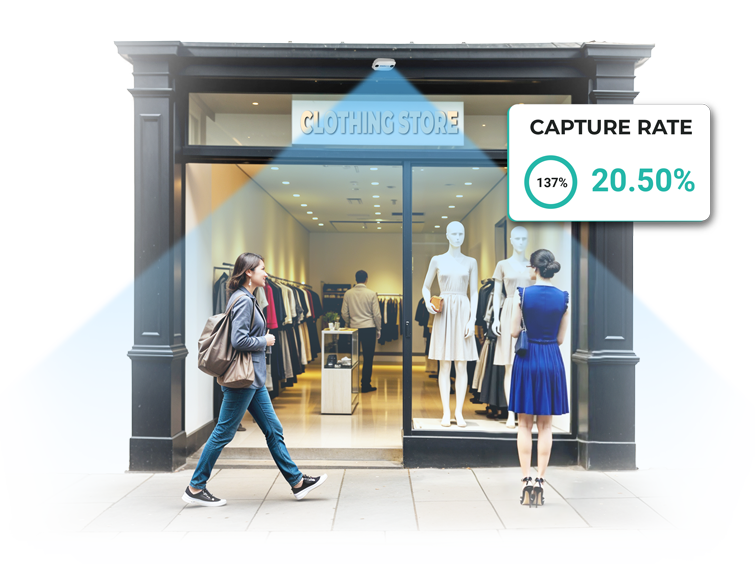
    Passersby counts outside the door and entries inside it give a capture rate. If a campaign moved sales but not capture rate, it worked on existing customers rather than new ones.

     
    04

    How many people are in the building now?

    Live occupancy against a defined limit, with alerts by email or SMS when a threshold is crossed. Required for safety compliance in venues, useful for queue management everywhere else.

    THE PLATFORM

    What VemCount does

    Live occupancy

    Real-time count of how many people are inside, against a capacity limit you set, using 3D stereo vision at 98%+ accuracy.

    Demographics

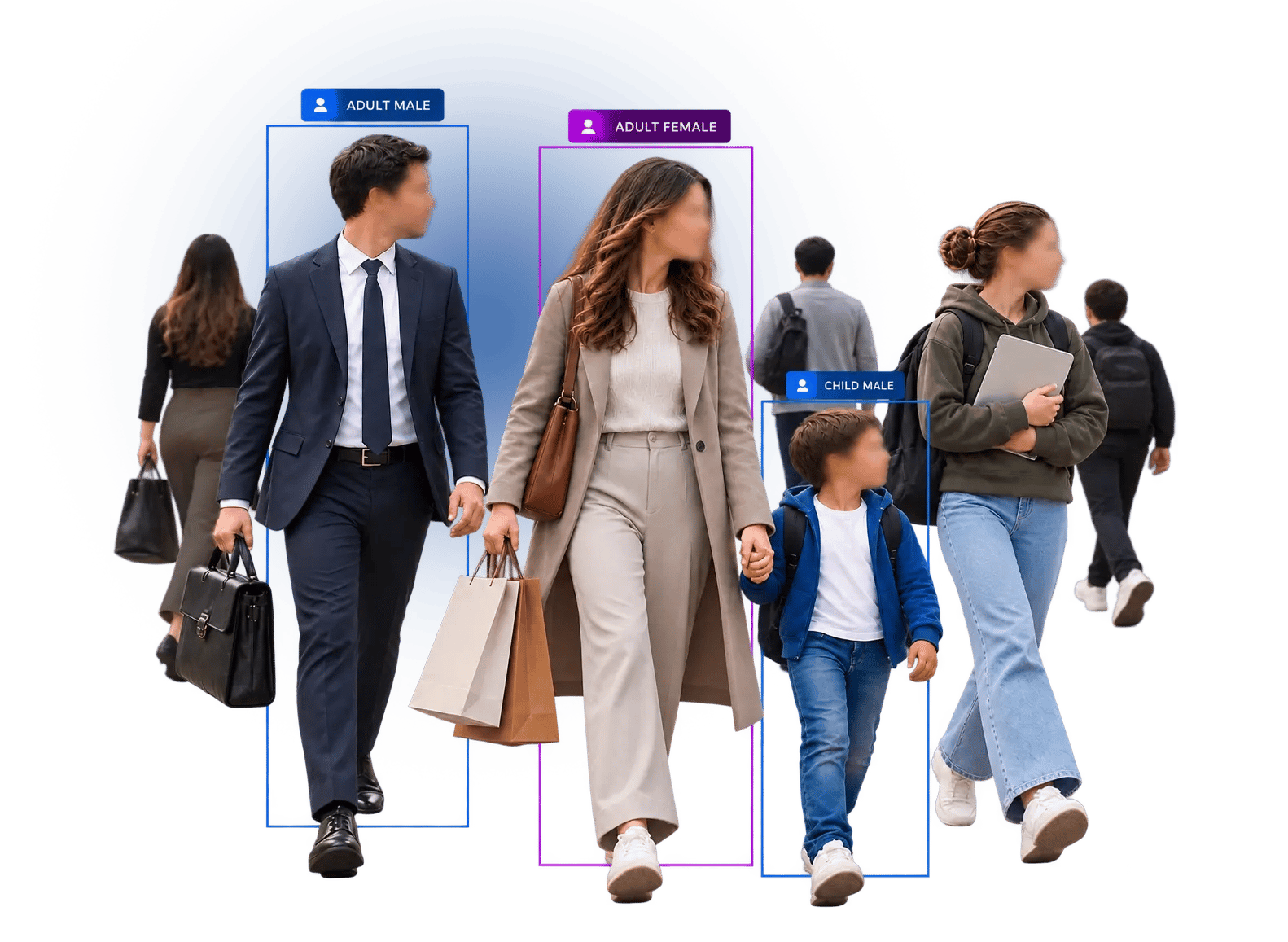
    Gender split and separate adult and child counts, derived from sensor height data rather than facial recognition.

    Staff exclusion

    Employee movement is removed from visitor totals automatically, so conversion rate is calculated against customers only.

    Sales KPIs via POS

    Native integration with your till system produces conversion rate, capture rate, average basket size, sales per visitor and dwell time.

    Passerby analysis

    Counts people passing the storefront as well as entering it, producing a capture rate for window displays and street-facing campaigns.

    Real-time alerts

    Email or SMS when occupancy crosses a threshold or a queue forms, so someone acts while it still matters.

    Custom dashboards

    Multiple dashboards per user, built from the widgets each role needs rather than a fixed template.

    Scheduled reports

    Daily, weekly or monthly exports comparing current and historical periods, delivered without anyone logging in.

    BY INDUSTRY

    People Counting by sector

    What gets measured changes by setting. These are the six where the measurement changes the decision most.


    01

    Retail stores

    Conversion rate against POS, capture rate from passersby, and hourly staffing against hourly footfall.
     
    02

    Shopping malls

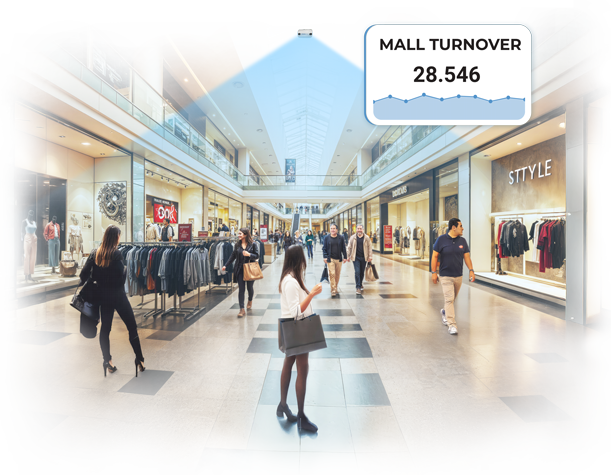
    Mall-wide and per-tenant counts, anchor store halo analysis, and footfall evidence for lease negotiations.
     
    03

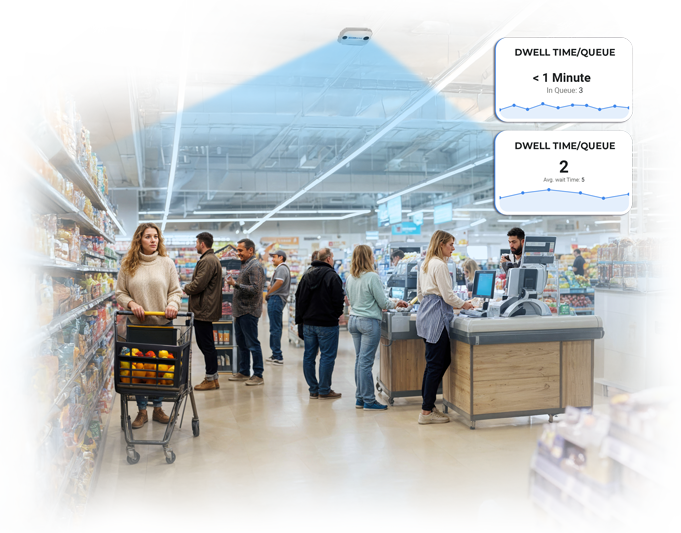
    Supermarkets

    Checkout staffing against arrival curves, queue formation alerts, and aisle-level flow.
     
    04

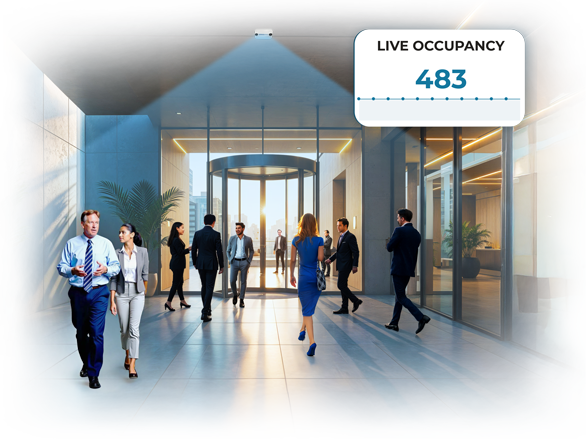
    Offices and smart buildings

    Desk and room utilisation, ghost meeting detection, and occupancy data fed into HVAC for energy reduction.

    05

    Airports and transport

    Passenger flow through terminals, dwell time in commercial zones, and queue analytics at security and check-in.
    06

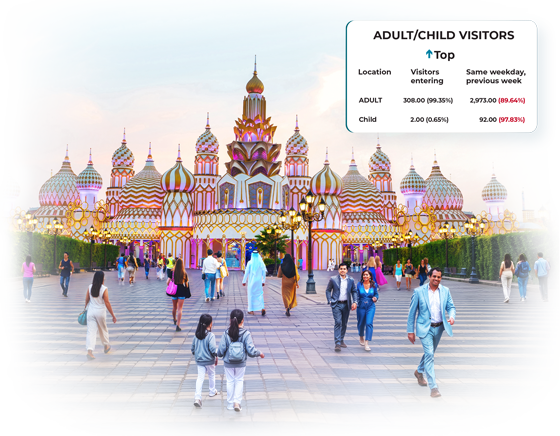
    Leisure and public venues

    Live occupancy against safety limits, exhibit dwell time, and visitor counts for public funding reporting.
    People Counting Lets You Say Goodbye To:

    Inaccurate Data

    People counting solutions help businesses say goodbye to manual counting methods, meaning no more inaccurate customer data.

    Manual Processes

    With people counting technology, businesses can discard manual counting processes, ultimately saving time and avoiding errors.

    Untargeted Marketing

    People counting uses AI to provide businesses with demographic data, allowing them to tailor their marketing to their actual audience.

    Resource Wastage

    Accurate people counting data helps businesses allocate resources effectively, so they avoid overstaffing or understaffing during peak hours.

    Dashboard-pc-updated-logo-2024@2x 1

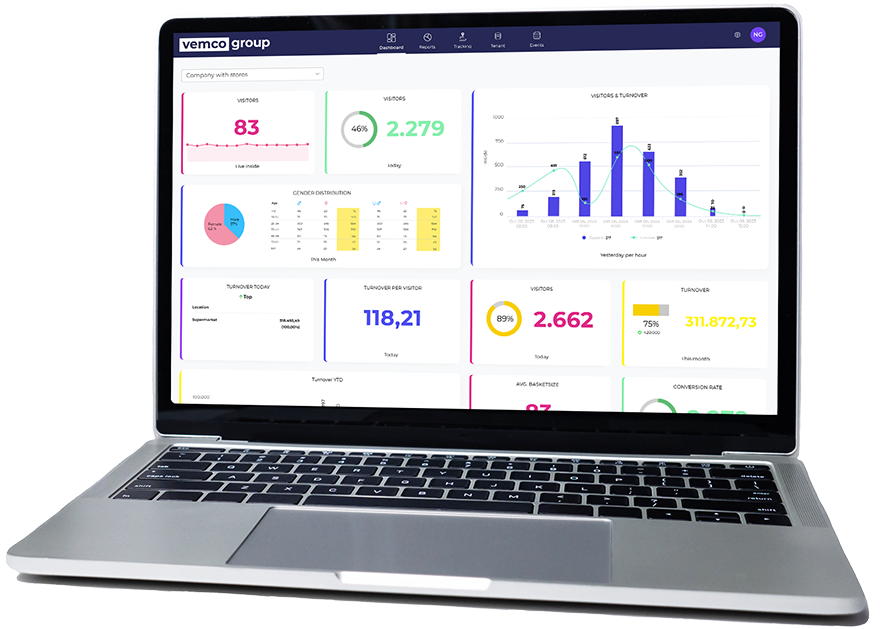
    VemCount

    VemCount is our in-house developed people counting software, providing you with all the data you need to solve your daily challenges.

    … To put it lightly, VemCount is the only software you will ever need.

    PRIVACY

    Yes, when the system stores no images. VemCount sensors process what they see on the device and output only counts. No video or still images are recorded, transmitted or stored, so visitors are never identifiable and there is no personal data to process.

    What this means in practice

    QUESTION YOU DPO WILL ASK ANSWER
    Is any video or image stored? No, counts only
    Can an individual be identified or re-identified? No, there's no biometric or facial data
    Where is the data hosted?

    AWS, with 99% uptime. Region confirmed at contract

    Is signage or consent required?

    No consent is required for anonymous counting, though many operators post signage as good practice

    ROLLOUT

    Installation and rollout

    Vemco Group installs with its own teams rather than subcontracting, in 98+ countries. A single site is typically live within [X] weeks of order; multi-site rollouts run in waves.

    STAGE WHAT HAPPENS WHAT YOU PROVIDE
    1.- Site survey Entrance widths, ceiling heights and sensor count confirmed Floor plans or a site visit
    2.- Specification Sensor type and positions specified per entrance Sign-off
    3.- Installation Vemco team mounts and calibrates on site Power and network at each mounting point
    4.- Integration POS, BI or ERP connection configured and validated API access to the connected system
    5.- Handover Dashboards built per role, team trained A list of who needs each view
    ROLLOUT

    See VemCount on your own floor plan

    A 30 minute call. We use your entrances and your questions, not a canned demo.


    • We map your entrances and tell you how many sensors you need
    • You see live counting, conversion rate and occupancy in the dashboard
    • We answer the accuracy, GDPR and integration questions directly
    • You leave knowing how many sensors your sites need


    A Solution to Every Problem

    Luksusbaby A/S
    Problem

    Luksusbaby wanted to view real-time, accurate KPIs regarding their physical stores, such as hit and conversion rates, for improved decision-making. 

    Solution

    Our solution helped Luksusbaby take action based on facts rather than intuition while discovering the age of their incoming visitors for accurate conversion rate data.

    luksusbaby
    Daells Bolighus
    Problem

    Daells Bolighus struggled to keep up with the changing market and had been in an economic deficit for 16 years. The main problems were old-fashioned marketing strategy and a lack of insight into customer data.

    Solution

    Vemco Group installed people counters in both Daells Bolighus stores and integrated sales and visitor data from the physical stores with online data from their website, allowing them to view and compare data across locations.

    reduced Daells Bolighus Vemco Group
    Magasin
    Problem

    Magasin had an outdated, unreliable people counting solution and wanted a hosted solution, exporting data into a central BI system to give them insight into customer behavior in all their department stores.

    Solution

    We delivered an accurate, up-to-date people counting solution to Magasin, which allowed them to reduce operational costs by outsourcing their customer data to us.

    magasin
    Odense Municipality
    Problem

    Odense Municipality wanted to access insight into how the citizens and visitors of Odense use the city and act on these insights based on factual decision-making rather than intuition.

    Solution

    To measure how the citizens and visitors of Odense use the shopping street, we cover all relevant entrances and exits with weather-resistant sensors that cover heights up to 20 meters.

    Odense v2

    People Counting Questions

    What is people counting?

    People counting is a process of tracking the number of individuals that enter or exit a particular area, such as a building, store, or public space. The process involves using technology to count people, typically through sensors.

    What is a people counter?

    A people counter is a device designed to record and count the number of people passing through a specific area or into a building. The purpose of a people counter is often to collect data about visitor flow and traffic patterns to help businesses or organizations understand and optimize their operations. 
     
    There are different types of people counters and they use different technologies to register people's presence. The most used forms of people counters come in the form of 3D sensors, infrared sensors, IoT sensors, etc. 

    Are visitor counters and customer counters the same as people counters?

    Yes, the terms "visitor counter" and "customer counter" can often refer to the same thing as a "people counter". These terms are generally used for devices or systems designed to record and count the number of people passing through a certain area or into a building. 
     
    The purpose of these counters may vary. While "customer counter" often refers to devices used in retail to track the number of customers in a store, "visitor counter" or "people counter" may be more general terms used in different contexts. For example, they can be used in shopping malls, airports, museums, or other places where you want to analyze and understand visitor behavior and flow patterns. 

    Why is people counting important?

    People counting is important for various reasons, including analyzing footfall traffic patterns, optimizing staffing levels, improving customer service, enhancing security, and making data-driven decisions regarding marketing and layout.

    What are the different methods of people counting?

    There are different methods of people counting, including 2D/3D sensors, infrared sensors, thermal imaging, and Wi-Fi tracking. Each method has its own advantages and limitations.

    What are the benefits of using people counting technology?

    The benefits of using people counting technology include improved operational efficiency, better customer experience, enhanced safety and security, increased sales and revenue, and the ability to make data-driven decisions.

    How accurate is people counting technology?

    The accuracy of people counting technology can vary depending on the method used and environmental factors. Generally, modern people counting systems can achieve accuracy rates ranging from 90% to 98%.

    How can people counting technology be integrated with other systems?

    People counting technology, such as Vemco Group’s, can be integrated with other systems such as POS, BI, and ERP systems, as well as access control systems and analytics platforms. This integration ability enables more comprehensive and efficient data analysis and reporting.

    What are the privacy concerns associated with people counting?

    Privacy concerns associated with people counting technology include the potential for invasion of personal privacy and the misuse of data collected through the technology. Thankfully, you do not have to worry if you choose Vemco Group. It is important to implement appropriate security measures and privacy policies to mitigate these risks, and we always put security at the top of our priority list.

    What industries use people counting technology?

    Industries that commonly use people counting technology include retail, malls, healthcare, transportation, cities, and entertainment. Essentially, any place with visitor or customer flows can benefit greatly from a people counting solution. These industries use people counting to improve operations, enhance customer experience, and boost sales.

    How can people counting data be analyzed and used?

    By pulling people counting data through a data analytics software, such as Vemcount, businesses can analyze and use the data to identify footfall traffic patterns, optimize staffing levels, track customer behavior, and measure the effectiveness of marketing campaigns. The data can also be used to make real-time decisions and improve operational efficiency.

    Content Hub

    Complete Guide to Iot Occupancy Sensors

    Blog

    Complete Guide to Iot Occupancy Sensors
    Learn More double right
    Vendor Evaluation Guide for Tenant Revenue Analytics Tender

    Blog

    Vendor Evaluation Guide for Tenant Revenue Analytics Tender
    Learn More double right
    LoRaWAN for Indoor Air Quality in the Gulf: EU868, Type Approval and the Mistakes That Cost Tenders

    Blog

    LoRaWAN for Indoor Air Quality in the Gulf: EU868, Type Approval and the Mistakes That Cost Tenders
    Learn More double right
    Indoor Air Quality Monitoring as a Service: Why Facilities Are Buying Outcomes Instead of Sensors

    Blog

    Indoor Air Quality Monitoring as a Service: Why Facilities Are Buying Outcomes Instead of Sensors
    Learn More double right
    The Eight Parameters of Indoor Air Quality Compliance and Why No Single Sensor Measures Them All

    Blog

    The Eight Parameters of Indoor Air Quality Compliance and Why No Single Sensor Measures Them All
    Learn More double right
    Indoor Air Quality Monitoring for Seed Banks and Gene Banks: Why Standard Sensors Fail at Minus Eighteen

    Blog

    Indoor Air Quality Monitoring for Seed Banks and Gene Banks: Why Standard Sensors Fail at Minus Eighteen
    Learn More double right

    Let’s Get in Touch!

    main-page-
    connect-icon3
    globe
    coment-box